
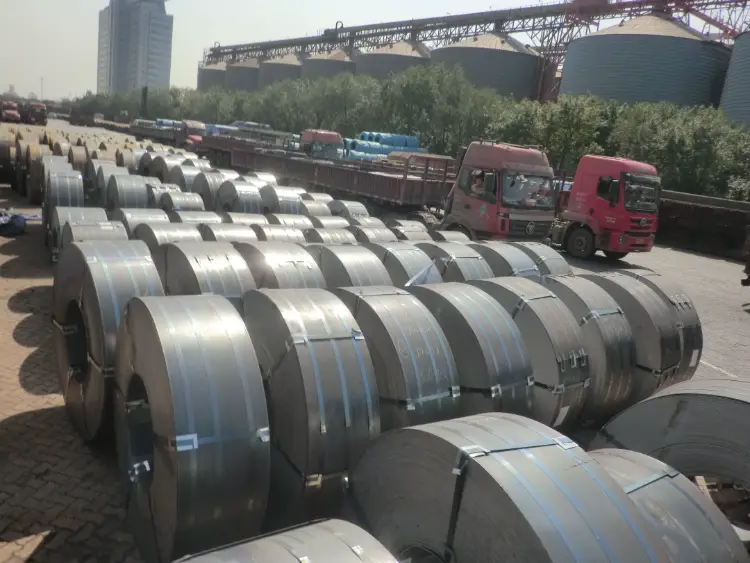
TB/T 1979 09CuPVRE Weather Resistant Steel Coil
TB/T 1979 09CuPVRE Weather Resistant Steel Coil: Chemical, Mechanical & Physical Data
Detailed material properties of 09CuPVRE weather resistant steel coil under China railway standard TB/T 1979, including composition, mechanical and thermal properties, equivalents, and application guide.
Hot rolling, cold forming, cutting, welding, stamping, bending
- Phone : +8618037372205
- Email : [email protected]
- WhatsApp: Contact via Whtsapp
- WeChat: +8618037372205
TB/T 1979 09CuPVRE Weather Resistant Steel Coil Introduction
09CuPVRE is a high-strength low-alloy weather resistant structural steel specially developed for railway vehicles under Chinese standard TB/T 1979. It contains copper, phosphorus, vanadium and rare earth elements (RE) to enhance atmospheric corrosion resistance by forming a dense, protective rust layer. The steel offers a minimum yield strength of 345 MPa, good ductility, and excellent weldability. It is primarily used in hot-rolled coils, strips, and plates for manufacturing rail car bodies, underframes and containers, providing long service life in unpainted or minimally maintained conditions.
TB/T 1979 09CuPVRE Weather Resistant Steel Coil Chemical Composition
The chemical composition of 09CuPVRE steel is precisely defined in TB/T 1979. It features additions of Cu, P, V, and RE to improve corrosion resistance. The rare earth elements refine the microstructure and enhance weathering performance. All values are ladle analysis limits.
| Element | Standard Value (%) | Remarks |
|---|---|---|
| Carbon, C | ≤ 0.12 | Maximum |
| Silicon, Si | 0.20 – 0.40 | |
| Manganese, Mn | 0.20 – 0.50 | |
| Phosphorus, P | 0.07 – 0.12 | |
| Sulfur, S | ≤ 0.020 | Maximum |
| Copper, Cu | 0.25 – 0.45 | Key weathering element |
| Vanadium, V | 0.02 – 0.08 | Microalloying for strength |
| Rare Earth (RE) | 0.10 – 0.20 (added amount) | Improves corrosion resistance and toughness |
TB/T 1979 09CuPVRE Weather Resistant Steel Coil Thermal and Electrical Physical Properties
Physical properties are provided as typical values for 09CuPVRE steel. They are influenced by the microstructure and can vary slightly with processing. These values aid in design calculations for thermal expansion, heat transfer, and electrical behaviour.
| Property | Typical Value | Unit | Test Condition / Remarks |
|---|---|---|---|
| Density (ρ) | 7.85 | g/cm³ | Room temperature |
| Modulus of Elasticity (E) | 206 | GPa | Room temperature |
| Shear Modulus (G) | 79.3 | GPa | Room temperature |
| Poisson's Ratio (ν) | 0.30 | — | Room temperature |
| Thermal Expansion Coefficient (α) | 12.1 × 10⁻⁶ | /K | Between 20℃ and 100℃ |
| Thermal Expansion Coefficient (α) | 13.8 × 10⁻⁶ | /K | Between 20℃ and 300℃ |
| Thermal Conductivity (λ) | 48.9 | W/(m·K) | At 100℃ |
| Specific Heat Capacity (c) | 486 | J/(kg·K) | At 100℃ |
| Electrical Resistivity (ρₑ) | 0.25 × 10⁻⁶ | Ω·m | Room temperature |
TB/T 1979 09CuPVRE Weather Resistant Steel Coil Mechanical Properties
Mechanical properties are determined on transverse specimens unless otherwise stated. Values depend on product thickness. The standard requires minimum yield and tensile strengths, minimum elongation, and impact toughness at -40℃. Bend tests ensure formability. All data conform to TB/T 1979 requirements.
| Property | Standard Required Value | Unit | Test Condition / Remarks |
|---|---|---|---|
| Yield Strength (ReH) | ≥ 345 | MPa | Thickness ≤ 16 mm |
| Yield Strength (ReH) | ≥ 335 | MPa | Thickness > 16 mm |
| Tensile Strength (Rm) | ≥ 480 | MPa | Thickness ≤ 16 mm |
| Tensile Strength (Rm) | ≥ 470 | MPa | Thickness > 16 mm |
| Elongation (A) | ≥ 22 | % | Gauge length 5.65√S₀, thickness ≤ 16 mm |
| Elongation (A) | ≥ 20 | % | Thickness > 16 mm |
| Bending Test (180°) | d = a | — | Bend diameter = specimen thickness, for plate thickness ≤ 6 mm |
| Bending Test (180°) | d = 2a | — | For plate thickness > 6 mm to 16 mm |
| Impact Energy (KV₂) | ≥ 27 | J | Longitudinal, -40℃, Charpy V-notch |
TB/T 1979 09CuPVRE Weather Resistant Steel Coil Fully Equivalent Material Standards and Replaceable Grades
| Country / Region | Standard | Grade | Remarks |
|---|
TB/T 1979 09CuPVRE Weather Resistant Steel Coil Application Introduction
09CuPVRE steel is specifically designed for railway vehicle manufacturing and similar applications where weight reduction, durability, and low maintenance are critical. Its corrosion resistance allows unpainted use in many environments, reducing lifecycle costs. Typical forming and welding processes are fully applicable.
Product Applications: Railway passenger car bodies (side panels, roof sheets), Freight car underframes and hopper cars, Shipping containers, Highway guardrails, Structural beams and columns
Processed into products: Cold-formed profiles (C, Z, U sections), Welded structural assemblies, Stamped and bent brackets, Corrugated roof and wall panels, Bogie frames (after ensured welding procedure)
Application industries: Railway Rolling Stock, Container Manufacturing, Bridge Construction, Building & Construction, Power Transmission Towers
TB/T 1979 09CuPVRE Weather Resistant Steel Coil Similar / Alternative Material Recommendations
| Country / Region | Standard | Grade | Remarks |
|---|---|---|---|
| China | GB/T 4171 | Q355NHE | Similar weathering steel for general structures; equivalent yield strength but different microalloying (Nb,Ti,V) and no RE. |
| USA | ASTM A588 | Grade A | High-strength low-alloy structural weathering steel; yield strength 345 MPa but different chemistry (Cu, Cr, Ni, no P or RE). |
| EU | EN 10025-5 | S355J2WP | Phosphorus-alloyed weathering steel; enhanced atmospheric corrosion resistance, but different alloy design and impact requirements. |
Notes:
Rare earth (RE) treatment improves both the weathering performance and the toughness of the heat-affected zone in welding. Preheating is generally not required for thicknesses up to 30 mm. The steel can be used in the unpainted condition after proper surface preparation to accelerate the formation of the protective patina. For painted applications, surface preparation must remove the tight oxide layer to ensure adhesion. All delivered products should comply with the chemical composition, mechanical properties, and dimensional tolerances defined in TB/T 1979.
- Share



