
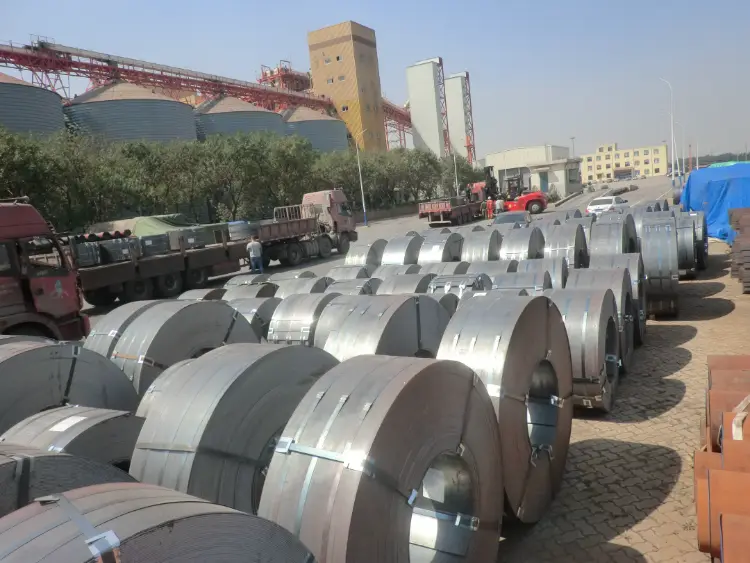
Q/HG056 Q450NQR1 Weather Resistant Steel Coil
Q/HG056 Q450NQR1 Weather Resistant Steel Coil - High-Strength Atmospheric Corrosion Resistance for Heavy-Duty Applications
Explore the properties, chemical composition, mechanical and thermal performance, equivalent grades, and application guide of Q450NQR1 weather resistant steel coil manufactured according to Q/HG056 enterprise standard.
Hot rolling, controlled rolling, cold forming, welding, laser/plasma cutting, stamping
- Phone : +8618037372205
- Email : [email protected]
- WhatsApp: Contact via Whtsapp
- WeChat: +8618037372205
Q/HG056 Q450NQR1 Weather Resistant Steel Coil Introduction
Q450NQR1 is a high-strength weather resistant structural steel grade defined by the enterprise standard Q/HG056, commonly used in the Chinese railway freight car, container, and bridge industries. This steel exhibits superior atmospheric corrosion resistance by forming a protective patina layer, eliminating the need for painting in many environments. The minimum yield strength is 450 MPa, with excellent toughness and weldability. By adding precise amounts of copper, chromium, nickel, and microalloying elements such as titanium or niobium, the steel achieves both high strength and enhanced durability. Typical delivery condition is hot-rolled coil, which can be further processed by cold forming, cutting, and welding.
Q/HG056 Q450NQR1 Weather Resistant Steel Coil Chemical Composition
The chemical composition of Q450NQR1 according to Q/HG056 is designed to provide a fine balance of corrosion resistance, strength, and weldability. The presence of Cu, Cr, and Ni promotes the formation of a dense, adherent rust layer that slows further corrosion. Microalloying with Ti and/or Nb enhances grain refinement and precipitation hardening. Strict control of phosphorus and sulfur ensures high toughness and low susceptibility to cracking.
- Carbon equivalent (CEV) is typically limited to 0.45% or less to guarantee good weldability.
- Elements not listed may be present as unavoidable residuals, max 0.30% total.
| Element | Standard Value (%) | Remarks |
|---|---|---|
| Carbon (C) | ≤ 0.12 | |
| Silicon (Si) | ≤ 0.75 | |
| Manganese (Mn) | ≤ 1.50 | |
| Phosphorus (P) | ≤ 0.025 | |
| Sulfur (S) | ≤ 0.020 | |
| Copper (Cu) | 0.20 – 0.55 | Key atmospheric corrosion resistance element |
| Chromium (Cr) | 0.30 – 1.25 | Enhances patina formation |
| Nickel (Ni) | ≤ 0.65 | Improves toughness and weather resistance |
| Titanium (Ti) | 0.02 – 0.10 | Microalloy, grain refinement |
| Niobium (Nb) | ≤ 0.06 | Optional microalloy, precipitation strengthening |
| Vanadium (V) | ≤ 0.12 | Optional |
| Aluminum (Al) total | ≥ 0.015 | Deoxidation, grain refinement |
| Nitrogen (N) | ≤ 0.012 |
Q/HG056 Q450NQR1 Weather Resistant Steel Coil Thermal and Electrical Physical Properties
Physical properties are based on typical values for Q450NQR1 or similar low-alloy steel at room temperature unless stated otherwise. These properties can vary with heat treatment and processing history.
- Density and elastic constants are near those of mild steel.
- Thermal expansion and conductivity are critical for design in temperature-varying environments.
| Property | Standard Requirement Value | Unit | Test Condition |
|---|---|---|---|
| Density (ρ) | 7.85 | g/cm³ | 20 °C |
| Modulus of elasticity (E) | 210 | GPa | 20 °C, tension |
| Shear modulus (G) | 81 | GPa | 20 °C, calculated from E and ν |
| Poisson's ratio (ν) | 0.29 | – | 20 °C, elastic range |
| Thermal expansion coefficient (α) | 11.5 – 12.5 ×10⁻⁶ | 1/K | 20–100 °C, average |
| Thermal conductivity (λ) | 38 – 45 | W/(m·K) | 20 °C |
| Specific heat capacity (c) | 460 – 480 | J/(kg·K) | 20 °C |
| Electrical resistivity (ρe) | 0.25 – 0.35 | μΩ·m | 20 °C |
Q/HG056 Q450NQR1 Weather Resistant Steel Coil Mechanical Properties
The mechanical properties are specified for strip/plate thickness ≤ 16 mm unless otherwise noted. Values for thicker products (16–40 mm) may be slightly lower (e.g., minimum yield strength 420 MPa). The steel offers excellent formability at high strength, with a minimum elongation of 22% on a standard gauge length.
- Test specimens are cut transverse to the rolling direction.
- Charpy V-notch impact test performed at -20 °C (or as agreed, 0 °C, -40 °C). Typical values for 10×10 mm specimens are given.
| Property | Standard Requirement Value | Unit | Test Condition |
|---|---|---|---|
| Yield strength (ReH, upper) | ≥ 450 | MPa | Thickness ≤ 16 mm, transverse |
| Tensile strength (Rm) | 550 – 750 | MPa | Thickness ≤ 16 mm, transverse |
| Elongation after fracture (A) | ≥ 22 | % | Gauge length L0=5.65√So, transverse |
| Bend test (mandrel diameter) | d = 2a (bend angle 180°) | a = specimen thickness; no cracks | |
| Charpy impact energy (KV2) | ≥ 27 (single min. ≥ 20) | J | -20 °C, transverse, 10×10 mm |
| Hardness, Brinell (HBW) | 170 – 240 (for reference) | As-rolled condition, typical |
Q/HG056 Q450NQR1 Weather Resistant Steel Coil Fully Equivalent Material Standards and Replaceable Grades
| Country/Region | Standard | Grade | Remarks |
|---|---|---|---|
| China | Q/HG056 | Q450NQR1 | Enterprise standard of specific manufacturer; exact composition and properties as per this dataset |
| China | GB/T 4171-2000 (superseded) | Q450NQR1 | Historical Chinese national standard; still referenced in many specifications |
| – | – | – | No direct full-equivalent in contemporary EN, ASTM, or JIS standards without agreed modifications |
Q/HG056 Q450NQR1 Weather Resistant Steel Coil Application Introduction
Q450NQR1 is engineered for structural applications where high strength and enhanced atmospheric corrosion resistance are required without protective painting. The steel is weldable with common processes (SMAW, GMAW, FCAW) using low-hydrogen consumables matched for weathering steel. Preheating is rarely needed for thickness below 30 mm. Post-weld heat treatment is generally not required. The material can be cold formed to a tight radius owing to good elongation.
- When exposed to alternate wetting and drying cycles, it develops a protective oxide layer; in marine or heavily contaminated environments, additional painting may be recommended.
- Available in coil form, suitable for roll-forming, press brake bending, and automated cutting.
Product Applications: Railway wagons (gondolas, hoppers, flat cars), ISO shipping containers and swap bodies, Roll-formed guardrail beams and posts, Prefabricated bridge sections, Lattice transmission towers
Processed into products: Cold-formed C-channels, Z-purlins, and hat sections, Stamped and bent brackets, gussets, and corner fittings, Welded hollow section columns and beams, Laser-cut plates for machine frames and supports, Corrugated sheets for container walls and roofs
Application industries: Railway freight car manufacturing (side walls, floors, underframes), Container fabrication (corner castings, side panels), Highway guardrail and barrier systems, Bridges and pedestrian overpasses, Transmission towers and telecommunication structures, Building facades, cladding, and roofing
Q/HG056 Q450NQR1 Weather Resistant Steel Coil Similar / Comparable Substitute Materials
| Country/Region | Standard | Grade | Remarks |
|---|---|---|---|
| China | GB/T 4171-2008 | Q460NH | Slightly higher min. yield; similar corrosion resistance; check impact test temperature |
| European Union | EN 10025-5:2019 | S355J0W / S355J2W | Lower yield strength (355 MPa); common structural weathering steel; S355J2W has better toughness |
| USA | ASTM A588 / A588M | Grade A / Grade B | Typical yield ~345 MPa; used for bridges and buildings; higher Cu and Cr content |
| USA | ASTM A606 / A606M | Type 4 | Similar corrosion resistance, yield ~345 MPa; available in thinner gauges |
| Japan | JIS G 3114 | SMA490AW / SMA490BW | Yield strength ≥ 365 MPa; welding structural weathering steel; paint or unpainted use |
Notes:
Note: The data provided are based on the enterprise standard Q/HG056 for Q450NQR1 and are consistent with typical mill certifications. Actual product specifications may vary with thickness and manufacturing route. For critical applications, verify with the material certificate and supplementary testing (e.g., ultrasonic inspection, Z-direction properties, impact at lower temperatures).
- Share



