
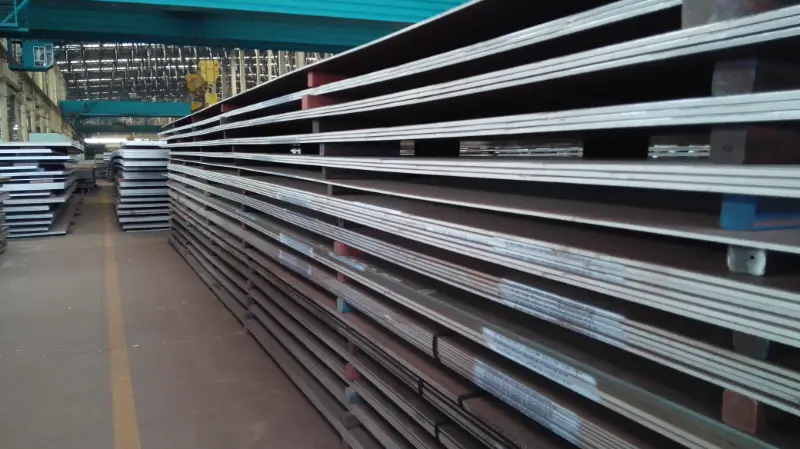
X6CrMo17-1 (1.4113) Ferritic Stainless Steel
X6CrMo17-1 (1.4113) Ferritic Stainless Steel - EN 10088-1 Standard Data, Equivalents & Applications
Full technical data for X6CrMo17-1 (1.4113) ferritic corrosion resisting stainless steel according to EN 10088-1, including chemical composition, mechanical & physical properties, international equivalents, and detailed application guide for plate and coil.
Cold forming, deep drawing, bending, machining, welding (with precautions), annealing
- Phone : +8618037372205
- Email : [email protected]
- WhatsApp: Contact via Whtsapp
- WeChat: +8618037372205
X6CrMo17-1 Ferritic Stainless Steel Introduction
X6CrMo17-1 (material number 1.4113) is a ferritic stainless steel defined in EN 10088-1. Characterized by a microstructure consisting mainly of ferrite, it offers a good combination of corrosion resistance and moderate strength. The addition of molybdenum (0.9–1.4%) enhances resistance to pitting and crevice corrosion, especially in chloride-containing environments, compared to standard chromium ferritics. The alloy is magnetic and cannot be hardened by heat treatment, but is typically supplied in the annealed condition for optimal ductility and formability. It is widely used in mildly corrosive environments where austenitic grades are not required, offering a cost-effective alternative with excellent resistance to stress corrosion cracking. Key attributes include:
- Good resistance to atmospheric corrosion, water, and certain chemicals
- Improved pitting resistance due to molybdenum
- Suitable for deep drawing, bending, and moderate forming operations
- Weldable with appropriate precautions to avoid grain growth
- Applications span automotive exhaust systems, kitchen equipment, architectural trim, and industrial components
X6CrMo17-1 Ferritic Stainless Steel Chemical Composition
Chemical composition according to EN 10088-1 for grade X6CrMo17-1 (1.4113). The limits represent the ladle analysis. The addition of molybdenum improves corrosion resistance in chloride environments. All values are maximum unless a range is given.
| Element | Standard Value | Remarks |
|---|---|---|
| Carbon (C) | ≤ 0.08 | Austenite former; lower carbon for improved weldability |
| Silicon (Si) | ≤ 1.00 | Deoxidiser and ferrite stabiliser |
| Manganese (Mn) | ≤ 1.00 | Austenite former; aids hot workability |
| Phosphorus (P) | ≤ 0.040 | Impurity, kept low for ductility |
| Sulfur (S) | ≤ 0.015 | Controlled for improved surface quality and corrosion resistance |
| Chromium (Cr) | 16.00 – 18.00 | Key element for corrosion resistance; ferrite stabiliser |
| Molybdenum (Mo) | 0.90 – 1.40 | Enhances pitting and crevice corrosion resistance |
X6CrMo17-1 Ferritic Stainless Steel Thermal and Electrical Physical Properties
Typical physical properties at room temperature unless otherwise noted. These values are representative for the ferritic stainless steel X6CrMo17-1 (1.4113) and may vary slightly depending on the exact composition and heat treatment. The coefficient of thermal expansion is comparable to other ferritic stainless steels, ensuring good dimensional stability in thermal cycling.
| Property | Standard Value | Unit | Test Condition |
|---|---|---|---|
| Density (ρ) | 7.7 | g/cm³ | 20 °C |
| Modulus of Elasticity (E) | 220 | GPa | 20 °C |
| Shear Modulus (G) | 77 | GPa | 20 °C (typical) |
| Poisson's Ratio (ν) | 0.28 | – | 20 °C |
| Thermal expansion coefficient (α) | 10.0 | 10⁻⁶/K | 20 – 100 °C |
| Thermal expansion coefficient (α) | 10.5 | 10⁻⁶/K | 20 – 200 °C |
| Thermal expansion coefficient (α) | 11.0 | 10⁻⁶/K | 20 – 400 °C |
| Thermal expansion coefficient (α) | 11.5 | 10⁻⁶/K | 20 – 600 °C |
| Thermal conductivity (λ) | 25 | W/(m·K) | 20 °C |
| Specific heat capacity | 460 | J/(kg·K) | 20 °C |
| Electrical resistivity (ρ_e) | 0.60 | Ω·mm²/m | 20 °C |
X6CrMo17-1 Ferritic Stainless Steel Mechanical Properties
Room temperature mechanical properties for flat products in the solution annealed condition (+A), as specified in EN 10088-2 for thickness ≤ 12 mm. The values are minimum for yield strength and elongation, and range for tensile strength. Due to the ferritic structure, the material exhibits a stable work-hardening rate and good formability. Hardness values are quoted for reference. Note: impact toughness is not mandatory for this grade and typically not specified for ferritic stainless steels.
| Property | Standard Requirement | Unit | Test Condition |
|---|---|---|---|
| 0.2% Proof Stress (Rp0.2) | 280 min | MPa | Transverse, t ≤ 12 mm, annealed |
| Tensile Strength (Rm) | 450 – 650 | MPa | Transverse, t ≤ 12 mm, annealed |
| Elongation A80mm | 20 min | % | Longitudinal, t ≤ 3 mm |
| Elongation A (5.65√So) | 20 min | % | Longitudinal, 3 < t ≤ 12 mm |
| Bend test (180°) – t ≤ 5 mm | D = t | – | No cracks, annealed condition |
| Bend test (180°) – t > 5 mm | D = 2t | – | No cracks, annealed condition |
| Hardness (HBW) | 200 max | HBW | Annealed, as per EN ISO 6506-1 |
| Hardness (HRB) | 95 max | HRB | Approximate conversion |
X6CrMo17-1 Ferritic Stainless Steel Completely Equivalent Standards and Replaceable Grades
| Country/Region | Standard | Grade | Remarks |
|---|---|---|---|
| Europe | EN 10088-1 | X6CrMo17-1 (1.4113) | Identical chemical and property requirements |
| International | ISO 15510 | X6CrMo17-1 (1.4113) | Technically equivalent grade |
| Germany | DIN EN 10088-1 | X6CrMo17-1 (1.4113) | Adopts EN standard directly |
| France | NF EN 10088-1 | X6CrMo17-1 (1.4113) | Adopts EN standard directly |
| United Kingdom | BS EN 10088-1 | X6CrMo17-1 (1.4113) | Adopts EN standard directly |
X6CrMo17-1 Ferritic Stainless Steel Application Introduction
X6CrMo17-1 is selected where a combination of moderate corrosion resistance, good formability, and cost efficiency is required. The molybdenum addition makes it preferable to standard 17% Cr ferritic grades in environments containing chlorides or mild acids. It is not recommended for heavy cold forming or extreme deep drawing due to limited ductility compared to austenitic grades, but excels in applications requiring stress corrosion cracking resistance. Typical markets and uses include:
Product Applications: Exhaust pipes, manifolds, mufflers, Kitchen sinks and countertops, Decorative panels and trim, Food storage containers and conveyor belts, Industrial scrubbers and tanks, Heat exchanger components (moderate temperature)
Processed into products: Automotive exhaust tubing and flanges, Deep-drawn sink bowls, Stamped architectural panels, Welded storage tanks, Dishwasher inner liners, Flue pipes and chimney components
Application industries: Automotive (exhaust systems, catalytic converter housings), Kitchenware & household appliances, Architecture, building & construction, Food processing & catering equipment, Chemical processing (mildly aggressive media), White goods (washing machine drums, dishwashers)
X6CrMo17-1 Ferritic Stainless Steel Closely Related Substitute Materials
| Country/Region | Standard | Grade | Remarks |
|---|---|---|---|
| USA | ASTM A240 / A240M | Type 434 (UNS S43400) | Slightly higher carbon (≤0.12); comparable Mo range. Suitable for many same applications. |
| Japan | JIS G 4304 / G 4305 | SUS 434 | Chemical composition very close; widely used equivalent in Asia. |
| China | GB/T 3280 / GB/T 4237 | 10Cr17Mo (old 1Cr17Mo) | Cr 16-18, Mo 0.75-1.25; C ≤0.12. Common domestic substitute. |
| Europe | EN 10088-1 | X6Cr17 (1.4016) | Mo-free variant; lower pitting resistance. Substitute when Mo not required. |
Notes:
Welding: The grade can be welded by common processes (TIG, MIG, resistance). Preheating is generally not required. Excessive heat input and interpass temperature above 150 °C should be avoided to prevent grain coarsening. Post-weld annealing is recommended to restore ductility and corrosion resistance.
Heat treatment: Annealing is performed at 780–850 °C, followed by air or forced air cooling. Water quenching may be used for thin sections. Stress relieving at 650–750 °C can be applied after heavy forming or welding.
Surface finish: Available in 2D, 2B, BA, or brushed finishes according to EN 10088-2. Bright annealing improves surface passivity.
Magnetic properties: The material is ferromagnetic, which may be an advantage or limitation depending on the application (e.g., induction cooking, electromagnetic compatibility).
- Share



