
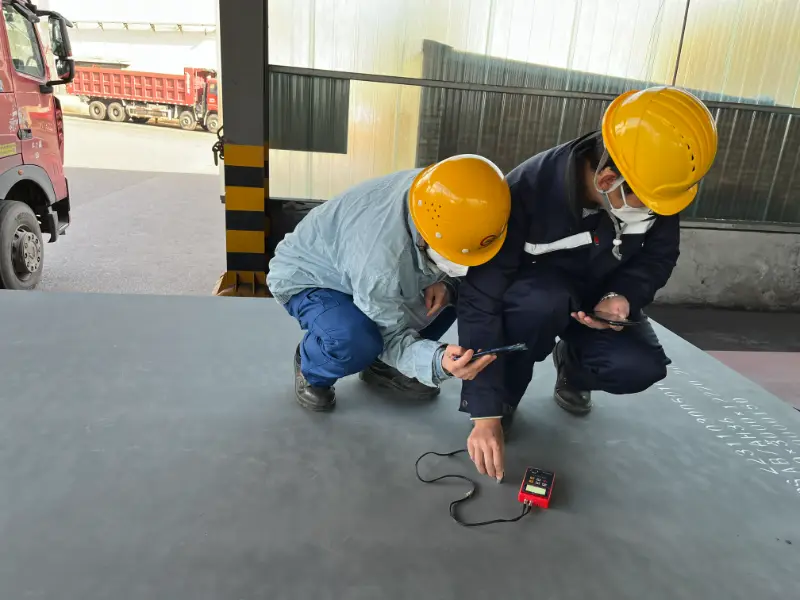
X2CrMoTi17-1 (1.4513) Ferritic Stainless Steel
X2CrMoTi17-1 (1.4513) Ferritic Stainless Steel: Corrosion Resistance, Formability & High-Temperature Strength
Comprehensive material data for X2CrMoTi17-1 ferritic stainless steel to EN 10088-1, including chemical composition, mechanical properties, thermal and electrical properties, international equivalents, and application guide.
Hot rolling, cold rolling, annealing, pickling, welding, deep drawing, bending, blanking
- Phone : +8618037372205
- Email : [email protected]
- WhatsApp: Contact via Whtsapp
- WeChat: +8618037372205
X2CrMoTi17-1 Ferritic Stainless Steel Introduction
X2CrMoTi17-1 (material number 1.4513) is a titanium-stabilized ferritic stainless steel with a nominal composition of 17% chromium and 1% molybdenum. It combines excellent resistance to stress corrosion cracking, good weldability, and high-temperature strength up to approximately 800°C. The titanium addition stabilizes the ferritic structure, preventing intergranular corrosion and sensitization. Its low carbon content (<0.025%) further enhances corrosion resistance. Compared to standard ferritic grades, this alloy offers improved pitting resistance in chloride-containing environments and is often used as an economic alternative to austenitic grades in applications such as
- hot water tanks
- exhaust systems
- industrial heat exchangers
.
X2CrMoTi17-1 Ferritic Stainless Steel Chemical Composition
Typical composition according to EN 10088-1. Titanium is added as a stabilizer; the minimum content depends on the carbon and nitrogen levels to ensure complete austenite elimination and resistance to intergranular attack. The formula Ti ≥ 0.15 + 4 × (C + N) is commonly applied, and the upper limit is 0.80%. All values are in weight percent (%).
| Element | Standard Value | Remarks |
|---|---|---|
| Carbon (C) | ≤ 0.025 | Low carbon to resist sensitization |
| Silicon (Si) | ≤ 1.00 | |
| Manganese (Mn) | ≤ 1.00 | |
| Phosphorus (P) | ≤ 0.040 | |
| Sulfur (S) | ≤ 0.015 | Low sulfur for improved ductility |
| Chromium (Cr) | 16.00 – 18.00 | Primary corrosion resistance element |
| Molybdenum (Mo) | 0.80 – 1.40 | Enhances pitting resistance |
| Titanium (Ti) | 0.15 + 4×(C+N) to 0.80 | Stabilizing element, min. calculated from actual C+N content |
| Nitrogen (N) | ≤ 0.020 | Low nitrogen preferred |
| Iron (Fe) | Balance |
X2CrMoTi17-1 Ferritic Stainless Steel Thermal and Electrical Physical Properties
Typical physical properties for X2CrMoTi17-1 at room temperature (20°C) unless otherwise noted. These values are representative and may vary slightly with processing; they are useful for design calculations involving heat transfer and thermal expansion.
| Property | Typical Value | Unit | Test Condition |
|---|---|---|---|
| Density (ρ) | 7.7 | g/cm³ | 20°C |
| Modulus of Elasticity (E) | 220 | GPa | 20°C |
| Shear Modulus (G) | 84 | GPa | Approximate (E × 0.38) |
| Poisson's Ratio (ν) | 0.30 – 0.31 | – | 20°C |
| Coefficient of Thermal Expansion (α) | 10.5 | ×10⁻⁶/K | 20–100°C |
| Coefficient of Thermal Expansion (α) | 11.0 | ×10⁻⁶/K | 20–200°C |
| Coefficient of Thermal Expansion (α) | 11.5 | ×10⁻⁶/K | 20–400°C |
| Thermal Conductivity (λ) | 25 | W/(m·K) | 20°C |
| Specific Heat Capacity (c) | 460 | J/(kg·K) | 20°C |
| Electrical Resistivity (ρ_e) | 0.60 | µΩ·m | 20°C |
X2CrMoTi17-1 Ferritic Stainless Steel Mechanical Properties
Mechanical properties at room temperature for cold-rolled sheet and strip in the annealed condition (2D/2B) according to EN 10088-2. Values depend on thickness. For thickness ≤3 mm, an elongation of ≥20% is required; for 3–6 mm, ≥18%. The material is not intended for quench hardening – it is used in the annealed state.
| Property | Standard Required Value | Unit | Test Condition |
|---|---|---|---|
| Yield Strength (Rp0.2) | ≥ 300 | MPa | Longitudinal direction, sheet thickness ≤ 6 mm |
| Tensile Strength (Rm) | 420 – 640 | MPa | Longitudinal direction, sheet thickness ≤ 6 mm |
| Elongation (A80) | ≥ 18 | % | Longitudinal, gauge length 80 mm, thickness 0.5–3 mm |
| Elongation (A) | ≥ 20 | % | Longitudinal, gauge length 50 mm, thickness 0.5–3 mm |
| Elongation (A) | ≥ 18 | % | Longitudinal, gauge length 50 mm, thickness 3–6 mm |
| Elongation (A) | ≥ 16 | % | Longitudinal, gauge length 50 mm, thickness 6–12 mm |
| Hardness | ≤ 190 | HBW | Annealed and descaled (typical maximum) |
| Bend Test | No cracks | - | Bend angle 180°, mandrel diameter = 2× thickness (t ≤ 6 mm) |
X2CrMoTi17-1 Ferritic Stainless Steel Fully Equivalent Material Standards and Substitutable Grades
| Country/Region | Standard | Designation | Remarks |
|---|---|---|---|
| Europe | EN 10088-1 / -2 / -3 | X2CrMoTi17-1 (1.4513) | Primary designation |
| Germany | DIN EN 10088-1 / -2 | X2CrMoTi17-1 (1.4513) | Same as European standard |
| France | NF EN 10088 | Z2CDT17-01 | National variant within EN system, sometimes used internally |
| United Kingdom | BS EN 10088 | X2CrMoTi17-1 | Identical to EN |
| International | ISO 15510 | X2CrMoTi17-1 | Identical chemical composition |
X2CrMoTi17-1 Ferritic Stainless Steel Application Introduction
X2CrMoTi17-1 is primarily chosen for its superior resistance to stress corrosion cracking, good high-temperature oxidation resistance, and economical advantage over nickel-containing austenitic grades. It is not hardenable by heat treatment and is supplied in the annealed condition. Typical fabrication includes welding (with or without filler metal of similar composition), deep drawing, and bending. Post-weld annealing is not necessary due to the stabilizing effect of titanium, but may be carried out to relieve residual stresses. The alloy is suitable for moderately aggressive chloride environments, but its resistance to strong reducing acids is limited.
Product Applications: Solar water heater storage tanks, Electric water heater inner shells, Automotive exhaust manifolds and mufflers, Furnace heat exchanger tubes, Flue gas condensers, Brewery and dairy processing vessels
Processed into products: Pressed and deep-drawn tank heads, Welded tube bundles, Bent and stamped brackets, Laser-welded panels, Expanded metal filter screens, Formed flanges and connectors
Application industries: Domestic and industrial water heating, Solar thermal energy systems, Automotive exhaust and after-treatment systems, Heat exchangers and condensers, Food processing equipment, Chemical / petrochemical (moderate conditions)
X2CrMoTi17-1 Ferritic Stainless Steel Similar or Alternative Materials
| Country/Region | Standard | Designation | Remarks |
|---|---|---|---|
| USA | ASTM A240/A240M | UNS S44400 (18Cr-2Mo-Ti) | Higher Mo (1.75–2.50) and Cr (17.5–19.5); often used interchangeably in many corrosive and thermal applications |
| Japan | JIS G4304 / G4305 | SUS444 | Similar to S44400, also with elevated Mo; good alternative for heat exchangers and hot water systems |
| China | GB/T 3280 | S11863 (06Cr18MoTi) | Contains 0.04–0.10% C; slightly higher carbon may affect weldability |
| China | GB/T 20878 | 019Cr19Mo2NbTi (S11972) | Stabilized with Nb+Ti, higher Cr and Mo; excellent corrosion resistance, but more expensive |
Notes:
The titanium stabilization mechanism requires careful control of composition during melting to avoid formation of coarse Ti(C,N) stringers, which can impair surface quality. This grade is magnetic and may undergo slight embrittlement after long-term exposure between 400–550°C due to 475°C embrittlement (alpha-prime phase formation). It is not recommended for use in highly reducing acids (e.g., hydrochloric acid) or concentrated sulphuric acid. For welding, filler metal of similar composition (e.g., EN 12072 W 17 1 Ti) or austenitic overalloyed fillers may be used to maintain corrosion resistance. Post-weld heat treatment is generally not required.
- Share



