
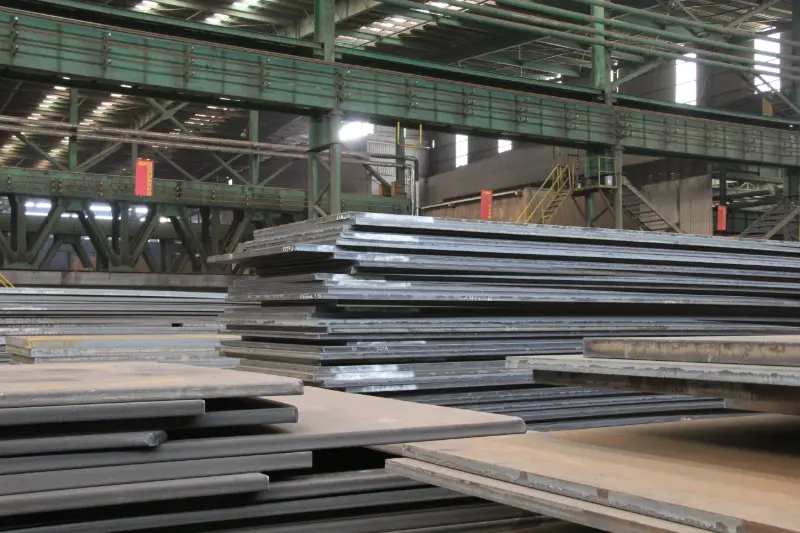
X105CrMo17 (1.4125) Martensitic Stainless Steel
X105CrMo17 (1.4125) Martensitic Stainless Steel - Plate & Coil per EN 10088-1
Detailed material data for X105CrMo17 martensitic stainless steel, including chemical composition, mechanical & physical properties, equivalents, and applications for plate and coil products.
Hot rolling, cold rolling, annealing, blanking, deep drawing (limited), machining, hardening & tempering
- Phone : +8618037372205
- Email : [email protected]
- WhatsApp: Contact via Whtsapp
- WeChat: +8618037372205
X105CrMo17 Martensitic Stainless Steel Introduction
X105CrMo17, designated 1.4125 under EN 10088-1, is a high-carbon martensitic stainless steel containing molybdenum. It offers excellent hardness and wear resistance after heat treatment, combined with moderate corrosion resistance. This grade is characterized by:
- High carbon (0.95–1.20%) enabling high hardness (up to 60 HRC) after quenching and tempering
- Molybdenum addition enhances corrosion resistance and strength at elevated temperatures
- Good dimensional stability and grindability
- Supplied typically in the annealed condition (+A) for machining, then hardened by the end user
Mainly used for cutting tools, bearings, valve parts, surgical instruments, and other wear-resistant components. Plate and coil forms comply with EN 10088-2 technical delivery conditions.
X105CrMo17 Martensitic Stainless Steel Chemical Composition
Chemical composition according to EN 10088-1 for grade X105CrMo17 (1.4125). Maximum limits apply unless stated otherwise. The composition is designed to provide high hardness after hardening while maintaining adequate corrosion resistance with the help of molybdenum.
| Element | Standard Value (%) | Remarks |
|---|---|---|
| Carbon (C) | 0.95 – 1.20 | Provides high hardenability and wear resistance. |
| Silicon (Si) | ≤ 1.00 | Deoxidizer, improves strength. |
| Manganese (Mn) | ≤ 1.00 | Aids hot workability; content kept low to avoid brittleness. |
| Phosphorus (P) | ≤ 0.040 | Impurity – kept low to maintain toughness. |
| Sulfur (S) | ≤ 0.015 | Impurity – lower in modern steels for better cleanliness. |
| Chromium (Cr) | 16.0 – 18.0 | Essential for corrosion and oxidation resistance. |
| Molybdenum (Mo) | 0.40 – 0.80 | Enhances pitting resistance and hardenability. |
X105CrMo17 Martensitic Stainless Steel Physical Properties
Physical properties for X105CrMo17 (1.4125) are typical for high-carbon martensitic stainless steels. These values may vary slightly depending on exact heat treatment and product form. Thermal conductivity and expansion are important for tool and bearing applications subject to temperature changes.
| Property | Value | Unit | Condition / Temperature |
|---|---|---|---|
| Density (ρ) | ~7.70 | kg/dm³ | At 20 °C |
| Elastic modulus (E) | 215 | GPa | At 20 °C |
| Shear modulus (G) | ~84 | GPa | Calculated from E and ν = 0.28–0.30 |
| Poisson ratio (ν) | 0.28 – 0.30 | - | Elastic range |
| Thermal expansion coefficient (α) | 10.5 | 10⁻⁶/K | 20 – 100 °C |
| Thermal expansion coefficient (α) | 11.0 | 10⁻⁶/K | 20 – 200 °C |
| Thermal expansion coefficient (α) | 11.5 | 10⁻⁶/K | 20 – 300 °C |
| Thermal conductivity (λ) | 30.0 | W/(m·K) | At 20 °C |
| Thermal conductivity (λ) | 27.0 | W/(m·K) | At 200 °C |
| Specific heat capacity (cₚ) | 460 | J/(kg·K) | At 20 °C |
| Electrical resistivity (ρₑ) | 0.80 | µΩ·m | At 20 °C |
X105CrMo17 Martensitic Stainless Steel Mechanical Properties
Values apply to plate/coil products supplied under EN 10088-2. In the soft annealed (+A) condition, only a maximum hardness is specified. After hardening and tempering, much higher strength levels can be achieved – typical values for quenched and tempered condition are provided for reference. Hardness test according to EN ISO 6506-1.
| Property | Value (Standard / Typical) | Unit | Condition |
|---|---|---|---|
| Hardness (HBW) | ≤ 255 | HBW | Annealed (+A) – as per EN 10088-2 |
| Tensile strength (Rm) typical | 800 – 1000 | MPa | Quenched & tempered (oil quenched 1000–1050 °C, tempered 150–350 °C) |
| 0.2% proof stress (Rp0.2) typical | ≥ 450 | MPa | Quenched & tempered, depending on temper |
| Elongation (A) typical | ≥ 8 | % | Quenched & tempered (gauge length L₀=5.65√S₀) |
| Impact energy (KV) typical | ≥ 15 (room temp.) | J | Quenched & tempered – limited toughness |
X105CrMo17 Martensitic Stainless Steel Exact Equivalent Material Standards and Substitute Grades
| Country/Region | Standard | Designation | Remarks |
|---|---|---|---|
| Europe | EN 10088-1 | X105CrMo17 (1.4125) | Original grade specified for plate/coil |
| USA | ASTM A240/A276 | 440C (UNS S44004) | Equivalent high‑carbon martensitic stainless; slight composition overlap |
| Japan | JIS G4303/G4304 | SUS440C | Chemical composition matches very closely |
| China | GB/T 1220 / GB/T 3280 | 102Cr17Mo (formerly 9Cr18Mo) | Slight carbon difference but interchangeable in many applications |
| International | ISO 15510 | X105CrMo17 | Identical designation and chemistry |
X105CrMo17 Martensitic Stainless Steel Application Introduction
X105CrMo17 is chosen where high hardness, wear resistance, and moderate corrosion resistance are required. Typical uses span mechanical engineering, medical technology, and food processing. Suitable for parts that undergo high mechanical loads and require excellent dimensional stability after hardening.
Product Applications: Blades and knives, Ball and roller bearings, Valve seats and needle valves, Shaft sleeves, Scissors forceps, dental drills, Nozzles and cutting tools
Processed into products: Martensitic hardened bearing races, Precision stamping dies, High‑pressure pump pistons, Shear blades for plastic/food cutting, Spring plungers and indexing pins
Application industries: Cutlery and household utensils, Bearings and automotive components, Valves and pump components (petrochemical/chemical), Surgical and dental instruments, Food processing machinery, High‑wear machine parts (moulds, dies, gauges)
X105CrMo17 Martensitic Stainless Steel Near‑Equivalent / Similar Materials Recommendations
| Country/Region | Standard | Designation | Remarks |
|---|---|---|---|
| Germany | DIN EN 10088-3 (bar) | X90CrMoV18 (1.4112) | Contains vanadium, improved wear resistance; slightly lower carbon |
| USA | ASTM A240 | 440B (S44003) | Lower carbon (0.75–0.95%), slightly lower hardness but better toughness |
| Japan | JIS G4303 | SUS440B | Similar to 440B; less carbon, used when less brittle material is needed |
| China | GB/T 1220 | 108Cr17Mo (formerly 11Cr17Mo) | Carbon around 1.08%, similar properties, good alternative for high hardness |
Notes:
For optimum corrosion resistance, the steel should be hardened and tempered, followed by passivation. Welding is difficult and usually requires preheating and post‑weld heat treatment with matching filler. Maximum service temperature in the hardened condition is around 300 °C due to risk of overtempering. Cold forming is limited; the material is primarily supplied for machining and subsequent heat treatment.
- Share



