
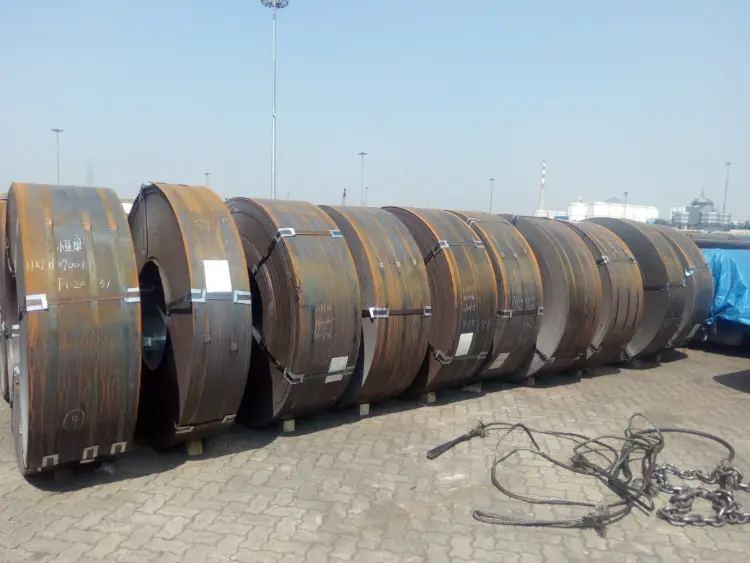
USt37-2 (DIN 17100) Carbon Structural Steel Coil
USt37-2 (DIN 17100) Carbon Structural Steel Coil - Composition, Properties & Global Equivalents
Complete material data for USt37-2 steel coil to DIN 17100: chemical composition, mechanical and physical properties, international cross-reference equivalents, and application guidance for structural engineering.
Hot rolling, cold forming, bending, welding, machining, oxy-fuel and plasma cutting
- Phone : +8618037372205
- Email : [email protected]
- WhatsApp: Contact via Whtsapp
- WeChat: +8618037372205
USt37-2 Carbon Structural Steel Coil Introduction
USt37-2 is a non-alloy rimming structural steel originally specified in the German standard DIN 17100 (now superseded by EN 10025-2). The grade belongs to the St37-2 family and is characterised by good weldability, moderate strength and excellent formability. Its typical yield strength is 235 MPa for thinner sections and it is widely used in general fabrication, construction and machinery. Because it is a rimming (un-killed) steel, the silicon content is very low, and it may exhibit more pronounced aging effects compared to aluminium-killed steels. Current practice replaces USt37-2 with the fully killed S235JR to EN 10025-2 for improved toughness and homogeneity. The steel is available as hot-rolled coil, plate, sections and tubes.
USt37-2 Carbon Structural Steel Coil Chemical Composition
Chemical requirements according to DIN 17100 for grade USt37-2 (rimming structural steel). Values refer to ladle analysis. For product analysis, the permissible deviations defined in the standard apply. The carbon limit depends on product thickness. Silicon is not intentionally added and remains at trace level typical of rimming practice.
| Element | Standard Value | Remarks |
|---|---|---|
| Carbon (C) | ≤0.17 | Thickness ≤16 mm; ≤0.20 for 16 mm < t ≤40 mm; ≤0.22 for 40 mm < t ≤100 mm |
| Silicon (Si) | ≤0.05 (trace) | Rimming steel; no intentional Si addition |
| Manganese (Mn) | ≤1.40 | For all thicknesses up to 100 mm |
| Phosphorus (P) | ≤0.045 | |
| Sulfur (S) | ≤0.045 | |
| Nitrogen (N) | ≤0.009 | Without nitrogen-binding elements; higher N may be accepted when Al, V etc. are used |
USt37-2 Carbon Structural Steel Coil Thermal and Electrical Physical Properties
Typical physical properties for carbon structural steel of the USt37-2 type at room temperature and elevated temperatures. These values are representative for non-alloy steels with approximately 0.15 % carbon. The actual properties can vary slightly depending on the specific heat and composition.
| Property | Typical Value | Unit | Condition / Remarks |
|---|---|---|---|
| Density (ρ) | 7.85 | g/cm³ | At 20 °C |
| Modulus of elasticity (E) | 210 | GPa | At 20 °C |
| Shear modulus (G) | ≈81 | GPa | At 20 °C |
| Poisson's ratio (ν) | 0.3 | — | At 20 °C |
| Thermal expansion coefficient (α) | 11.5 × 10⁻⁶ | K⁻¹ | 20 °C to 100 °C |
| Thermal expansion coefficient (α) | 12.5 × 10⁻⁶ | K⁻¹ | 20 °C to 200 °C |
| Thermal expansion coefficient (α) | 13.5 × 10⁻⁶ | K⁻¹ | 20 °C to 400 °C |
| Thermal conductivity (λ) | 53 | W/(m·K) | At 20 °C |
| Thermal conductivity (λ) | 51 | W/(m·K) | At 200 °C |
| Specific heat capacity (cp) | 460 | J/(kg·K) | At 20 °C |
| Electrical resistivity (ρ_e) | ≈0.15 | μΩ·m (or Ω·mm²/m) | At 20 °C |
USt37-2 Carbon Structural Steel Coil Mechanical Properties
Tensile properties and bend test requirements as per DIN 17100 for USt37-2. Yield strength and elongation vary with thickness. Elongation values are given for proportional gauge lengths (L0 = 5.65√S0, equivalent to L0 = 80 mm for sheets and strips). The steel does not have a guaranteed impact energy (USt37-2 is not a notch-impact grade). All tests are performed in the delivery condition (as-rolled or normalised).
| Property | Standard Requirement | Unit | Test Condition |
|---|---|---|---|
| Yield strength (ReH) | ≥235 | MPa | Nominal thickness ≤16 mm |
| Yield strength (ReH) | ≥225 | MPa | 16 mm < t ≤40 mm |
| Yield strength (ReH) | ≥215 | MPa | 40 mm < t ≤63 mm |
| Yield strength (ReH) | ≥205 | MPa | 63 mm < t ≤80 mm |
| Yield strength (ReH) | ≥195 | MPa | 80 mm < t ≤100 mm |
| Tensile strength (Rm) | 360 – 510 | MPa | All thicknesses |
| Elongation (A) | ≥26 (long.) / ≥24 (trans.) | % | t ≤40 mm; L0 = 5.65√S0 (≈80 mm) |
| Elongation (A) | ≥25 (long.) / ≥23 (trans.) | % | 40 mm < t ≤63 mm |
| Elongation (A) | ≥24 (long.) / ≥22 (trans.) | % | 63 mm < t ≤100 mm |
| Bend test (180°) | D = 0.5 a (no cracks) | — | t ≤16 mm |
| Bend test (180°) | D = 1.0 a (no cracks) | — | 16 mm < t ≤100 mm |
USt37-2 Carbon Structural Steel Coil Complete Equivalent Material Standards and Substitutable Grades
| Country/Region | Standard | Grade | Remarks |
|---|---|---|---|
| Germany | DIN 17100 | USt37-2 | Original rimming structural steel; standard withdrawn |
| European Union | EN 10025-2:2004 | S235JR | Silicon-killed replacement for new designs; fully killed (S235JRG2 analogy) |
| European Union | EN 10025:1993 | S235JRG1 | Direct equivalent for rimming grade USt37-2 under withdrawn EN standard |
| International | ISO 630-2 | E235B (ex-Fe360B) | Comparable structural steel; mechanical properties aligned |
| China | GB/T 700 | Q235B | Rimming variant Q235AF matches USt37-2 practice |
| Japan | JIS G3101 | SS400 | Similar general structural steel; minor differences in tensile range |
| USA | ASTM A36 / A283M | A36 / Grade C | Equivalent strength level; chemical requirements differ slightly |
USt37-2 Carbon Structural Steel Coil Application Introduction
USt37-2 steel coil is predominantly employed in general structural and mechanical engineering applications that require moderate load-bearing capacity and good weldability. The steel can be readily cold-formed, bent, punched and cut. Typical end-use sectors and products include:
Product Applications: Hot-rolled coils, sheets and plates for further processing, Structural sections (I-beams, channels, angles, hollow profiles), Welded pipes and tubes for mechanical and structural use, Cold-formed profiles and purlins, Welded frames, supports and braces, Pressed and stamped sheet metal components
Processed into products: Building frames, columns and trusses, Bridge girders and deck plates, Vehicle chassis members and cross-members, Machinery bases, brackets and housings, Container walls and side panels, Agricultural tines, ploughs and tillage parts, Scaffolding elements and falsework components, Furniture frames and shelving systems, Ducts, hoppers and silos
Application industries: Construction and civil engineering, Shipbuilding and marine structures, Automotive and transportation, Machinery and plant engineering, Storage tank and container manufacturing, Agricultural and earth-moving equipment
USt37-2 Carbon Structural Steel Coil Similar / Alternative Material Recommendations
| Country/Region | Standard | Grade | Remarks |
|---|---|---|---|
| European Union | EN 10025-2 | S235J0 | Contains impact requirement at 0 °C; otherwise comparable strength |
| European Union | EN 10025-2 | S275JR | Higher minimum yield strength (275 MPa); good formability |
| USA | ASTM A572/A572M | Grade 50 | Low-alloy, higher strength (345 MPa) alternative for weight reduction |
| China | GB/T 1591 | Q345B | High-strength low-alloy steel; 345 MPa yield, widely used in China |
| Japan | JIS G3106 | SM400A | Welded structural steel with guaranteed impact energy; similar strength |
Notes:
Important notice: The USt37-2 grade is no longer listed in current European standards. For new engineering projects, S235JR (EN 10025-2) should be specified. Rimming steel may exhibit higher susceptibility to strain ageing and reduced through-thickness properties. Welding procedures should account for the material's fine-grained nature. The physical property values given are typical for carbon steels; always refer to a specific mill certificate for guaranteed data. When substituting materials, verify the required notched-bar impact energy, as USt37-2 has no guaranteed impact requirements.
- Share



