
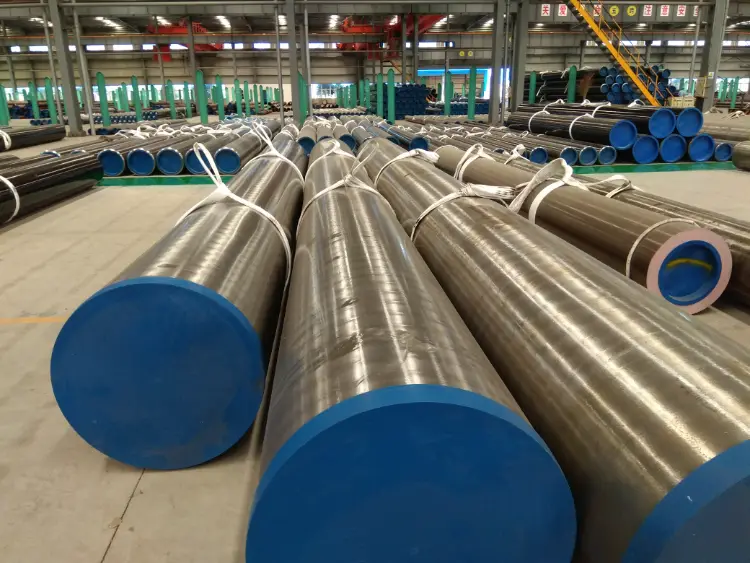
GB/T9711-2011 PSL2 L360 LSAW Pipe Steel
GB/T9711-2011 PSL2 L360 LSAW Pipe Steel: Composition, Mechanical & Physical Properties and Equivalents
Comprehensive technical data for L360 steel grade according to GB/T 9711-2011 PSL2, typically used in LSAW pipes for oil and gas transmission, including chemical composition, mechanical properties, physical properties, and equivalent international grades.
Thermo-mechanical controlled processing (TMCP), normalizing, or as-rolled; cold expansion after welding for LSAW pipes is typical.
- Phone : +8618037372205
- Email : [email protected]
- WhatsApp: Contact via Whtsapp
- WeChat: +8618037372205
GB/T9711-2011 PSL2 L360 LSAW Pipe Steel Introduction
L360 (PSL2) is a high-strength low-alloy (HSLA) steel grade specified in GB/T 9711-2011 for petroleum and natural gas pipeline systems. It is designed for longitudinal submerged-arc welded (LSAW) pipes and other welded or seamless line pipes operating under stringent service conditions. Supplied under Product Specification Level 2 (PSL2), L360 offers improved toughness, mandatory impact testing, and stricter chemical control compared to PSL1.
Key features:
- Minimum yield strength of 360 MPa, with excellent ductility and weldability.
- Fine-grained ferritic-pearlitic microstructure achieved through thermo-mechanical controlled processing (TMCP) or normalizing.
- Resistance to brittle fracture and good corrosion resistance in hydrocarbon and water environments.
- Widely used for long-distance oil and gas transmission pipelines, both onshore and offshore.
This material is considered the Chinese equivalent to API 5L X52 and ISO 3183 L360, enabling global interchangeability.
GB/T9711-2011 PSL2 L360 LSAW Pipe Steel Chemical Composition
The chemical composition of L360 PSL2 is strictly controlled to ensure good weldability, toughness, and strength. Maximum limits for elements are specified to avoid detrimental effects. Micro-alloying elements such as Nb, V, and Ti are used for grain refinement and precipitation strengthening. The sum of Nb+V+Ti is restricted to ensure stable mechanical properties. Note: Values are for heat analysis of the steel supplied for pipe manufacturing; product analysis may have slightly wider tolerances as per the standard.
| Element | Standard Value (max, unless range given) | Remarks |
|---|---|---|
| C | ≤ 0.22 | For improved weldability in field girth welding |
| Si | ≤ 0.45 | Deoxidation, higher values may affect toughness |
| Mn | ≤ 1.40 | Major strengthening and toughening element |
| P | ≤ 0.025 | Stringent limit for PSL2 to avoid segregation and brittleness |
| S | ≤ 0.015 | Ultra-low sulfur for improved toughness and HIC resistance |
| V | ≤ 0.05 | Micro-alloying element; contributes to precipitation strengthening |
| Nb | ≤ 0.05 | Grain refinement and controlled rolling aid |
| Ti | ≤ 0.04 | Grain refinement and sulfide shape control |
| V+Nb+Ti | ≤ 0.15 | Sum limitation to avoid excessive hardening |
| Cu | ≤ 0.50 | Residual element; may be restricted for specific environments |
| Ni | ≤ 0.50 | Residual; improves toughness but limited to control cost |
| Cr | ≤ 0.50 | Residual; enhances corrosion resistance but may affect weldability |
| Mo | ≤ 0.50 | Residual; increases strength but may impair toughness at high levels |
GB/T9711-2011 PSL2 L360 LSAW Pipe Steel Thermal and Electrical Physical Properties
The following physical properties are representative for low-carbon micro-alloyed steel in the hot-rolled or normalized condition. Actual values may vary slightly depending on the exact chemical composition and manufacturing process. These properties are essential for pipeline design, heat transfer calculations, and cathodic protection design.
| Property | Typical Value | Unit | Conditions |
|---|---|---|---|
| Density (ρ) | 7850 | kg/m³ | At 20°C |
| Elastic Modulus (E) | 205 | GPa | Room temperature, static load |
| Shear Modulus (G) | 79 | GPa | Calculated from E and ν |
| Poisson's Ratio (ν) | 0.30 | — | Room temperature |
| Thermal Expansion Coeff. (α) | 10.8 (20–100°C) / 11.8 (20–200°C) / 12.8 (20–400°C) | 10⁻⁶/K | Mean linear expansion; varies with temperature |
| Thermal Conductivity (λ) | 50 | W/(m·K) | At 20°C |
| Specific Heat Capacity | 460 | J/(kg·K) | At 20°C |
| Electrical Resistivity (ρₑ) | 0.14 | µΩ·m | At 20°C |
GB/T9711-2011 PSL2 L360 LSAW Pipe Steel Mechanical Properties
Mechanical properties are determined according to standard test procedures on base metal specimens. For welded pipes, transverse tests are common. Impact testing is mandatory for PSL2 at 0°C or lower if specified. Elongation values are based on a gauge length of 50 mm (or equivalent using the formula A=1940·Ax²/Um⁰·⁹ where Ax is the cross-sectional area and Um is tensile strength). The yield strength may be recorded as Rt0.5 for materials without a distinct yield point.
| Property | Required Value | Unit | Test Conditions / Remarks |
|---|---|---|---|
| Yield Strength (ReH or Rt0.5) | 360 – 530 | MPa | Transverse strip test, room temperature |
| Tensile Strength (Rm) | 460 – 760 | MPa | Transverse strip test, room temperature |
| Elongation (A) | ≥ 21 (for wall thickness ≤ 25 mm) | % | Longitudinal specimen, gauge length 50 mm; formula applies for other configurations |
| Charpy V-notch Impact Energy (CVN) | ≥ 27 (average of 3 specimens) | J | Full-size (10×10 mm) specimen, 0°C; individual minimum 20 J |
| Bend Test (Weld) | No cracks or ruptures > 3 mm | – | For welded pipes, 180° bend around a mandrel; diameter = 3t for thickness ≤ 12.5 mm |
GB/T9711-2011 PSL2 L360 LSAW Pipe Steel Directly Equivalent Material Standards and Replaceable Grades
| Country/Region | Standard | Designation/Grade | Remarks |
|---|---|---|---|
| China | GB/T 9711-2011 | L360 (PSL2) | Original standard; for line pipe |
| International | ISO 3183:2007 | L360 | Identical technical requirements |
| USA | API Spec 5L (44th Edition) | X52 (PSL2) | Most common equivalent; same yield range |
| Europe | EN 10208-2 | L360MB | M for TMCP, B for specific carbon equivalent limits |
| Russia | GOST 20295-85 | K52 | Comparable strength grade for line pipe |
| Australia/New Zealand | AS 2885 | X52 (reference) | Based on API 5L; widely used |
GB/T9711-2011 PSL2 L360 LSAW Pipe Steel Application Introduction
L360 PSL2 steel is primarily used in high-pressure, long-distance gas and oil transmission pipelines, where reliability and safety are critical. Its balanced strength and toughness make it suitable for both onshore and offshore applications, including sour service environments when supplementary requirements (HIC/SSC tests) are applied. Typical pipe types manufactured from this grade include LSAW (JCOE or UOE process), spiral submerged-arc welded (SSAW), and seamless pipes.
Product Applications: Longitudinally Submerged-Arc Welded (LSAW) Pipe, Spiral Submerged-Arc Welded (SSAW) Pipe, Seamless Line Pipe, Induction Bends and Fittings (elbows, tees, reducers), Flowlines and Gathering Lines
Processed into products: Main line pipe segments (12 m typical length), Hot induction bends (3D, 5D, 10D bending radii), Flanges and weldolets, Pig launchers/receivers, Riser pipes for offshore platforms
Application industries: Oil and Gas Exploration & Transportation, Petrochemical and Refinery Plant Piping, Water and Slurry Pipelines, Offshore Platform Structural Piping, Energy Infrastructure (Gas distribution networks)
GB/T9711-2011 PSL2 L360 LSAW Pipe Steel Similar/Alternative Materials with Comparable Properties
| Country/Region | Standard | Designation | Remarks |
|---|---|---|---|
| China | GB/T 9711-2011 | L290 (X42) | Lower strength grade; similar toughness requirements |
| China | GB/T 9711-2011 | L415 (X60) | Higher strength grade; may require stricter welding controls |
| International | ISO 3183 | L290 / L415 | Adjacent grades in the ISO 3183 series; suitable substitutions when strength requirements differ |
| USA | API 5L | X46 / X56 | Often considered if L360/X52 is unavailable, with design adjustments |
Notes:
Additional requirements for PSL2: Carbon equivalent (CE) limits are specified to ensure field weldability; typically CEIIW ≤ 0.43%. Stricter non-destructive evaluation (NDE) of the weld seam (radiography or ultrasonic inspection) is mandatory. For sour service applications, the material must satisfy NACE MR0175/ISO 15156 requirements with hardness control and HIC/SSC testing. Supplementary impact testing at lower temperatures (e.g., -20°C) may be ordered. LSAW pipe specifics: The pipe is formed from plate and welded by submerged arc, then expanded (cold expansion) to achieve ovality and improve yield strength. Weld metal toughness must match the base metal.
- Share



