
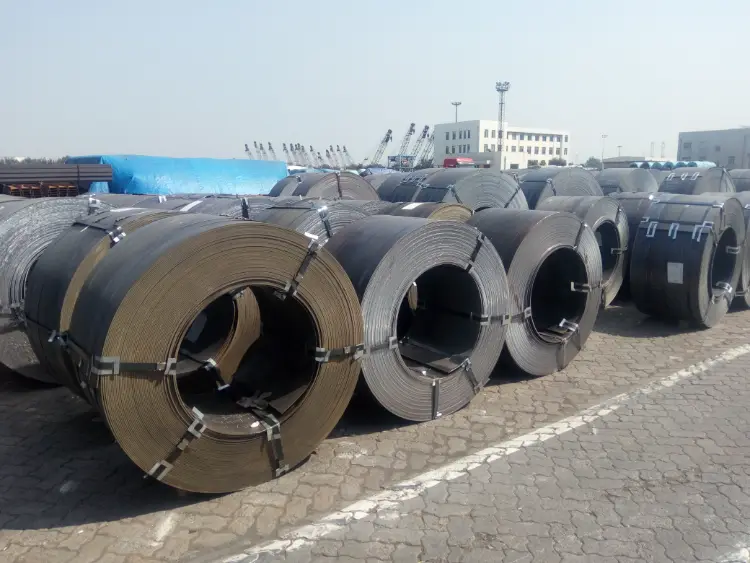
DIN 17100 ST37-2 Carbon Structural Steel Coil
DIN 17100 ST37-2: Structural Steel for General Applications with Balanced Strength and Formability
Explore ST37-2 steel under DIN 17100, a low-carbon structural steel coil with reliable weldability, formability, and mechanical properties for construction and engineering applications.
Hot rolling, cold forming, gas cutting, welding, punching, drilling, machining
- Phone : +8618037372205
- Email : [email protected]
- WhatsApp: Contact via Whtsapp
- WeChat: +8618037372205
DIN 17100 ST37-2 Carbon Structural Steel Coil Introduction
DIN 17100 ST37-2 is a general-purpose structural carbon steel that falls under the German standard for hot-rolled products made of non-alloy structural steels. It is widely used in civil engineering and mechanical constructions due to its balanced combination of moderate strength, excellent weldability, and good cold forming capability. ST37-2 represents a basic grade with minimum yield strength of 235 MPa for thicknesses up to 16 mm, while its tensile strength ranges from 360 to 510 MPa. The material is typically supplied as hot-rolled coils, sheets, plates, and sections, and is characterized by a ferritic-pearlitic microstructure. Its global equivalents include EN S235JR, JIS SS400, and ASTM A36, making it a versatile choice in international trade and standardized structural design.
DIN 17100 ST37-2 Carbon Structural Steel Coil Chemical Composition
The chemical composition of DIN 17100 ST37-2 is designed to ensure good weldability and formability while keeping costs low. Carbon is limited to a maximum of 0.17% to avoid cracking during welding, and manganese, up to 1.40%, provides solid-solution strengthening without compromising toughness. Phosphorus and sulfur are controlled to moderate levels typical of rimmed or semi-killed steel practices. Nitrogen is restricted below 0.009% to minimize strain aging. The grade may also contain small amounts of residual copper, chromium, nickel, and molybdenum, which are not intentionally added but can be present from scrap.
| Element | Standard Value (wt%) | Remarks |
|---|---|---|
| C | ≤ 0.17 | Ladle analysis; for thickness >30 mm, C ≤ 0.20 allowed |
| Si | ≤ 0.40 | May be lower in rimmed steels |
| Mn | ≤ 1.40 | For thickness ≤ 16 mm; for >16 mm, Mn ≤ 1.50 |
| P | ≤ 0.045 | Ladle analysis; product analysis may be slightly higher |
| S | ≤ 0.045 | Typically controlled below 0.035 for better formability |
| N | ≤ 0.009 | For product thickness ≤ 16 mm; for >16 mm, ≤ 0.012 |
| Cu | ≤ 0.55 | Residual element; may be limited for certain applications |
| Cr | ≤ 0.30 | Residual element |
| Ni | ≤ 0.30 | Residual element |
| Mo | ≤ 0.08 | Residual element |
DIN 17100 ST37-2 Carbon Structural Steel Coil Thermal and Electrical Properties
Physical properties are provided as typical values for carbon-manganese structural steels at room temperature unless stated otherwise. The density is approximately 7.85 g/cm³. Young's modulus and shear modulus are consistent with ferritic steels. The thermal expansion coefficient is about 12×10⁻⁶ K⁻¹ in the range 20–100°C, increasing at higher temperatures. Thermal conductivity decreases with rising temperature, while specific heat capacity increases. Electrical resistivity is around 0.16 µΩ·m, typical for low-alloy steels. These values may vary slightly based on exact composition and heat treatment but are suitable for engineering calculations.
| Property | Typical Value | Unit | Test Condition |
|---|---|---|---|
| Density (ρ) | 7.85 | g/cm³ | at 20°C |
| Elastic Modulus (E) | 210 | GPa | at 20°C |
| Shear Modulus (G) | 81 | GPa | at 20°C |
| Poisson's Ratio (ν) | 0.30 | – | at 20°C |
| Thermal Expansion Coefficient (α) | 12.0 | 10⁻⁶/K | 20 – 100°C |
| Thermal Expansion Coefficient (α) | 13.0 | 10⁻⁶/K | 20 – 300°C |
| Thermal Expansion Coefficient (α) | 14.0 | 10⁻⁶/K | 20 – 500°C |
| Thermal Conductivity (λ) | 53 | W/(m·K) | at 20°C |
| Thermal Conductivity (λ) | 51 | W/(m·K) | at 100°C |
| Thermal Conductivity (λ) | 47 | W/(m·K) | at 300°C |
| Specific Heat Capacity (cp) | 460 | J/(kg·K) | at 20°C |
| Specific Heat Capacity (cp) | 490 | J/(kg·K) | at 100°C |
| Specific Heat Capacity (cp) | 550 | J/(kg·K) | at 300°C |
| Electrical Resistivity (ρe) | 0.16 | µΩ·m | at 20°C |
DIN 17100 ST37-2 Carbon Structural Steel Coil Mechanical Properties
Mechanical properties of ST37-2 are thickness-dependent due to the hot-rolling process. The yield strength (ReH) decreases as section thickness increases, reflecting the coarser grain structure in heavier sections. Tensile strength (Rm) is maintained between 360-510 MPa for thicknesses up to 100 mm. Elongation after fracture (A5 or A80) ensures adequate ductility for cold forming. Bending tests are used to verify formability around a specified mandrel without cracking. Impact toughness is not routinely guaranteed unless the material is ordered with special quality (e.g., ST37-2 G3). In standard delivery condition, the steel does not have a Charpy-V impact requirement.
| Property | Standard Requirement | Unit | Test Condition |
|---|---|---|---|
| Yield Strength (ReH) | ≥ 235 | MPa | thickness ≤ 16 mm |
| Yield Strength (ReH) | ≥ 225 | MPa | 16 mm < thickness ≤ 40 mm |
| Yield Strength (ReH) | ≥ 215 | MPa | 40 mm < thickness ≤ 63 mm |
| Yield Strength (ReH) | ≥ 205 | MPa | 63 mm < thickness ≤ 80 mm |
| Yield Strength (ReH) | ≥ 195 | MPa | 80 mm < thickness ≤ 100 mm |
| Yield Strength (ReH) | ≥ 185 | MPa | 100 mm < thickness ≤ 150 mm |
| Tensile Strength (Rm) | 360 – 510 | MPa | thickness ≤ 100 mm |
| Tensile Strength (Rm) | 350 – 500 | MPa | 100 mm < thickness ≤ 150 mm |
| Elongation (A5) | ≥ 26 | % | longitudinal, thickness ≤ 40 mm |
| Elongation (A5) | ≥ 25 | % | longitudinal, 40 < thickness ≤ 63 mm |
| Elongation (A5) | ≥ 24 | % | longitudinal, 63 < thickness ≤ 100 mm |
| Elongation (A80) | ≥ 21 | % | transverse, thickness < 3 mm (typical) |
| Bend Test | Mandrel diameter = 0.5 × thickness | – | thickness ≤ 16 mm, bending through 180° |
| Bend Test | Mandrel diameter = 1.0 × thickness | – | 16 < thickness ≤ 100 mm, bending through 180° |
DIN 17100 ST37-2 Carbon Structural Steel Coil Direct Equivalent Standards and Substitutable Grades
| Country / Region | Standard | Grade | Remarks |
|---|---|---|---|
| European Union | EN 10025-2:2004 | S235JR (1.0038) | Direct replacement; impact tested at +20°C (27 J) |
| Japan | JIS G 3101:2015 | SS400 | Similar chemistry; yield 245 MPa min for t ≤ 16 mm |
| China | GB/T 700-2006 | Q235B | C ≤ 0.20; impact test at +20°C, 27 J min |
| USA | ASTM A283/A283M-18 | Grade C | Tensile 380-515 MPa; no impact requirement |
| USA | ASTM A36/A36M-19 | A36 | Yield 250 MPa min; widely used structural steel |
| International | ISO 630-2:2011 | S235B | Includes impact test option at 0°C or -20°C |
| Russia | GOST 380-2005 | St3sp | Similar carbon-manganese steel; used in structures |
| India | IS 2062:2011 | E250A / Fe410WA | Yield 250 MPa; Fe410WA with guaranteed weldability |
DIN 17100 ST37-2 Carbon Structural Steel Coil Application Introduction
ST37-2 is a versatile structural steel ideal for applications where moderate strength and excellent fabricability are paramount. It can be readily welded, gas-cut, and cold-formed, making it suitable for a wide array of products. Common design codes allow its use in statically loaded structures in non-aggressive environments. When improved corrosion protection is needed, it is delivered with a shop primer or can be hot-dip galvanized. The material is typically used in the as-rolled condition, but stress-relief heat treatment may be applied after extensive welding.
Product Applications: Welded H-beams and I-beams for industrial buildings, Hot-rolled coils slit into strips for cold roll forming of profiles, Plates and sheets for tank shells, vessel components, and platforms, Structural hollow sections (square, rectangular, circular), Corrugated sheets for roofing and cladding, Purlins, side rails, and girts in pre-engineered steel buildings, Merchant bars (angles, channels, flats) for secondary structures
Processed into products: Anchor bolts and foundation fasteners (where high strength is not critical), Base plates and stiffeners for steel columns, Gusset plates and splice plates in trusses, Braced frame components and wind bracing members, Non-pressurized tank nozzles and manhole covers, Forged hooks, lifting eyes, and clevises (after simple forging), Machine guards, walkways, and handrail posts, Welded pipe supports and cable tray brackets, Trailer chassis members and agricultural attachment frames
Application industries: Construction and civil engineering (building frames, bridges, footbridges, towers), Mechanical engineering (frames, brackets, supports), Shipbuilding (non-critical structural parts, temporary structures), Automotive and rail transport (chassis components, wagon underframes), Agricultural machinery (plough frames, harvester bodies), Storage tanks and silos (shell plates under atmospheric conditions), Renewable energy (wind turbine tower internals, solar support structures), General fabrication and boilermaking
DIN 17100 ST37-2 Carbon Structural Steel Coil Near / Alternative Grade Recommendations
| Country / Region | Standard | Grade | Remarks |
|---|---|---|---|
| Germany | DIN 17100 | USt37-2 | Rimmed version of ST37-2 with similar mechanical properties |
| European Union | EN 10025-2 | S235J0 (1.0114) | Impact tested at 0°C (27 J); slightly stricter weldability |
| European Union | EN 10025-2 | S235J2 (1.0117) | Impact tested at -20°C; suitable for thicker sections |
| Canada | CSA G40.21 | 230G | Similar carbon steel with yield 230 MPa |
| United Kingdom | BS 4360 | 43A | Obsolete British standard, historically comparable to ST37-2 |
| Italy | UNI 7070 | Fe360B | Older Italian designation with yield 235 MPa |
| France | NF A35-501 | E24-2 | Former French standard; replaced by EN S235JR |
| International | ISO 630 | Fe360B | ISO designation from previous editions |
Notes:
DIN 17100 has been officially withdrawn and replaced by the EN 10025 series. However, ST37-2 remains a common commercial designation. The grade can be supplied in different deoxidation methods: U (rimmed), R (killed, including semi-killed), or with special requirements such as notched-bar impact testing (e.g., ST37-2 G3). For welded structures subjected to dynamic loading or low temperatures, the impact-tested equivalent S235JR (or S235J0/J2) is recommended. Copper content may be limited to max. 0.40% for hot-dip galvanizing compatibility. Typical welding methods include SMAW, GMAW, SAW, and resistance welding, with preheating recommended for thicker sections (>30 mm) to avoid hydrogen-induced cracking.
- Share



