
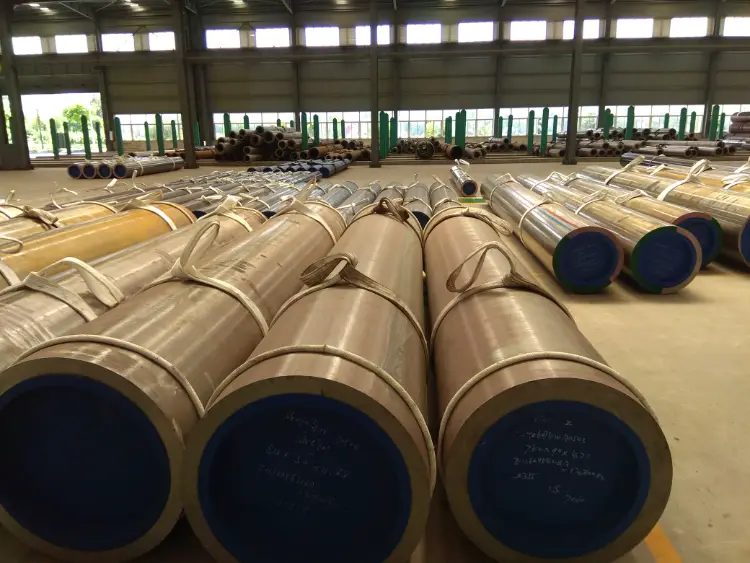
GB/T 9711-2011 PSL2 L320 LSAW Pipe
GB/T 9711-2011 PSL2 L320 LSAW Pipe Material Data and Equivalents
Comprehensive material analysis of GB/T 9711-2011 PSL2 L320 longitudinal submerged arc welded (LSAW) steel pipe for oil and gas pipelines, including chemical composition, mechanical and physical properties, international equivalents, and application guidance.
Hot rolling, TMCP, normalizing; LSAW welding (longitudinal submerged arc welding); cold expansion (optional).
- Phone : +8618037372205
- Email : [email protected]
- WhatsApp: Contact via Whtsapp
- WeChat: +8618037372205
GB/T 9711-2011 PSL2 L320 LSAW Pipe Introduction
GB/T 9711-2011 PSL2 L320 is a Chinese standard line pipe steel grade for longitudinal submerged arc welded (LSAW) pipes used in the petroleum and natural gas industries. It is equivalent to API 5L X46 PSL2 and ISO 3183 L320.
L320 belongs to the PSL2 (Product Specification Level 2) category, which imposes stricter requirements on chemical composition, mechanical properties, non-destructive testing, and toughness compared to PSL1.
Key features: minimum yield strength of 320 MPa, good weldability, excellent low-temperature toughness, and suitability for sour service when specified. The LSAW manufacturing process produces large-diameter, thick-wall pipes with high dimensional accuracy, ideal for high-pressure transmission pipelines and structural applications.
GB/T 9711-2011 PSL2 L320 LSAW Pipe Chemical Composition
Maximum limits for PSL2 L320 as per GB/T 9711-2011 (Table A.1). The actual ladle analysis is controlled by the manufacturer to meet mechanical properties and carbon equivalent requirements. Fine grain practice with additions of Nb, V, Ti is mandatory.
| Chemical Element | Standard Value | Remark |
|---|---|---|
| C | ≤0.22 | max |
| Si | Not specified (typically 0.15-0.35) | For killed steel |
| Mn | ≤1.40 | max |
| P | ≤0.025 | max |
| S | ≤0.015 | max |
| V | ≤0.10 | max |
| Nb | ≤0.05 | max |
| Ti | ≤0.04 | max |
| Ni | ≤0.30 | max |
| Cr | ≤0.30 | max |
| Mo | ≤0.15 | max |
| Cu | ≤0.50 | max |
| Al (total) | ≤0.06 | max |
| N | ≤0.012 | max |
GB/T 9711-2011 PSL2 L320 LSAW Pipe Thermal and Electrical Physical Properties
These values are not specified in GB/T 9711-2011 and are typical for low‑carbon L320 (X46) line pipe steel. They serve as engineering reference and may vary slightly with actual composition and processing.
| Property | Typical Value | Unit | Test Condition |
|---|---|---|---|
| Density (ρ) | 7.85 | g/cm³ | 20 °C |
| Elastic Modulus (E) | 205 | GPa | 20 °C |
| Shear Modulus (G) | 79 | GPa | 20 °C |
| Poisson's Ratio (ν) | 0.30 | — | 20 °C |
| Thermal Expansion (α) | 11.7 | 10⁻⁶/°C | 20–300 °C |
| Thermal Conductivity (λ) | 51.9 | W/(m·K) | 20 °C |
| Specific Heat Capacity | 486 | J/(kg·K) | 20 °C |
| Electrical Resistivity (ρₑ) | 0.17 | µΩ·m | 20 °C |
GB/T 9711-2011 PSL2 L320 LSAW Pipe Mechanical Properties
Tensile and impact properties for PSL2 L320 pipe body and weld, tested at room temperature unless otherwise specified. Transverse specimens are taken from the pipe (base metal) or across the weld. Minimum values are given; actual results often exceed these due to TMCP processing.
| Property | Standard Requirement | Unit | Test Condition |
|---|---|---|---|
| Yield Strength (ReH) | 320 – 525 | MPa | Transverse, pipe body |
| Tensile Strength (Rm) | 435 – 655 | MPa | Transverse, pipe body |
| Elongation (A) | ≥22 | % | Gauge length 50 mm, transverse, pipe body |
| Yield to Tensile Ratio | ≤0.93 (for strain-based design if required) | — | By agreement |
| Weld Tensile Strength | ≥435 | MPa | Transverse to weld |
| Charpy Impact (KV) | ≥27 avg / ≥20 single | J | Transverse, at 0°C (typical; temperature by agreement) |
| Guided Bend Test (weld) | No crack >3 mm | — | Face and back bends, 180° around specified mandrel |
GB/T 9711-2011 PSL2 L320 LSAW Pipe Completely Equivalent Material Standards and Substitute Grades
| Country/Region | Standard | Grade | Remark |
|---|---|---|---|
| International | ISO 3183:2007 / ISO 3183:2012 | L320 PSL2 | Identical to GB/T 9711-2011 |
| USA | API Spec 5L (46th Edition) | X46 PSL2 | Equivalent line pipe grade |
| Europe | EN 10208-2:2009 | L320 | Seamless/welded line pipe |
| Norway | DNV-OS-F101 | Grade 320 | Offshore pipeline systems |
GB/T 9711-2011 PSL2 L320 LSAW Pipe Application Introduction
L320 LSAW pipe is extensively used in the oil and gas sector for high‑pressure transmission lines, both onshore and offshore. Its PSL2 qualification ensures high integrity and toughness, enabling use in challenging environments including low‑temperature and mildly sour service.
Product Applications: Long‑distance transmission pipelines, Flowlines and gathering lines, Water injection lines, Offshore risers and J‑tubes, Piling pipes and structural tubulars
Processed into products: Line pipe segments (straight and transition pieces), Hot induction bends (factory‑made), Tees, reducers, and caps, Flanges and weld‑neck connections, Pipeline repair sleeves and pups
Application industries: Oil & Gas Exploration and Production, Pipeline Transport (onshore/offshore), Water Supply and Sewage, Structural and Civil Engineering, Offshore Platforms and Subsea Systems
GB/T 9711-2011 PSL2 L320 LSAW Pipe Similar or Nearby Substitute Materials
| Country/Region | Standard | Grade | Remark |
|---|---|---|---|
| International | ISO 3183 | L290 (X42) PSL2 | Lower yield (≥290 MPa); suitable for less demanding service |
| International | ISO 3183 | L360 (X52) PSL2 | Higher yield (≥360 MPa); may require downgauging or alternative design |
| USA | ASTM A572/A572M | Grade 50 (Type 1) | Structural steel with 345 MPa yield; not designed for pipeline sour service |
| Europe | EN 10025-4 | S355ML | Thermo-mechanical rolled, similar strength but for structural/offshore use |
Notes:
PSL2 additional requirements: Carbon equivalent (CE) limits apply (CE IIW ≤0.43 or CE Pcm ≤0.25 typically), depending on product analysis and wall thickness. Mandatory non‑destructive testing (NDE) of the weld and full‑body hydrostatic test are required. For sour service, supplementary hydrogen‑induced cracking (HIC) and sulfide stress cracking (SSC) tests may be imposed. The user should specify desired temperature for Charpy tests and any special coating or lining requirements.
- Share



