
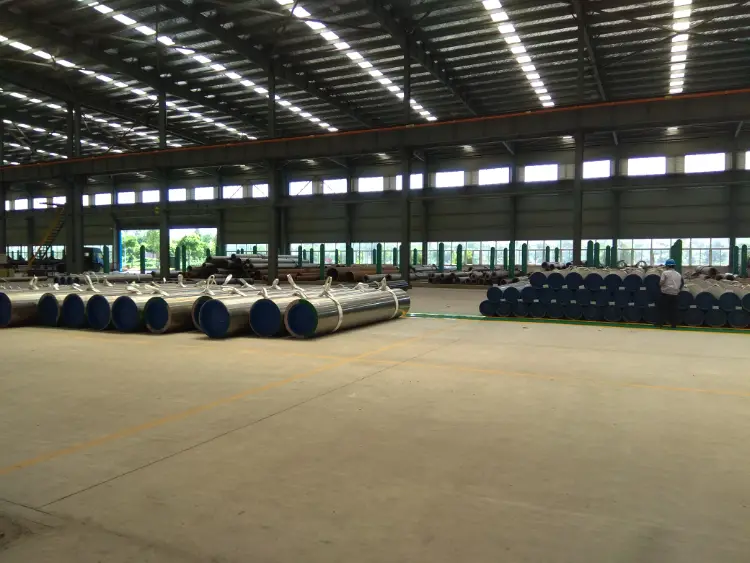
GB/T 9711-2011 PSL2 L290 LSAW Pipe
GB/T 9711-2011 PSL2 L290 LSAW Pipe: High-Strength Pipeline Steel for Oil & Gas Transmission
Comprehensive material data for L290 PSL2 steel for LSAW line pipes according to GB/T 9711-2011, including chemical composition, mechanical and physical properties, equivalent grades, and application guidance.
Welding (LSAW, spiral), hot rolling, cold forming, normalizing, quenching and tempering (optional)
- Phone : +8618037372205
- Email : [email protected]
- WhatsApp: Contact via Whtsapp
- WeChat: +8618037372205
GB/T 9711-2011 PSL2 L290 LSAW Pipe Introduction
L290 is a low-alloy high-strength steel grade specified in GB/T 9711-2011 (equivalent to ISO 3183:2012) for longitudinally submerged arc welded (LSAW) line pipes used in oil and gas transmission pipelines. Classified under PSL2, it offers enhanced toughness and stricter quality requirements compared to PSL1. The grade features a minimum yield strength of 290 MPa and excellent weldability, making it suitable for high-pressure onshore and offshore pipeline systems. It is typically supplied in normalized or as-rolled condition with detailed inspection and testing.
GB/T 9711-2011 PSL2 L290 LSAW Pipe Chemical Composition
Chemical composition limits for L290 PSL2 steel according to GB/T 9711-2011. The values are based on heat analysis. Maximum limits for C, Mn, P, S, and other elements ensure good weldability and toughness. Microalloying elements (Nb, V, Ti) may be added to refine grain size and improve strength.
| Element | Required Value (max, %) | Remarks |
|---|---|---|
| Carbon (C) | 0.22 | Maximum for PSL2; lower carbon improves weldability |
| Silicon (Si) | 0.45 | Maximum |
| Manganese (Mn) | 1.20 | Maximum |
| Phosphorus (P) | 0.025 | Maximum, typical for low-sulfur, low-phosphorus clean steel |
| Sulfur (S) | 0.015 | Maximum |
| Niobium (Nb) | 0.05 | Optional microalloy; maximum allowed |
| Vanadium (V) | 0.10 | Optional microalloy; maximum allowed |
| Titanium (Ti) | 0.04 | Optional microalloy; maximum allowed |
| Aluminum (Al) | 0.015 - 0.060 | Total aluminum; for grain refinement |
| Nitrogen (N) | 0.012 | Maximum unless microalloyed |
| Copper (Cu) | 0.50 | Maximum, if added for corrosion resistance |
| Chromium (Cr) | 0.30 | Maximum, residual or intentional |
| Nickel (Ni) | 0.30 | Maximum, residual or intentional |
| Molybdenum (Mo) | 0.15 | Maximum, residual or intentional |
| Calcium (Ca) | Inclusion shape control required for PSL2 | Optional for sulfide shape control |
GB/T 9711-2011 PSL2 L290 LSAW Pipe Thermal and Electrical Physical Properties
Physical properties for L290 grade as typical low-carbon low-alloy steel. Data are based on general engineering references and may vary slightly with specific manufacturing. Density, elastic modulus, and thermal expansion are essential for design of pipeline systems. Electrical resistivity is given for cathodic protection considerations.
| Property | Typical Value | Unit | Test Condition / Remarks |
|---|---|---|---|
| Density (ρ) | 7850 | kg/m³ | At 20°C |
| Elastic Modulus (E) | 205 - 210 | GPa | At 20°C, static tensile test |
| Shear Modulus (G) | 79 - 81 | GPa | Estimated from E and ν, ~E/[2(1+ν)] |
| Poisson's Ratio (ν) | 0.29 - 0.30 | - | Typical for carbon steels |
| Thermal Expansion Coefficient (α) | 11.7 - 12.5 | 10⁻⁶/K | 20–100°C range; typical value 12.0 |
| Thermal Conductivity (λ) | 45 - 52 | W/(m·K) | At 20°C; decreases with temperature |
| Specific Heat Capacity | 460 - 500 | J/(kg·K) | At 20°C |
| Electrical Resistivity (ρ_e) | 0.15 - 0.25 | μΩ·m | At 20°C; used for cathodic protection design |
GB/T 9711-2011 PSL2 L290 LSAW Pipe Mechanical Properties
Mechanical properties are determined on the pipe body (transverse direction) according to GB/T 9711-2011. Values include tensile testing, Charpy V-notch impact tests at specified temperatures, and guided bend tests for welds. The yield strength range is 290–495 MPa, and the tensile strength range is 415–760 MPa. Impact energy requirements depend on pipe diameter and wall thickness. Multiple conditions (e.g., temperature) are shown when standard specifies different values.
| Property | Required Value | Unit | Test Condition |
|---|---|---|---|
| Yield Strength (ReH) | 290 - 495 | MPa | Transverse, pipe body, 0.5% total extension under load |
| Tensile Strength (Rm) | 415 - 760 | MPa | Transverse, pipe body |
| Elongation (A) | ≥ 22 | % | Gauge length 50 mm (or calculated via formula for other gauge lengths); transverse specimen |
| Yield to Tensile Ratio (ReH/Rm) | ≤ 0.93 | - | Required for PSL2 to ensure ductile behavior |
| Bend Test (Weld Seam) | No cracks ≥ 3 mm in any direction | - | Guided bend test on weld, 180° bend angle, former diameter per standard |
| Charpy V-notch Impact Energy (KV2) | Minimum average: ≥ 27 J (single: ≥ 20 J) | J | Transverse, pipe body, at -20°C (or as agreed for lower temperatures) |
| Charpy V-notch Impact Energy (Heat-affected Zone) | Minimum average: ≥ 27 J (single: ≥ 20 J) | J | Transverse, weld HAZ, at -20°C as typical requirement |
| Hardness (HV10) | ≤ 300 (pipe body), ≤ 325 (HAZ) | HV | Vickers hardness; applicable for sour service if specified |
GB/T 9711-2011 PSL2 L290 LSAW Pipe Completely Equivalent Material Standards and Substitutable Grades
| Country/Region | Standard | Grade | Remarks |
|---|---|---|---|
| International | ISO 3183:2012 | L290 | Identical technical requirements, PSL2 |
| USA | API 5L (46th Ed.) | X42 | API 5L X42 PSL2 is the direct equivalent for line pipe |
| European Union | EN 10208-2 | L290 | European standard for steel pipes for pipelines; equivalent grade |
GB/T 9711-2011 PSL2 L290 LSAW Pipe Application Introduction
L290 PSL2 LSAW pipes are engineered for high-pressure oil and gas transmission where strength, toughness, and weld integrity are critical. PSL2 requirements include mandatory Charpy impact testing, chemical composition restrictions, and hydrostatic testing. Typical applications span onshore and offshore pipelines, gathering lines, and station piping. The material is well-suited for sour service when hardness limits are applied, and for low-temperature environments using appropriate impact test temperatures.
Product Applications: Long-distance cross-country pipelines, Subsea flowlines and risers, Gas gathering systems, Compressor station piping, High-pressure transmission mains
Processed into products: Mainline pipe sections (LSAW joints), Fittings (tee, elbow, reducer) compatible with L290, Flanges and connectors (if fabricated from same grade), Casing and tubular structures for offshore platforms, Reinforcement pads and support rings
Application industries: Oil & Gas Upstream (exploration and production), Midstream (pipeline transportation), Petrochemical plants, Power generation (fuel gas lines), Water/wastewater (high-pressure transmission)
GB/T 9711-2011 PSL2 L290 LSAW Pipe Similar or Alternative Material Recommendations
| Country/Region | Standard | Grade | Remarks |
|---|---|---|---|
| China | GB/T 9711-2011 | L245 | Lower strength grade (yield 245 MPa) for less demanding applications |
| USA | API 5L | X46 | Higher strength (yield ~317 MPa), may substitute if design allows |
| USA | ASTM A572 / A709 | Grade 42 | Structural quality similar to X42 but with different chemistry; not for line pipe unless agreed |
| International | ISO 3183 | L290 (PSL1) | PSL1 version with less testing; may be considered for non-critical applications |
Notes:
PSL2 additional requirements: Compared to PSL1, L290 PSL2 mandates fracture toughness testing (CVN), hardness limits (when specified for sour service), limits on CEV (carbon equivalent value typically ≤ 0.43% for thickness ≤ 25 mm), and stricter control of sulfide inclusions. The pipe must be 100% hydrostatically tested. For LSAW pipes, weld metal and HAZ properties must meet the same toughness requirements as the base metal. Non-destructive testing (UT/RT) of the weld seam is performed per standard. When ordering, the purchaser should specify service conditions (sour, low temperature, etc.) to ensure the appropriate supplementary requirements are invoked.
- Share



