
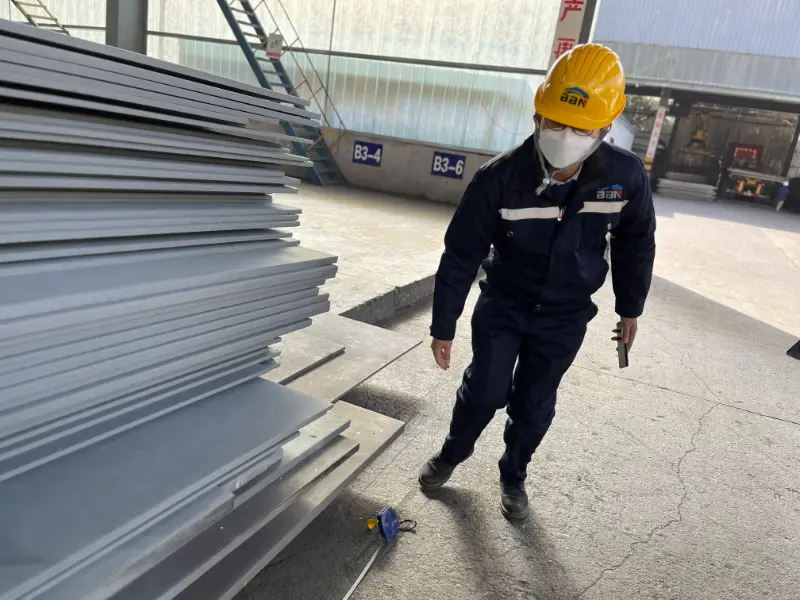
UNS S43035 (439) Ferritic Stainless Steel Plate & Coil
UNS S43035 (439) Ferritic Stainless Steel Plate & Coil: High-Temperature Oxidation Resistance and Weldability
In-depth technical data for 439 (S43035) ferritic stainless steel in plate and coil form. Includes chemical composition, mechanical and physical properties per ASTM A240, and international equivalents.
Cold forming, bending, stamping, deep drawing, welding (common methods), machining (slightly gummy), annealing
- Phone : +8618037372205
- Email : [email protected]
- WhatsApp: Contact via Whtsapp
- WeChat: +8618037372205
UNS S43035 Ferritic Stainless Steel Plate & Coil Introduction
UNS S43035, commonly known as Grade 439, is a titanium-stabilized ferritic stainless steel designed for improved weldability and resistance to intergranular corrosion in the as-welded condition. It contains 17-19% chromium and a controlled addition of titanium to stabilize carbon and nitrogen, preventing sensitization. This grade offers a good combination of strength, ductility, and oxidation resistance up to approximately 900°C (1650°F). 439 is widely used in automotive exhaust systems, heat exchangers, and formed components where moderate corrosion resistance and high-temperature oxidation resistance are required. It exhibits magnetic properties typical of ferritic stainless steels.
UNS S43035 Ferritic Stainless Steel Plate & Coil Chemical Composition
The chemical composition conforms to the requirements for UNS S43035 (Grade 439) per ASTM A240. Titanium is present as a stabilizing element with a minimum content defined by 0.20+4(C+N) to neutralize the harmful effects of carbon and nitrogen on intergranular corrosion.
- Titanium stabilization ensures excellent resistance to sensitization during welding.
- Low carbon and nitrogen levels (<0.03%) further enhance ductility and corrosion resistance.
| Element | Standard Value (wt%) | Remarks |
|---|---|---|
| Carbon (C) | ≤ 0.03 | Max |
| Manganese (Mn) | ≤ 1.00 | Max |
| Phosphorus (P) | ≤ 0.040 | Max |
| Sulfur (S) | ≤ 0.030 | Max |
| Silicon (Si) | ≤ 1.00 | Max |
| Chromium (Cr) | 17.0 - 19.0 | Nominal 18% |
| Nickel (Ni) | ≤ 0.50 | Max (residual) |
| Nitrogen (N) | ≤ 0.030 | Max |
| Titanium (Ti) | 0.20+4(C+N) min, 0.75 max | Stabilizing addition |
UNS S43035 Ferritic Stainless Steel Plate & Coil Physical Properties
Physical properties are representative for annealed Grade 439 ferritic stainless steel. These values are influenced by temperature and microstructure.
- Thermal conductivity is higher than austenitic grades, aiding heat transfer applications.
- Coefficient of thermal expansion is lower than austenitic stainless steels, reducing thermal stresses.
- Magnetic permeability is high, making the alloy ferromagnetic at all temperatures.
| Property | Typical Value | Unit | Conditions / Temperature |
|---|---|---|---|
| Density (ρ) | 7.70 | g/cm³ | 20°C (68°F) |
| Modulus of Elasticity (E) | 200 | GPa | 20°C |
| Shear Modulus (G) | 77 | GPa | Calculated |
| Poisson's Ratio (ν) | 0.27 | – | Room temperature |
| Thermal Expansion Coeff. (α) | 10.6 | 10⁻⁶/K | 20–100°C |
| Thermal Conductivity (λ) | 25.0 | W/m·K | 100°C |
| Specific Heat Capacity (cp) | 460 | J/kg·K | 20°C |
| Electrical Resistivity (ρe) | 0.60 | μΩ·m | 20°C |
UNS S43035 Ferritic Stainless Steel Plate & Coil Mechanical Properties
The following mechanical properties are minimum values for annealed plate, sheet, and strip specified in ASTM A240 for Grade 439. Actual values depend on product thickness and processing.
- Yield strength is defined by 0.2% offset (proof strength).
- For thin gauge material (< approx. 1.27 mm), elongation may be slightly lower but still conforms to standard.
- Hardness is typically 89 HRB max or 200 HBW max.
| Property | Required Value | Unit | Test Condition |
|---|---|---|---|
| Tensile Strength (Rm) | ≥ 450 (65) | MPa (ksi) | Ambient temperature, longitudinal specimen |
| Yield Strength (Rp0.2) | ≥ 205 (30) | MPa (ksi) | Ambient temperature, 0.2% offset |
| Elongation (A) | ≥ 22 | % | 50 mm (2 in.) gauge length |
| Hardness | ≤ 89 HRB (or ≤ 200 HBW) | HRB / HBW | Annealed condition |
| Bend Test | 180° bend, d=2a (t ≤ 1.27 mm) or d=2.5a (t > 1.27 mm) | – | Cold bending, no cracking |
UNS S43035 Ferritic Stainless Steel Plate & Coil Exact Equivalent Material Standards and Substitute Grades
| Country/Region | Standard | Grade | Remarks |
|---|---|---|---|
| USA / International | ASTM A240/A240M | 439 (UNS S43035) | Reference grade |
| Europe | EN 10088-2 | 1.4510 (X3CrTi17) | Chemical and performance equivalent; minor Cr range 16.0-18.0 |
| Japan | JIS G4304 | SUS430LX | Titanium-stabilized 17%Cr steel |
| China | GB/T 3280 | 019Cr17Ti (S11803? or Y10Cr17Ti?) – 022Cr17Ti | Comparable stabilized ferritic; verify exact Ti content |
UNS S43035 Ferritic Stainless Steel Plate & Coil Application Introduction
Grade 439 combines titanium stabilization with 18% chromium, making it the standard choice for fabricated weldments exposed to moderate corrosion and high-temperature oxidation. It is not hardenable by heat treatment and is typically used in the annealed condition.
Product Applications: Exhaust manifold and muffler components, Round and oval tubing for exhaust systems, Stamped heat shields, Coated or uncoated automotive trim, Flatware and kitchen sinks (as a lower-cost alternative to 304)
Processed into products: Exhaust flanges, pipes, and tailpipes, Catalytic converter cans, Heat exchanger baffles and plates, Deep-drawn cooking utensils, Brackets and structural supports for high-temperature environments
Application industries: Automotive (exhaust systems, mufflers, catalytic converter shells, tubing), Heat exchangers and boilers (low-pressure side), White goods (washing machine drums, oven liners), Industrial ventilation and architectural metalwork, Food processing equipment (non-severe conditions)
UNS S43035 Ferritic Stainless Steel Plate & Coil Similar or Alternative Ferritic Stainless Steel Grades
| Country/Region | Standard | Grade | Remarks |
|---|---|---|---|
| USA | ASTM A240 | 409 (S40900) | Ti-stabilized, 11%Cr; lower oxidation resistance, widely used in exhaust systems |
| USA | ASTM A240 | 430 (S43000) | Non-stabilized 17%Cr; can be sensitized after welding, lower weldability |
| USA/Europe | ASTM A240 / EN 10088-2 | 441 (S44100) / 1.4509 | Nb-stabilized, 18%Cr with Nb; similar oxidation resistance, improved creep strength |
| USA | ASTM A240 | 444 (S44400) | Mo-alloyed (1.8%Mo) ferritic for higher pitting resistance |
| Europe | EN 10088-2 | 1.4521 (X2CrMoTi18-2) | Similar Mo-bearing stabilized grade for more aggressive environments |
Notes:
- Welding: Grade 439 can be welded using typical fusion methods (GTAW, GMAW, resistance welding) with matching or slightly over-alloyed filler (e.g., ER430Ti, ER430). Post-weld heat treatment is usually not required for corrosion resistance due to Ti stabilization.
- Surface finish: Available in 2B, 2D, BA, polished finishes; standard sheet/plate finishes per ASTM A480.
- Heat treatment: Anneal at 790–850°C (1450–1560°F) followed by rapid air or water cooling. Soaking time depends on thickness.
- Deep drawing: Because the alloy is ferritic, it may wrinkle; proper blankholder pressure and lubrication are essential.
- Magnetic: The alloy is strongly ferromagnetic at all temperatures, similar to standard 430.
- Share



