
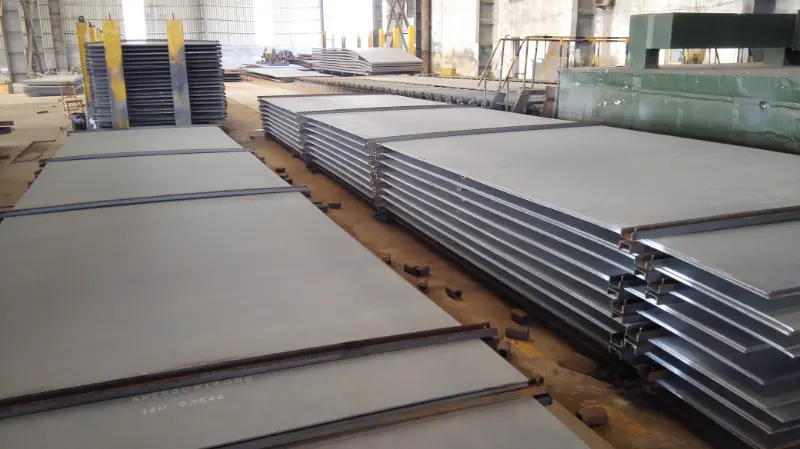
434 (S43400) Ferritic Stainless Steel
434 (S43400) Ferritic Stainless Steel: Corrosion-Resistant Plate & Coil for Exhaust & Heat Exchanger Applications
Explore 434 (S43400) ferritic stainless steel, a molybdenum-enhanced grade with improved pitting resistance. Ideal for automotive exhaust, heat exchangers, and chemical processing.
Hot rolling, cold rolling, annealing, pickling, skin passing, slitting, cut-to-length
- Phone : +8618037372205
- Email : [email protected]
- WhatsApp: Contact via Whtsapp
- WeChat: +8618037372205
434 Ferritic Stainless Steel Introduction
434 stainless steel (UNS S43400) is a ferritic chromium-molybdenum stainless steel designed for enhanced corrosion resistance in mildly corrosive environments. The addition of 0.75–1.25 % molybdenum significantly improves pitting and crevice corrosion resistance compared to standard 430 grade, while maintaining good formability, weldability, and oxidation resistance up to 815 °C (1500 °F). It offers high thermal conductivity and a low thermal expansion coefficient, making it suitable for cyclic heating applications.
- Excellent resistance to chloride-containing media and automotive exhaust condensates
- Good mechanical strength and ductility in the annealed condition
- Non-hardenable by heat treatment; supplied in annealed or skin-passed finish
- Available as plate and coil for stamping, deep drawing, and roll forming
434 Ferritic Stainless Steel Chemical Composition of 434 Stainless Steel per ASTM A240
The chemical composition of S43400 is balanced to provide ferritic microstructure with improved corrosion resistance through molybdenum addition. Maximum limits are shown unless a range is indicated. Note: Residual elements such as nickel and nitrogen are not specifically restricted by ASTM A240 for this grade but are typically kept low to maintain a stable ferritic microstructure.
| Element | Standard Value (max or range) | Remarks |
|---|---|---|
| Carbon (C) | 0.12 max | Lower carbon enhances weldability |
| Manganese (Mn) | 1.00 max | Deoxidizer and strength contributor |
| Silicon (Si) | 1.00 max | Deoxidizer; may be adjusted for specific finishes |
| Phosphorus (P) | 0.040 max | Impurity; kept low for ductility |
| Sulfur (S) | 0.030 max | Added in free-machining variants; normally low |
| Chromium (Cr) | 16.0 – 18.0 | Primary element for corrosion and oxidation resistance |
| Molybdenum (Mo) | 0.75 – 1.25 | Enhances pitting resistance, especially in chloride environments |
434 Ferritic Stainless Steel Physical Properties of 434 Stainless Steel
The thermal and electrical properties provided below represent typical values for annealed 434 stainless steel and may vary slightly depending on heat treatment, product form, and test methodology. These data are widely accepted for engineering calculations.
- Density at room temperature
- Elastic moduli at 20 °C
- Thermal expansion covering common service temperature ranges
- Thermal conductivity data at elevated temperatures
| Property | Typical Value | Unit | Test Condition / Temperature |
|---|---|---|---|
| Density (ρ) | 7.74 | g/cm³ | 20 °C |
| Elastic Modulus (E) | 200 | GPa | 20 °C |
| Shear Modulus (G) | 77 | GPa | 20 °C (calculated) |
| Poisson's Ratio (ν) | 0.28 | – | 20 °C |
| Thermal Expansion Coefficient (α) | 10.4 | µm/m·°C | 20–100 °C |
| Thermal Expansion Coefficient (α) | 11.0 | µm/m·°C | 20–300 °C |
| Thermal Expansion Coefficient (α) | 11.6 | µm/m·°C | 20–500 °C |
| Thermal Conductivity (λ) | 26.1 | W/m·K | 100 °C |
| Thermal Conductivity (λ) | 26.8 | W/m·K | 300 °C |
| Thermal Conductivity (λ) | 27.5 | W/m·K | 500 °C |
| Specific Heat Capacity (cp) | 460 | J/kg·K | 20 °C |
| Electrical Resistivity (ρe) | 0.60 | µΩ·m | 20 °C |
434 Ferritic Stainless Steel Mechanical Properties of 434 Stainless Steel
The following mechanical properties represent the minimum requirements for annealed plate, sheet, and strip per ASTM A240. Different thickness ranges and product forms may have slightly adjusted requirements, but the values below are the most commonly referenced.
- Yield strength measured at 0.2% offset
- Elongation gauge length: 50 mm (or 2 in) for thicknesses ≥ 0.065 in (ASTM A480)
- Hardness values are typical maximum; actual may be lower after full annealing
- Bend test: 180° bend around diameter equal to specimen thickness (D = 1t) without cracks
| Property | Standard Required Value | Unit | Test Condition |
|---|---|---|---|
| Yield Strength (ReH, 0.2% offset) | 310 min | MPa | Room temperature, annealed |
| Tensile Strength (Rm) | 450 min | MPa | Room temperature, annealed |
| Elongation (A) | 22 min | % | In 50 mm, annealed |
| Hardness (Rockwell B) | 89 max | HRB | Annealed |
| Hardness (Brinell) | 207 max | HBW | Annealed |
| Bend Test | 180° without cracks; D = 1t | – | Room temperature, annealed |
434 Ferritic Stainless Steel International Equivalents to 434 Stainless Steel
| Country / Region | Standard | Designation / Grade | Remarks |
|---|---|---|---|
| United States | ASTM A240/A240M | 434 (UNS S43400) | Original specification; plate, sheet, strip |
| Europe | EN 10088-2 | 1.4113 – X6CrMo17-1 | Identical chemistry and application range |
| Japan | JIS G4304/G4305 | SUS434 | Direct equivalent; widely used in automotive exhaust systems |
| China | GB/T 3280 | S11770 (similar) | May have slight tolerance variations; check Cr and Mo ranges |
434 Ferritic Stainless Steel Application Introduction
434 stainless steel's combination of moderate corrosion resistance, good formability, weldability, and cost-effectiveness makes it a versatile choice for many industrial and consumer products. It excels in mildly corrosive environments that may cause pitting in non-Mo grades like 430.
- Automotive exhaust components exposed to condensates and road salts
- Heat exchangers where chloride-containing water or steam is present
- Chemical processing equipment handling organic acids and mild chlorides
- Food processing equipment that requires periodic cleaning with chlorinated detergents
Product Applications: Exhaust mufflers, catalytic converter shells, and exhaust pipes, Shell-and-tube heat exchangers, condenser tubes, Hot water storage tanks, Commercial kitchen sinks and countertops, Evaporative cooling pads and brine tanks, Flue pipes and chimney liners
Processed into products: Automotive exhaust tubing, flanges, and hangers, Heat exchanger baffles, tube sheets, and U-bend tubes, Pressed or deep-drawn sinks, bowls, and trays, Welded brackets, mounts, and structural clips, Roll-formed channels and profiles, Solar collector absorber plates and casings
Application industries: Automotive (exhaust and emission control), Heat exchanger and boiler manufacturing, Chemical and petrochemical processing, Appliance and kitchenware, Solar thermal energy, Building and construction (decorative trim, flue liners)
434 Ferritic Stainless Steel Similar Stainless Steel Grades with Comparable Performance
| Country / Region | Standard | Designation / Grade | Comparison and Notes |
|---|---|---|---|
| United States | ASTM A240 | 430 (S43000) | Base ferritic grade without molybdenum. Lower corrosion resistance, particularly against chlorides, but lower cost. Suitable for indoor or mild atmospheric exposure. |
| United States / Europe | ASTM A240 / EN 10088-2 | 436 (S43600) / 1.4526 | Contains molybdenum and niobium/titanium stabilization. Better high-temperature strength and intergranular corrosion resistance. Often used in automotive mufflers and exhaust tubing. |
| United States / Europe | ASTM A240 / EN 10088-2 | 444 (S44400) / 1.4521 | Low-carbon, molybdenum-stabilized ferritic with superior pitting resistance (PRE≈24). Suitable for hot water tanks, heat exchangers, and aggressive condensate environments. Slightly higher cost than 434. |
| United States | ASTM A240 | 439 (S43900) | Titanium-stabilized ferritic with ~17% Cr, no Mo. Improved weldability and resistance to intergranular attack but lower overall pitting resistance than 434. Used in exhaust applications where Mo-free grade is sufficient. |
Notes:
When welding 434 stainless steel, austenitic filler metals (e.g., ER308L or ER309L) are often used to maintain ductility in the weld zone. Post-weld annealing is not always required for thin sections, but may be beneficial for stress relief in thicker components. Intergranular corrosion can occur if held too long at 450–850 °C; proper cooling after welding is recommended. Additional surface passivation can further improve pitting resistance in chloride service.
- Share



