
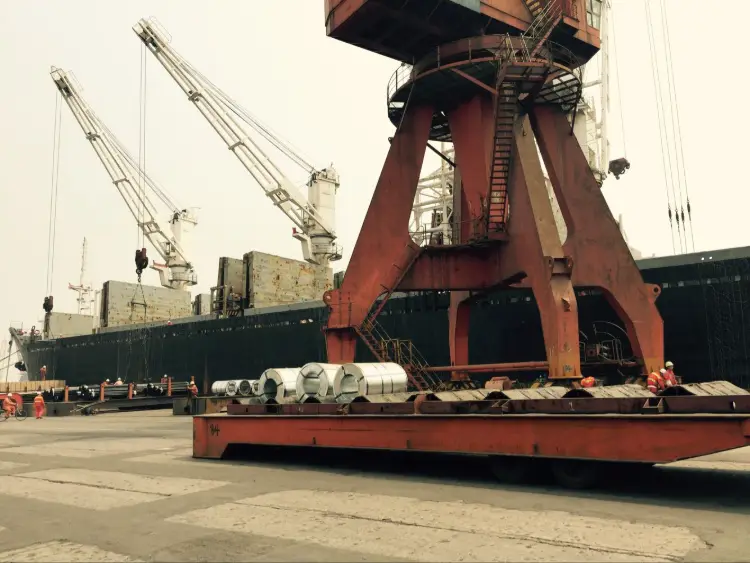
API Spec 2H Gr50 Offshore Structural Steel Coil
API Spec 2H Gr50 Offshore Structural Steel Coil | Chemical & Mechanical Properties
Comprehensive chemical, mechanical, thermal and electrical property data for API Spec 2H Grade 50 steel coil, with full international equivalents and application guide.
Welding, flame cutting, cold forming, machining, suitable for offshore fabrication
- Phone : +8618037372205
- Email : [email protected]
- WhatsApp: Contact via Whtsapp
- WeChat: +8618037372205
API Spec 2H Gr50 Offshore Structural Steel Coil Introduction
API Spec 2H Grade 50 is a carbon-manganese structural steel specifically designed for offshore platforms and marine environments. It offers a minimum yield strength of 50 ksi (345 MPa) combined with excellent toughness at low temperatures. The steel is produced with fine grain practice and fully killed, ensuring high integrity for welded structures. Typical applications include primary members of jacket platforms, semisubmersibles, and tension leg platforms. Supplementary requirements for through-thickness properties (Z35) and strict sulfur control enhance its performance against lamellar tearing.
API Spec 2H Gr50 Offshore Structural Steel Coil Chemical Composition
Ladle analysis limits according to API Spec 2H. Elements not listed are subject to agreement between purchaser and manufacturer. Residual restrictions ensure good weldability and toughness.
| Element | Standard Value (%) | Remarks |
|---|---|---|
| Carbon (C) | ≤ 0.18 | Max |
| Manganese (Mn) | 0.90 - 1.35 | For thickness ≤ 50 mm; may be adjusted for thicker gauges |
| Phosphorus (P) | ≤ 0.030 | Max |
| Sulfur (S) | ≤ 0.010 | Max; lower for Z-quality options |
| Silicon (Si) | 0.15 - 0.40 | |
| Nickel (Ni) | ≤ 0.40 | Residual |
| Chromium (Cr) | ≤ 0.25 | Residual |
| Molybdenum (Mo) | ≤ 0.08 | Residual |
| Copper (Cu) | ≤ 0.35 | Residual |
| Vanadium (V) | ≤ 0.06 | Residual, unless added intentionally |
| Niobium (Nb) | ≤ 0.05 | Residual, unless added intentionally |
| Titanium (Ti) | ≤ 0.02 | Residual, unless added intentionally |
| Aluminum (Al) | ≥ 0.020 (acid soluble) | Fine grain practice requirement |
API Spec 2H Gr50 Offshore Structural Steel Coil Thermal and Electrical Physical Properties
These properties are representative for carbon-manganese structural steels and are approximate. They are not mandatory requirements of API Spec 2H but useful for design and simulation.
| Property | Typical Value | Unit | Test Condition / Temperature |
|---|---|---|---|
| Density (ρ) | 7.85 | g/cm³ | Ambient |
| Modulus of elasticity (E) | 205 | GPa | Ambient |
| Shear modulus (G) | 80 | GPa | Ambient |
| Poisson's ratio (ν) | 0.3 | Ambient | |
| Thermal expansion coefficient (α) | 11.7 | 10⁻⁶/K | 20 - 100 °C |
| Thermal expansion coefficient (α) | 12.5 | 10⁻⁶/K | 20 - 200 °C |
| Thermal conductivity (λ) | 52 | W/(m·K) | 20 °C |
| Specific heat capacity | 500 | J/(kg·K) | 20 °C |
| Electrical resistivity (ρe) | 0.20 - 0.25 | µΩ·m | Ambient |
API Spec 2H Gr50 Offshore Structural Steel Coil Mechanical Properties
Tensile test properties as per API Spec 2H, transverse test pieces unless otherwise noted. Impact toughness values are Charpy V-notch absorbed energy at the specified temperature.
| Property | Standard Value | Unit | Test Condition / Remarks |
|---|---|---|---|
| Yield strength (ReH) | ≥ 345 (50) | MPa (ksi) | Thickness ≤ 50 mm, transverse; for thickness > 50 mm, minimum 325 MPa (47 ksi) |
| Tensile strength (Rm) | 483 - 620 (70 - 90) | MPa (ksi) | For all thicknesses |
| Elongation (A) | ≥ 21 | % | Gauge length 200 mm (8 in.), thickness ≤ 50 mm; ≥ 18% for thickness > 50 mm |
| Elongation (A) | ≥ 24 | % | Gauge length 50 mm (2 in.) typical |
| Bend test (180°) | d = 2.5a | Mandrel diameter/thickness ratio, thickness ≤ 50 mm; d = 3a for thickness > 50 mm | |
| Charpy impact (KV) | ≥ 34 (25) | J (ft·lbf) | Longitudinal specimen at -20 °C (-4 °F) or as agreed; average of three |
| Charpy impact (KV) | ≥ 20 (15) | J (ft·lbf) | Transverse specimen at -20 °C (-4 °F) or as agreed; average of three |
API Spec 2H Gr50 Offshore Structural Steel Coil Fully Equivalent Standard & Alternative Grades
| Country / Region | Standard | Grade | Remarks |
|---|---|---|---|
| International (API) | API Spec 2H | Grade 50 | Original specification for offshore structural steel |
| Europe | EN 10225 | S355G10 | Weldable structural steels for offshore structures; very similar strength and toughness |
| UK | BS 7191 | 355EMZ | Offshore structural steel with through-thickness properties |
| Norway | NORSOK M-120 | Y35 | Norwegian standard for structural offshore steel; matching chemistry and toughness |
| ISO | ISO 19902 | Grade 355 | Petroleum and natural gas industries — fixed steel platforms |
API Spec 2H Gr50 Offshore Structural Steel Coil Application Introduction
API Spec 2H Grade 50 is a workhorse material for welded offshore structures. It is suitable for primary steelwork in aggressive marine environments. The steel exhibits good weldability and can be formed and machined using standard procedures.
Key application areas:
Product Applications: Fixed offshore platforms (jacket legs, braces, conductor guides), Floating production, storage and offloading (FPSO) hull modules, Self-elevating drilling rigs (legs, spud cans), Offshore wind turbine monopiles and tripods, Semisubmersible columns and pontoons, Tension Leg Platform (TLP) tendons and nodes
Processed into products: Welded beams and girders, Built-up box columns, Tubular joints and nodes, Transition pieces for wind towers, Grillage foundation plates, Primary stiffeners and bulkhead plates
Application industries: Offshore Oil & Gas (platforms, jackets, topsides), Offshore Wind Energy (foundations, transition pieces), Shipbuilding and Marine Engineering (structural hull parts), Heavy Civil Engineering (coastal and port infrastructure)
API Spec 2H Gr50 Offshore Structural Steel Coil Similar / Approximate Alternative Grades
| Country / Region | Standard | Grade | Remarks |
|---|---|---|---|
| USA | ASTM A572 / A572M | Grade 50 | High-strength low-alloy structural steel; similar strength but less stringent impact requirements unless specified |
| USA | ASTM A131 / ABS | DH36 / EH36 | Shipbuilding steel with comparable strength and Charpy; often used in marine structures |
| International | API Spec 2W | Grade 50 | Steel for offshore platform plates produced by thermo-mechanical control process (TMCP) |
| Europe | EN 10025-3 | S460N/NL | Normalized fine grain steel; higher strength level, used as upgrade when design requires |
| China | GB 712 | EH36 | Chinese shipbuilding steel with similar yield and impact properties; commonly used in offshore construction |
Notes:
- API Spec 2H Gr50 is often ordered with supplementary requirements such as: Z35 through-thickness tensile test (S% ≤ 0.008), low temperature Charpy testing down to -40°C, and post-weld heat treatment (PWHT) simulation.
- For offshore applications, NACE MR0175/ISO 15156 compliance may be required, which limits hardness and impurity levels.
- Typical delivery condition is normalized or quench-and-tempered; TMCP is frequently offered with equivalent API Spec 2W.
- When specifying coil, the purchaser should confirm flatness and coiling temperature control to avoid excessive scale or strength variability.
- Share



