
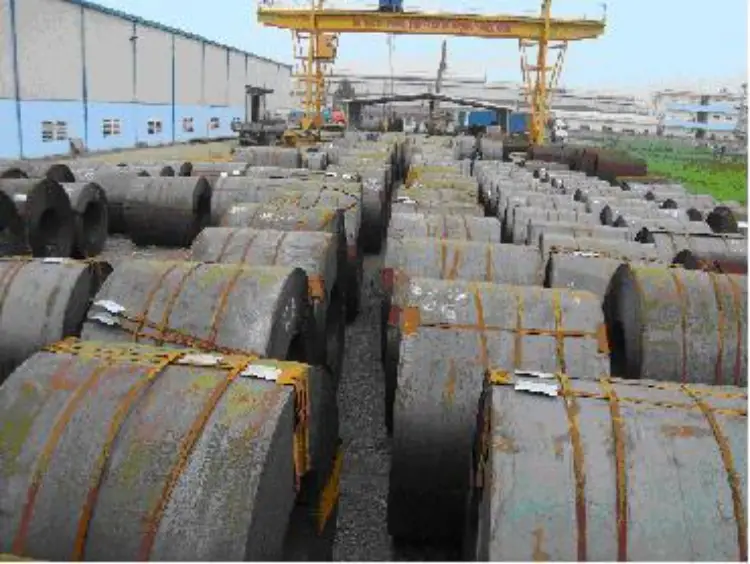
API Spec 2H Grade 42 Shipbuilding Steel Coil
API Spec 2H Grade 42 Shipbuilding Steel Coil - Offshore Structural Steel Data
Detailed material properties of API Spec 2H Grade 42 steel: chemical composition, mechanical and thermal performance, equivalent grades and applications for offshore structures.
Hot rolling, controlled rolling, normalizing, TMCP (Thermo-Mechanical Controlled Processing)
- Phone : +8618037372205
- Email : [email protected]
- WhatsApp: Contact via Whtsapp
- WeChat: +8618037372205
API Spec 2H Grade 42 Shipbuilding Steel Coil Introduction
API Spec 2H Grade 42 is a carbon-manganese steel plate specifically designed for offshore structures, providing a minimum yield strength of 42 ksi (290 MPa). It offers good weldability and notch toughness at low temperatures, typically tested at -40°F (-40°C). Manufactured through controlled rolling or normalizing, this grade is suitable for critical applications in ship hulls and mobile offshore drilling units. Its balanced composition ensures reliable performance under demanding marine environments.
API Spec 2H Grade 42 Shipbuilding Steel Coil Chemical Composition
API Spec 2H Grade 42 requires controlled levels of carbon and manganese to achieve the desired strength and toughness. Microalloying elements such as niobium and vanadium may be added for grain refinement. The phosphorus and sulfur contents are kept low to ensure weldability and ductility. Aluminum is added for deoxidation.
| Element | Value (max, unless specified) | Remarks |
|---|---|---|
| C | 0.18 | |
| Mn | 1.15 - 1.60 | |
| P | 0.025 | |
| S | 0.025 | |
| Si | 0.15 - 0.40 | |
| Ni | 0.40 | |
| Cr | 0.25 | |
| Mo | 0.08 | |
| Cu | 0.35 | |
| V | 0.05 | |
| Nb | 0.05 | |
| Al (total or acid soluble) | 0.020 min | For fine grain practice |
| CE (IIW) | 0.43 typically | Dependent on thickness, per API 2H |
API Spec 2H Grade 42 Shipbuilding Steel Coil Physical and Thermal Properties
These physical properties are generic for carbon-manganese structural steels and are provided as a practical reference. Actual values may vary slightly depending on processing history and composition. Thermal expansion and conductivity are critical for welding and design calculations in offshore environments.
| Property | Typical Value | Unit | Condition |
|---|---|---|---|
| Density (ρ) | 7.85 | kg/dm³ | Room temperature |
| Modulus of Elasticity (E) | 210 | GPa | Ambient |
| Shear Modulus (G) | 80 | GPa | Ambient |
| Poisson's Ratio (ν) | 0.3 | — | Ambient |
| Thermal Expansion Coefficient (α) | 11.5 - 13.0 | 10⁻⁶/°C | 20 – 200 °C |
| Thermal Conductivity (λ) | 48 - 52 | W/m·K | 20 °C |
| Specific Heat Capacity | 450 - 500 | J/kg·K | 20 °C |
| Electrical Resistivity (ρ_e) | 0.15 - 0.20 | μΩ·m | 20 °C |
API Spec 2H Grade 42 Shipbuilding Steel Coil Mechanical Properties
The mechanical properties of API 2H Grade 42 are validated by tensile and impact tests. All tensile tests are performed in accordance with ASTM A370. Charpy V-notch impact tests are conducted at low temperature to ensure sufficient fracture toughness for offshore service. Bend test is required for formability verification.
| Property | Value | Unit | Test Condition |
|---|---|---|---|
| Yield Strength (ReH) | 290 min (42 min) | MPa (ksi) | Transverse, 0.2% offset, plate thickness ≤ 75 mm |
| Tensile Strength (Rm) | 427 - 586 (62 - 85) | MPa (ksi) | Transverse |
| Elongation (A) | 21 min | % | 50 mm gauge length, plates ≤ 20 mm; reduced for thicker plates |
| Bend Test | 180°, d=3a (no cracking) | deg/thickness ratio | Mandrel diameter = 3 × specimen thickness (a) |
| Charpy V-notch Impact (KV) | 27 min average, 22 min individual | J | Longitudinal, -40 °C (-40 °F) |
API Spec 2H Grade 42 Shipbuilding Steel Coil Direct Equivalent Standards & Substitute Grades
Although API Spec 2H Grade 42 is a proprietary grade, similar strength and toughness requirements can be met by other international offshore structural steel standards. The table below lists the most commonly used direct or equivalent specifications that may be considered for substitution, subject to project approval.
| Country/Region | Standard | Grade | Remarks |
|---|---|---|---|
| United States | API Spec 2H | Grade 42 | Original specification; yield 290 MPa |
| United States | ASTM A572/A572M | Grade 42 | Yield 290 MPa, for structural applications; impact test optional |
| Europe | EN 10225:2009 | S355G10+M | Yield 355 MPa, TMCP; higher strength but similar applications |
| International (ABS) | ABS Rules | AH32, DH32, EH32 | Yield 315 MPa; stronger but frequently used for same offshore projects |
API Spec 2H Grade 42 Shipbuilding Steel Coil Application Introduction
API 2H Grade 42 is specifically developed for marine and offshore structures, where high strength, good weldability and low-temperature toughness are paramount. It is typically used in the construction of mobile offshore drilling units, fixed platforms, and shipbuilding. The steel can be processed by cutting, cold forming, and welding, often in thicknesses up to 75 mm.
Product Applications: Hull plates for tankers, bulk carriers, and container ships, Deck structures and bulkheads of mobile offshore drilling units (MODUs), Self-elevating platform legs and spudcans, Tubular joints and node cans for jacket structures
Processed into products: Main deck plating, Bottom and side shell plating, Longitudinal stiffeners and transverse frames, Rack chocks and pinion plates for jack-up rigs, Helicopter deck structures, Offshore wind transition pieces
Application industries: Offshore oil and gas exploration and production, Shipbuilding and marine engineering, Renewable energy (offshore wind turbine foundations), Port and harbor construction
API Spec 2H Grade 42 Shipbuilding Steel Coil Similar or Alternative Materials for Reference
In cases where API 2H Grade 42 is not available, the following grades offer comparable mechanical and toughness characteristics. Differences in yield strength, carbon equivalent, and delivery condition should be evaluated for the intended design.
| Country/Region | Standard | Grade | Remarks |
|---|---|---|---|
| United States | ASTM A131/A131M | EH32, FH32 | High strength shipbuilding steel, impact tested at -40°C, yield 315 MPa |
| Japan | JIS G3106 | SM490YA | Welded structural steel, yield 365 MPa; good low-temperature toughness |
| Europe | EN 10025-3 | S420N | Normalized fine grain steel, yield 420 MPa; suitable for offshore when toughness is critical |
| China | GB/T 712 | EH32 | Ship structural steel, yield 315 MPa; similar to ABS EH32 |
| Norway | DNV Rules | NV E32 | Certified offshore steel with -40°C impact test, yield 315 MPa |
Notes:
Welding & Fabrication: API 2H Grade 42 has a carbon equivalent (CE) typically limited to 0.43% to avoid hydrogen-induced cracking. Low-hydrogen welding procedures are recommended. Post-weld heat treatment (PWHT) may be required for thick sections per project specification. Certification: Material can be supplied with ABS, DNV, LR, or BV class certificates upon request. Thickness Range: Usually available from 6 mm to 75 mm in plate form; coil thicknesses are typically thinner (up to 25 mm).
- Share



