
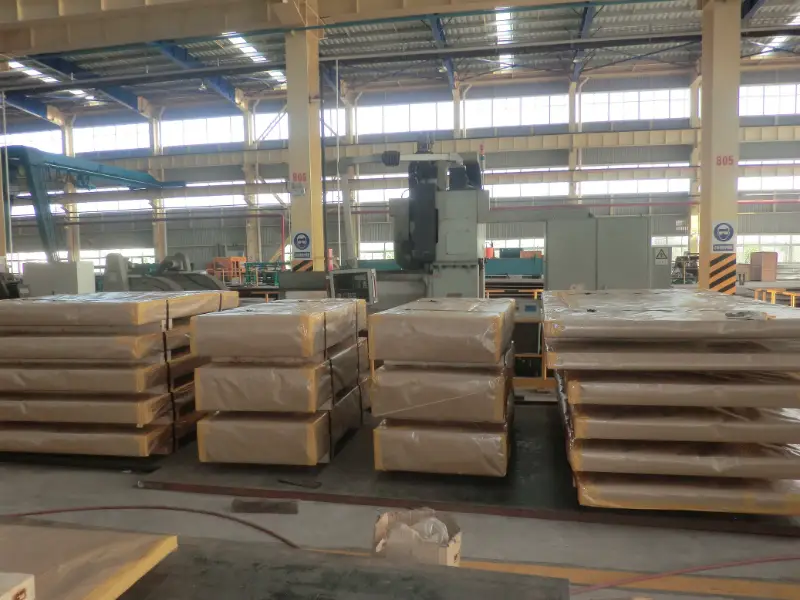
316N Stainless Steel (UNS S31651)
316N Stainless Steel (UNS S31651) - High-Strength Austenitic Plate & Coil for Corrosive Environments
Explore the properties of UNS S31651 (316N) austenitic stainless steel plate/coil: enhanced strength from nitrogen addition, excellent corrosion resistance, and key mechanical and thermal data.
Hot rolling, cold rolling, forming, machining, welding (all common methods including GTAW, GMAW, SMAW, SAW), and moderate cold working; cannot be hardened by heat treatment
- Phone : +8618037372205
- Email : [email protected]
- WhatsApp: Contact via Whtsapp
- WeChat: +8618037372205
316N Stainless Steel Introduction
UNS S31651 (316N) is a nitrogen-strengthened austenitic stainless steel derived from the classic 316 grade. The deliberate addition of nitrogen (0.10–0.16%) provides significantly higher yield and tensile strength compared to standard 316, while maintaining excellent ductility, toughness, and corrosion resistance. This material is non-magnetic in the annealed condition, offers outstanding weldability by common fusion and resistance methods, and exhibits superior resistance to pitting and crevice corrosion in chloride-containing environments. It is typically supplied as plate, sheet, and coil in the solution-annealed condition, making it ideal for demanding applications in chemical processing, marine hardware, food equipment, and pressure vessels where higher strength permits material down-gauging without compromising safety.
316N Stainless Steel Chemical Composition
The chemical composition of UNS S31651 is specified by ASTM A240/A240M. The controlled nitrogen range is essential for achieving the enhanced strength without sacrificing corrosion resistance. All values are maximum unless a range is indicated.
| Element | Standard Value | Remarks |
|---|---|---|
| Carbon (C) | 0.08 max | Promotes intergranular corrosion; kept low |
| Manganese (Mn) | 2.00 max | Deoxidizer, balances austenite stability |
| Silicon (Si) | 0.75 max | Deoxidizer, improves oxidation resistance |
| Phosphorus (P) | 0.045 max | Impurity, controlled to avoid hot cracking |
| Sulfur (S) | 0.030 max | Impurity, improves machinability but kept low for corrosion resistance |
| Chromium (Cr) | 16.0 – 18.0 | Key element for passivity and corrosion resistance |
| Nickel (Ni) | 10.0 – 14.0 | Austenite stabilizer, contributes to ductility |
| Molybdenum (Mo) | 2.00 – 3.00 | Enhances pitting/crevice corrosion resistance, especially in chlorides |
| Nitrogen (N) | 0.10 – 0.16 | Strengthens by solid-solution and grain-boundary effect; increases yield strength |
316N Stainless Steel Physical Properties
These physical properties are representative for UNS S31651 in the annealed condition at room temperature, unless otherwise indicated. Thermal properties vary with temperature; values are provided for engineering calculations.
| Property | Standard Value | Unit | Test Condition |
|---|---|---|---|
| Density (ρ) | 8.0 | g/cm³ | 20°C |
| Elastic Modulus (E) | 193 | GPa | Tension, room temperature |
| Shear Modulus (G) | 74 | GPa | Calculated from E and Poisson's ratio |
| Poisson's Ratio (ν) | 0.30 | - | Room temperature |
| Thermal Expansion Coefficient (α) | 16.0 | µm/m·°C | 20–100°C |
| Thermal Expansion Coefficient | 16.5 | µm/m·°C | 20–300°C |
| Thermal Expansion Coefficient | 17.5 | µm/m·°C | 20–500°C |
| Thermal Conductivity (λ) | 14.6 | W/m·K | 100°C |
| Thermal Conductivity | 16.2 | W/m·K | 300°C |
| Thermal Conductivity | 21.5 | W/m·K | 500°C |
| Specific Heat Capacity (cp) | 500 | J/kg·K | 0–100°C |
| Electrical Resistivity (ρe) | 0.74 | µΩ·m | 20°C |
316N Stainless Steel Mechanical Properties
The mechanical properties are as required by ASTM A240/A240M for plate/coil in the solution-annealed condition at room temperature. Actual values depend on thickness and processing but must meet or exceed these minima for the standard.
| Property | Standard Requirement (minimum) | Unit | Test Condition |
|---|---|---|---|
| Tensile Strength (Rm) | 515 | MPa | Room temperature, longitudinal or transverse |
| Yield Strength (ReH, 0.2% offset) | 205 | MPa | Room temperature, longitudinal or transverse |
| Elongation (A) | 40 | % | 50 mm gauge length (or 2 in.), depending on thickness |
| Bend Test | No cracks | - | Bend angle 180°, diameter of bend = thickness of specimen (t) for plates up to 19 mm; for details refer to A240 |
| Hardness | 95 HRB max / 217 HBW max | - | Rockwell B or Brinell; values typical for soft austenitic condition |
| Impact Toughness (KV) | Not required by A240; typically high (> 100 J at -196°C) | J | Charpy V-notch at cryogenic temperatures – for reference only |
316N Stainless Steel Complete Equivalent Material Standards and Substitutable Grades
| Country/Region | Standard | Grade | Remarks |
|---|---|---|---|
| USA | ASTM A240/A240M | 316N (UNS S31651) | Original designation; for plate/sheet/coil |
| Japan | JIS G4304 | SUS 316N | Carbon ≤0.08, N 0.10-0.22; closely match |
| China | GB/T 20878-2007 / GB/T 3280-2015 | 06Cr17Ni12Mo2N (S31658) | New Chinese designation; similar chemical boundaries |
| Europe | EN 10088-2 | 1.4406 (X5CrNiMo17-12-2N) | N content 0.10-0.22, C ≤0.07; approximate equivalent, check exact spec for complete interchangeability |
| International | ISO 15510 | X5CrNiMo17-12-2 | ISO covers this composition with N range 0.10-0.22; can be considered equivalent |
316N Stainless Steel Application Introduction
316N combines high strength with excellent corrosion resistance, making it a preferred material for applications where thinner gauge plates reduce weight and cost while maintaining structural integrity. It performs reliably in a wide range of acidic and chloride-bearing environments up to approximately 400°C.
Product Applications: Pressure vessels and storage tanks, Heat exchangers and condenser tubing, Piping systems and flanges, Valve bodies and pump casings, Food and dairy processing machinery, Surgical and laboratory equipment, Offshore structural grating and walkways, Brewing and fermentation tanks
Processed into products: Reactor shells and heads, Tube sheets and baffles, Flanges, gaskets, and bolting assemblies, Pump shafts and impellers, Mixer paddles, Chiller plates, Seawater-handling strainers, Column trays and packings, Hygienic pipe fittings (couplings, tees, reducers)
Application industries: Chemical and Petrochemical Processing, Oil and Gas (offshore platforms, piping systems), Marine Engineering (propeller shafts, boat fittings), Pharmaceutical and Food Processing Equipment, Power Generation (heat exchangers, condensers), Desalination Plants, Architecture and Construction (structural brackets, canopies), Pulp and Paper Industry, Textile and Dyeing Equipment
316N Stainless Steel Similar/Near-Equivalent Material Recommendations
| Country/Region | Standard | Grade | Remarks |
|---|---|---|---|
| USA | ASTM A240 | 316 (UNS S31600) | Standard 316 grade without intentional nitrogen; lower yield strength (~170 MPa min) but similar corrosion resistance; suitable for less demanding structural needs |
| USA | ASTM A240 | 316L (UNS S31603) | Low-carbon variant; same low yield strength advantage as 316 but improved weld corrosion resistance; replace if nitrogen strengthening not required |
| USA | ASTM A240 | 316LN (UNS S31653) | Low carbon plus nitrogen; provides both good weldability and high strength; ideal substitute for cryogenic or heavy welded applications |
| USA | ASTM A240 | 317L (UNS S31703) | Higher Mo (3.0-4.0%) for superior pitting resistance; lower strength than 316N but better corrosion performance |
| Japan | JIS G4304 | SUS 316L | Equivalent to 316L; low carbon version with lower strength |
| Europe | EN 10088-2 | 1.4404 (X2CrNiMo17-12-2) | 316L grade with similar constraints; often used when 316N is not available |
Notes:
Welding: Use standard austenitic stainless steel filler metals such as ER316L, ER316, or E316L electrodes. No post-weld heat treatment is required for general service. For maximum corrosion resistance, pickling and passivation after welding are recommended.
Forming: Excellent cold formability; however, due to its higher nitrogen content, it exhibits slightly greater springback than 316. Intermediate annealing may be required after severe deformation.
Heat treatment: Solution annealing at 1040–1100°C followed by rapid air or water cooling. Avoid slow cooling or prolonged exposure at 500–850°C to prevent chromium carbide precipitation.
Certification: Material can be supplied with EN 10204 Type 3.1 or 3.2 certificates verifying compliance with ASTM A240, ASME SA240 (for pressure vessels), and other specified standards.
- Share



