
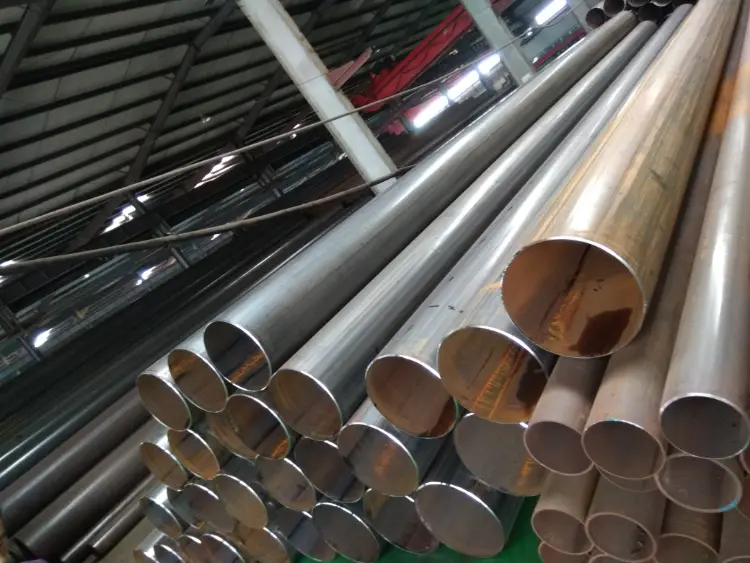
ASTM A789 S32760 Super Duplex Stainless Steel Pipe
ASTM A789 S32760 Super Duplex Stainless Steel Pipe: High Strength & Corrosion Resistance for Extreme Environments
Complete material data for ASTM A789 UNS S32760 super duplex stainless steel pipe: chemical composition, mechanical properties, physical properties, equivalent grades, applications, and processing guidelines. Ideal for offshore oil & gas, chemical processing, and seawater systems.
Hot forming, cold drawing, welding (with appropriate filler metal), machining (with consideration for work hardening), solution annealing
- Phone : +8618037372205
- Email : [email protected]
- WhatsApp: Contact via Whtsapp
- WeChat: +8618037372205
ASTM A789 S32760 Super Duplex Stainless Steel Pipe Introduction
ASTM A789 S32760 is a super duplex stainless steel pipe grade with a mixed ferrite-austenite microstructure, delivering an exceptional combination of high strength and outstanding corrosion resistance. The alloy is characterized by a high chromium, molybdenum, and nitrogen content, with deliberate additions of tungsten and copper to enhance pitting and crevice corrosion resistance in chloride-rich environments. It typically exhibits a minimum yield strength of 550 MPa (80 ksi) and a tensile strength of 750 MPa (109 ksi), roughly twice that of standard austenitic grades. S32760 is widely used in aggressive media such as seawater, sour gas, and chemical process streams, where its resistance to stress corrosion cracking, pitting, and general corrosion is critical. The material is available as seamless and welded pipe under ASTM A789, typically in the solution-annealed condition.
ASTM A789 S32760 Super Duplex Stainless Steel Pipe Chemical Composition
The chemical composition conforms to ASTM A789/A789M for UNS S32760. The alloy is balanced to obtain approximately 50% ferrite and 50% austenite after solution annealing. Stringent control of intermetallic phases and grain boundary precipitates is required for optimal corrosion resistance.
- Chromium, molybdenum, and nitrogen provide resistance to pitting and crevice corrosion.
- Tungsten and copper further improve localized corrosion resistance and chloride stress corrosion cracking resistance.
| Element | Specified Value (wt%) | Remarks |
|---|---|---|
| Carbon (C) | ≤ 0.030 | |
| Manganese (Mn) | ≤ 1.00 | |
| Silicon (Si) | ≤ 1.00 | |
| Phosphorus (P) | ≤ 0.030 | |
| Sulfur (S) | ≤ 0.010 | |
| Chromium (Cr) | 24.0 – 26.0 | Key element for corrosion resistance |
| Nickel (Ni) | 6.0 – 8.0 | Austenite stabilizer |
| Molybdenum (Mo) | 3.0 – 4.0 | Enhances pitting resistance |
| Nitrogen (N) | 0.20 – 0.30 | Austenite stabilizer and strengthener |
| Copper (Cu) | 0.50 – 1.00 | Improves general corrosion and chloride SCC resistance |
| Tungsten (W) | 0.50 – 1.00 | Increases pitting resistance equivalent number (PREN) |
ASTM A789 S32760 Super Duplex Stainless Steel Pipe Thermal and Electrical Physical Properties
The physical properties are typical for super duplex stainless steel S32760 at 20 °C (68 °F) and may vary slightly depending on final heat treatment and product form. These values are provided for engineering design calculations.
- Thermal expansion is lower than that of austenitic grades, reducing thermal stresses in constrained geometries.
- Thermal conductivity is higher than that of austenitic stainless steels, improving heat transfer.
| Property | Typical Value | Unit | Test Condition |
|---|---|---|---|
| Density (ρ) | 7.81 | g/cm³ (kg/dm³) | 20 °C |
| Modulus of Elasticity (E) | 200 | GPa | Tension, room temperature |
| Shear Modulus (G) | 77 | GPa | Calculated |
| Poisson's Ratio (ν) | 0.30 | — | Room temperature |
| Coefficient of Thermal Expansion (α) | 13.0 | 10⁻⁶/K | 20–100 °C |
| Coefficient of Thermal Expansion (α) | 13.5 | 10⁻⁶/K | 20–200 °C |
| Coefficient of Thermal Expansion (α) | 14.0 | 10⁻⁶/K | 20–300 °C |
| Thermal Conductivity (λ) | 13.5 | W/m·K | 20 °C |
| Thermal Conductivity (λ) | 15.0 | W/m·K | 100 °C |
| Specific Heat Capacity (cp) | 500 | J/kg·K | 20 °C |
| Electrical Resistivity (ρ_e) | 0.80 | μΩ·m | 20 °C |
ASTM A789 S32760 Super Duplex Stainless Steel Pipe Mechanical Properties
The mechanical property values below are the minimum requirements for ASTM A789 S32760 pipe in the solution-annealed condition. Actual values are often higher. The high strength allows for reduced wall thickness and weight savings in pressure-containing applications. Testing is performed in accordance with ASTM A370 or A450.
| Property | Required Value | Unit | Test Condition |
|---|---|---|---|
| Tensile Strength (Rm) | ≥ 750 (109) | MPa (ksi) | Room temperature, longitudinal specimen |
| Yield Strength (ReH, 0.2% offset) | ≥ 550 (80) | MPa (ksi) | Room temperature |
| Elongation (A, 2 in. or 50 mm) | ≥ 25 | % | Longitudinal strip or full section |
| Hardness | ≤ 32 HRC (≤ 310 HV) | Rockwell C; as per ASTM A789 general requirement, unless specified otherwise | |
| Bend Test | Not specified mandatory in A789; per agreement | Typically not required | |
| Impact Toughness (KV) | Not specified in A789; may be required by supplementary requirements (e.g., NACE MR0175) | J (ft·lb) | At -46 °C (-50 °F) per NACE, typical ≥ 40 J |
| Microstructure | Free from deleterious intermetallic phases | ASTM A923 Method C or equivalent |
ASTM A789 S32760 Super Duplex Stainless Steel Pipe Completely Equivalent Material Standards and Substitutable Grades
| Country/Region | Standard | Grade/Designation | Remarks |
|---|---|---|---|
| Europe | EN 10216-5 / EN 10217-7 | 1.4501, X2CrNiMoCuWN25-7-4 | Identical chemical and mechanical requirements for pressure purposes |
| International | ISO 15156-3 / NACE MR0175 | UNS S32760 | Qualified for sour service up to NACE Level VI/VII (depending on conditions) |
| United States | ASTM A790 / A789 | UNS S32760 | Seamless and welded super duplex pipe; same composition |
| United States | ASTM A928 / A815 | S32760 | Welded pipe fittings; equivalent chemistry |
| Norway | NORSOK M-650 | UNS S32760 | Qualified for hydrogen sulfide service per Norwegian sector requirements |
ASTM A789 S32760 Super Duplex Stainless Steel Pipe Application Introduction
ASTM A789 S32760 super duplex pipes are designed for demanding environments where high mechanical strength and exceptional corrosion resistance are required simultaneously. The alloy is particularly suited for sour service, seawater, and chemical processing. Typical applications include:
- Seawater intake/outfall piping
- Heat exchanger tubes in refineries
- Offshore topside and subsea piping systems
- Desalination plant brine lines
- Chemical reactor vessels and piping
Product Applications: Seamless and welded pipes for process lines, Heat exchanger tubes and tube sheets, U-bend tubes for shell-and-tube exchangers, Subsea flowlines and risers, Hydraulic and instrumentation tubing, Corrosion-resistant structural hollow sections
Processed into products: Pipe spools and bends, Tube-to-tubesheet welds, Flanges and fittings (elbows, tees, reducers), Valve bodies and trim, Pump shafts and casings, Pressure vessel shells (when formed from pipe), Seawater injection nozzles
Application industries: Oil & Gas (upstream, refining, gas processing), Chemical & Petrochemical, Desalination & Water Treatment, Marine & Offshore Engineering, Pulp & Paper, Pollution Control (flue gas desulfurization), Hydrometallurgy
ASTM A789 S32760 Super Duplex Stainless Steel Pipe Similar or Approximate Alternative Materials
| Country/Region | Standard | Grade | Remarks |
|---|---|---|---|
| United States | ASTM A789 / A790 | UNS S32750 (2507) | Super duplex; slightly lower PREN (~42 vs 43 for S32760); lacks tungsten. Good alternative for many chloride environments. |
| United States | ASTM A789 / A790 | UNS S32550 (Ferralium 255) | Super duplex with higher copper content; PREN ~40. Lower pitting resistance but good sulfuric acid resistance. |
| Europe | EN 10216-5 | 1.4410 (X2CrNiMoN25-7-4, UNS S32750) | Super duplex without tungsten; comparable strength, slightly lower corrosion resistance. |
| International | ASTM A312 | UNS N08904 (904L) | High-alloy austenitic; lower strength but very good corrosion resistance; used when weldability or forming is prioritized. |
| International | ASTM B677 / B673 | UNS N08367 (AL-6XN®) | Super-austenitic stainless steel; excellent chloride resistance, but lower strength than super duplex. |
Notes:
- Welding: Use filler metals matching (ER2594/ER2597) or over-alloyed compositions; preheating not required, but control interpass temperature (max. 150 °C). Post-weld solution annealing may be required to restore corrosion resistance in certain service conditions (e.g., NACE MR0175 sour service).
- Heat treatment: Solution annealing at 1080–1120 °C (1975–2050 °F) followed by rapid water quenching. Avoid prolonged holding at 475 °C (885 °F) embrittlement range and sigma phase formation range (600–950 °C).
- Corrosion testing: According to ASTM A923 or ASTM G48 Method A/C, the material should exhibit corrosion rate ≤ 1.0 mg/dm²·day and no intermetallic phases. S32760 typically achieves a critical pitting temperature (CPT) above 50 °C in 6% FeCl₃.
- Standards compliance: For sour service, S32760 is listed in ISO 15156-3 / NACE MR0175 up to specific H₂S partial pressure and chloride limits. Verify with the latest edition for user-specific service conditions.
- Share



