
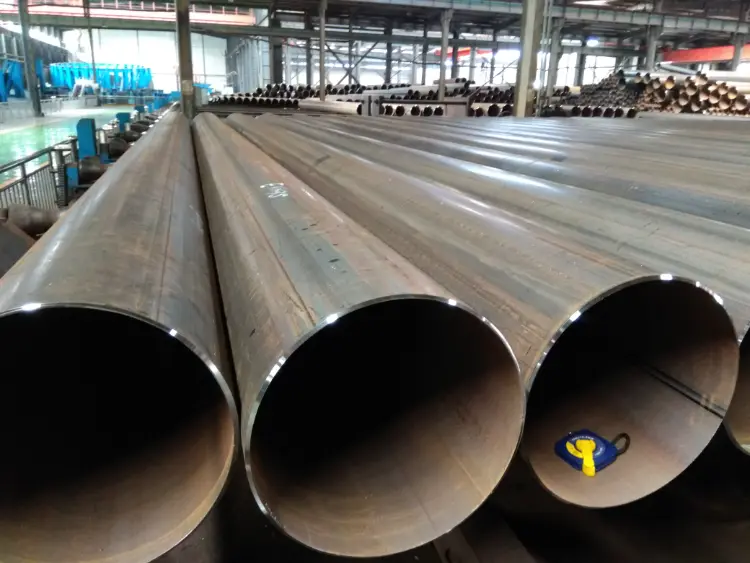
ASTM A789 S32900 Duplex Stainless Steel Pipe
ASTM A789 S32900 Duplex Stainless Steel Pipe: Composition, Properties, and Equivalents
Detailed technical data for ASTM A789 S32900 duplex stainless steel pipe including chemical composition, mechanical and physical properties, equivalent grades, and applications.
Forming, machining, welding (with appropriate filler), bending, heat treatment
- Phone : +8618037372205
- Email : [email protected]
- WhatsApp: Contact via Whtsapp
- WeChat: +8618037372205
ASTM A789 S32900 Duplex Stainless Steel Pipe Introduction
ASTM A789 S32900 is a ferritic-austenitic (duplex) stainless steel pipe grade standardized for general service. It combines high chromium (23–28%) and moderate molybdenum (1–2%) to offer a good balance of strength and corrosion resistance. The duplex microstructure provides approximately equal amounts of ferrite and austenite, yielding higher yield strength than common austenitic grades like 304/316L and improved resistance to chloride stress corrosion cracking. Typical applications include heat exchangers, chemical process piping, and seawater handling equipment. This grade is supplied in the solution-annealed condition and is available in seamless or welded forms.
ASTM A789 S32900 Duplex Stainless Steel Pipe Chemical Composition
The chemical requirements for ASTM A789 S32900 as specified in ASTM A789/A789M are listed below. The iron (Fe) content makes up the balance. This composition yields a duplex microstructure with good pitting and crevice corrosion resistance in chloride environments.
| Element | Standard Value (wt. %) | Remarks |
|---|---|---|
| Carbon (C) | ≤ 0.20 | Maximum |
| Manganese (Mn) | ≤ 1.00 | Maximum |
| Silicon (Si) | ≤ 1.00 | Maximum |
| Phosphorus (P) | ≤ 0.040 | Maximum |
| Sulfur (S) | ≤ 0.030 | Maximum |
| Chromium (Cr) | 23.0 – 28.0 | Key ferrite stabilizer, enhances corrosion resistance |
| Nickel (Ni) | 2.5 – 5.0 | Austenite stabilizer |
| Molybdenum (Mo) | 1.0 – 2.0 | Improves pitting resistance |
| Nitrogen (N) | Not specified | May be present as residual |
| Iron (Fe) | Balance | Remainder |
ASTM A789 S32900 Duplex Stainless Steel Pipe Thermal and Electrical Physical Properties
The following physical properties are typical for annealed S32900 duplex stainless steel at room temperature unless otherwise noted. These values are derived from published data for UNS S32900 and similar duplex grades and serve as design references.
| Property | Typical Value | Unit | Condition / Temperature |
|---|---|---|---|
| Density (ρ) | 7.8 | g/cm³ | 20°C |
| Elastic Modulus (E) | 200 | GPa | 20°C |
| Shear Modulus (G) | 77 | GPa | 20°C |
| Poisson Ratio (ν) | 0.30 | — | 20°C |
| Thermal Expansion Coefficient (α) | 11.2 (20–100°C), 11.8 (20–300°C), 12.3 (20–500°C) | µm/m·°C | Mean coefficient between 20°C and indicated temperature |
| Thermal Conductivity (λ) | 15.0 at 100°C, 17.5 at 300°C, 20.5 at 500°C | W/m·K | At specified temperature |
| Specific Heat Capacity | 460 at 20°C, 500 at 200°C, 540 at 400°C | J/kg·K | At specified temperature |
| Electrical Resistivity (ρ_e) | 0.75 | µΩ·m | 20°C |
ASTM A789 S32900 Duplex Stainless Steel Pipe Mechanical Properties
The tensile requirements for ASTM A789 S32900 tubing at room temperature, in the solution-annealed condition, are defined by ASTM A789. These values ensure structural integrity and reliability in service. Hardness is not mandated by the standard but is often controlled in practice.
| Property | Specified Value | Unit | Test Condition |
|---|---|---|---|
| Tensile Strength (Rm) | ≥ 620 (90) | MPa (ksi) | Room temperature, longitudinal direction |
| Yield Strength (ReH, 0.2% offset) | ≥ 485 (70) | MPa (ksi) | Room temperature, longitudinal direction |
| Elongation (A) | ≥ 15 | % | Gauge length 50 mm (2 inches) |
| Hardness (Brinell) | ≤ 269 (typical) | HBW | For reference only, not an ASTM A789 requirement |
| Hardness (Rockwell C) | ≤ 27 (typical) | HRC | For reference only |
ASTM A789 S32900 Duplex Stainless Steel Pipe Identical Specification and Grade Substitutes
| Country/Region | Standard | Grade | Remarks |
|---|---|---|---|
| USA | ASTM A789/A789M | S32900 (UNS S32900) | Original specification for duplex tubing |
| USA | ASME SA789 | S32900 (UNS S32900) | Adopted by ASME Boiler and Pressure Vessel Code – identical requirements |
| International | ISO 13680 | — | No direct equivalent; S32900 may be referenced by UNS number in project specifications |
ASTM A789 S32900 Duplex Stainless Steel Pipe Application Introduction
ASTM A789 S32900 duplex stainless steel pipe is well-suited for service where both high strength and excellent corrosion resistance are required. Its duplex structure provides good resistance to chloride stress corrosion cracking and pitting, making it a preferred material in many industrial sectors.
Product Applications: Seamless or welded tubes for shell-and-tube heat exchangers, Process piping for corrosive chemical transfer, Instrumentation tubing in offshore platforms, Urea synthesis plant high-pressure pipes, Hydraulic and umbilical tubing for subsea systems
Processed into products: Heat exchanger tubes and tube sheets, Pipe spools and fittings (elbows, tees, reducers), Piping manifolds and flanges, Pressure vessel internals, Stub ends and lap joint flanges, Custom-machined connectors and adapters for high‑pressure applications
Application industries: Chemical and petrochemical processing (acids, solvents, corrosive fluids), Oil and gas production (seawater injection, produced water, hydraulic systems), Pulp and paper mills (digesters, bleach plant piping), Desalination and water treatment (reverse osmosis, brine lines), Heat exchangers and condensers in power generation and marine services, Food and pharmaceutical equipment when high cleanliness is required
ASTM A789 S32900 Duplex Stainless Steel Pipe Recommended Similar or Alternative Grades
| Country/Region | Standard | Grade | Remarks |
|---|---|---|---|
| Europe | EN 10088-3 / EN 10216-5 | 1.4460 (X3CrNiMoN27-5-2) | Similar Cr, Ni, Mo content but with controlled nitrogen. Often used interchangeably in many applications, but verify composition and properties. |
| USA | ASTM A789/A789M | S32205 (2205) | Lower Cr (22%) and Mo (3%) offers slightly lower pitting resistance but better toughness and weldability. Widely available alternative. |
| USA | ASTM A789/A789M | S32750 (2507) | Super-duplex with higher Cr (25%) and Mo (4%) for superior corrosion resistance. Suitable for more aggressive environments but more expensive. |
| Japan | JIS G3463 | SUS329J1 | Historically equivalent to UNS S32900, although recent editions may incorporate nitrogen additions. |
Notes:
Welding of S32900 should be performed with matching filler metals (e.g., AWS ER2553) to maintain phase balance. Post-weld heat treatment is generally not required, but solution annealing may restore optimum corrosion resistance. Due to its higher carbon content (max 0.20%) compared to modern duplex grades, low heat input welding procedures are recommended to avoid sensitization. The material can be cold worked, but extensive forming may require intermediate annealing.
- Share



