
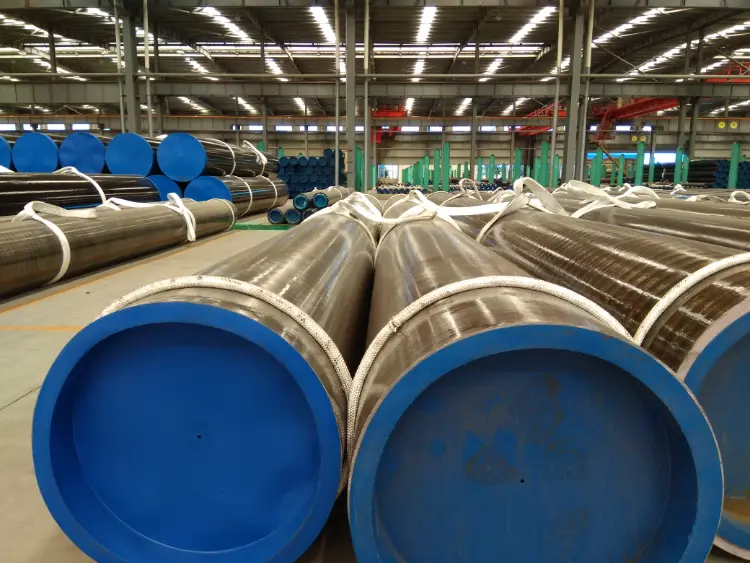
ASTM A789 S32950 Duplex Stainless Steel Pipe
ASTM A789 S32950 Super Duplex Stainless Steel Pipe: Properties, Equivalents & Applications
Complete material data sheet for ASTM A789 S32950 super duplex stainless steel pipe including chemical composition, mechanical and thermal physical properties, international equivalents, and application guidance.
Hot forming, cold forming, machining, welding (TIG, MIG, SAW, etc.)
- Phone : +8618037372205
- Email : [email protected]
- WhatsApp: Contact via Whtsapp
- WeChat: +8618037372205
ASTM A789 S32950 Duplex Stainless Steel Pipe Introduction
ASTM A789 S32950 is a high-alloy super duplex stainless steel specified in the standard ASTM A789/A789M for seamless and welded ferritic/austenitic stainless steel tubing for general service. This grade offers an excellent combination of high strength, exceptional corrosion resistance, and good weldability, making it ideal for aggressive environments. With a typical PREN value above 40, it provides outstanding resistance to pitting and crevice corrosion in chloride-containing media. The balanced dual-phase microstructure (approximately 50% ferrite and 50% austenite) ensures resistance to stress corrosion cracking (SCC) and high mechanical strength. Typical applications include:
- Oil and gas offshore platforms and subsea piping
- Chemical processing equipment
- Desalination plants
- Heat exchangers requiring high chloride resistance
- Marine engineering components
The material is usually supplied in the solution-annealed and quenched condition to maximize corrosion resistance.
ASTM A789 S32950 Duplex Stainless Steel Pipe Chemical Composition
Chemical composition limits according to ASTM A789/A789M for S32950 super duplex stainless steel. The balance is iron. All values are maximum unless a range is indicated.
| Element | Content (%) | Notes |
|---|---|---|
| Carbon (C) | 0.030 max | 0.030% maximum |
| Manganese (Mn) | 1.00 max | 1.00% maximum |
| Silicon (Si) | 1.00 max | 1.00% maximum |
| Phosphorus (P) | 0.030 max | 0.030% maximum |
| Sulfur (S) | 0.010 max | 0.010% maximum |
| Chromium (Cr) | 26.0 – 29.0 | 26.0% minimum, 29.0% maximum |
| Nickel (Ni) | 4.5 – 6.5 | 4.5% minimum, 6.5% maximum |
| Molybdenum (Mo) | 1.0 – 2.5 | 1.0% minimum, 2.5% maximum |
| Nitrogen (N) | 0.15 – 0.30 | 0.15% minimum, 0.30% maximum |
| Copper (Cu) | 0.50 – 1.50 | 0.50% minimum, 1.50% maximum |
| Iron (Fe) | Balance | Remaining percentage |
ASTM A789 S32950 Duplex Stainless Steel Pipe Physical Properties
Typical physical properties for S32950 super duplex stainless steel at ambient conditions unless stated otherwise. These values are for general engineering use.
| Property | Value | Unit | Test Condition |
|---|---|---|---|
| Density (ρ) | 7.8 | g/cm³ | Room temperature |
| Modulus of Elasticity (E) | 200 | GPa | Tension, room temperature |
| Shear Modulus (G) | 77 | GPa | Calculated from E and ν |
| Poisson's Ratio (ν) | 0.31 | – | Room temperature |
| Thermal Expansion (α) | 13.0 | µm/m·°C | 20-100°C |
| Thermal Conductivity (λ) | 15 | W/m·K | At 20°C |
| Specific Heat Capacity (cp) | 500 | J/kg·K | At 20°C |
| Electrical Resistivity (ρe) | 0.80 | µΩ·m | At 20°C |
ASTM A789 S32950 Duplex Stainless Steel Pipe Mechanical Properties
Minimum mechanical properties for S32950 tubing in the solution-annealed condition as per ASTM A789/A789M. Additional reference values for impact toughness are typically required for low-temperature service.
| Property | Value | Unit | Test Condition |
|---|---|---|---|
| Tensile Strength (Rm) | 690 min | MPa | Room temperature, longitudinal specimen |
| Yield Strength (Rp0.2) | 485 min | MPa | Room temperature, 0.2% offset |
| Elongation (A2") | 15 min | % | 50 mm gauge length |
| Hardness | 32 max | HRC | Solution-annealed state |
| Hardness | 293 max | HB | Alternative hardness measurement |
| Impact Toughness (KV2) | 27 min (typical) | J | -40°C, transverse specimen (optional) |
| Bend Test | No cracks acceptable | – | As per ASTM A789 requirements (if specified) |
ASTM A789 S32950 Duplex Stainless Steel Pipe Directly Equivalent Standards and Substitute Grades
| Country/Region | Standard | Designation | Notes |
|---|---|---|---|
| USA | ASTM A789/A789M | S32950 (UNS S32950) | Original specification – no direct EN or ISO equivalent |
ASTM A789 S32950 Duplex Stainless Steel Pipe Application Introduction
S32950 super duplex stainless steel pipe is designed for demanding environments where high mechanical strength, excellent resistance to stress corrosion cracking, and outstanding pitting corrosion resistance are required. It outperforms standard duplex grades in chloride-rich and sour service conditions. Typical application areas include:
Product Applications: Seamless and welded pipes and tubes, Flanges, fittings, and valves, Pressure vessels and reactors, Umbilicals and hydraulic tubing, Structural piping in offshore platforms
Processed into products: Pipe spools and connectors, Pump shafts and impellers, Welded heat exchanger tubes, Borehole casing in geothermal and oil wells, Fasteners and forgings for corrosive service
Application industries: Oil and gas (subsea flowlines, topside piping, manifolds), Chemical and petrochemical processing, Desalination plants (evaporators, brine circuits), Marine engineering (propeller shafts, seawater cooling), Pulp and paper industry (bleaching equipment), Heat exchangers in aggressive media
ASTM A789 S32950 Duplex Stainless Steel Pipe Similar / Alternative Super Duplex Grades
| Country/Region | Standard | Designation | Notes |
|---|---|---|---|
| Global | ASTM A789/A790 / EN 1.4410 | S32750 (2507) | Most common super duplex grade; slightly higher Mo and N, similar Cr, lower Cu |
| Global | ASTM A789/A790 / EN 1.4501 | S32760 (Zeron 100) | Contains W and Cu additions for enhanced pitting resistance |
| USA | ASTM A789/A790 | S32550 (255) | Lower Cr and Mo content compared to S32950, but still high-performance duplex |
| Global | ASTM A789 / EN 1.4462 | S32205 (2205) | Standard duplex – lower alloy content, suitable for less aggressive environments |
Notes:
- Welding should be performed with appropriate filler metals (e.g., ER2594 or similar over-alloyed wire) to maintain corrosion resistance.
- Post-weld heat treatment is not typically required, but pickling/passivation is recommended to restore the chromium oxide layer.
- Working temperature range: -50°C to 300°C for severe corrosive service; higher temperatures may cause undesirable sigma phase precipitation.
- Always refer to the latest revision of ASTM A789/A789M for actual procurement specifications.
- Share



