
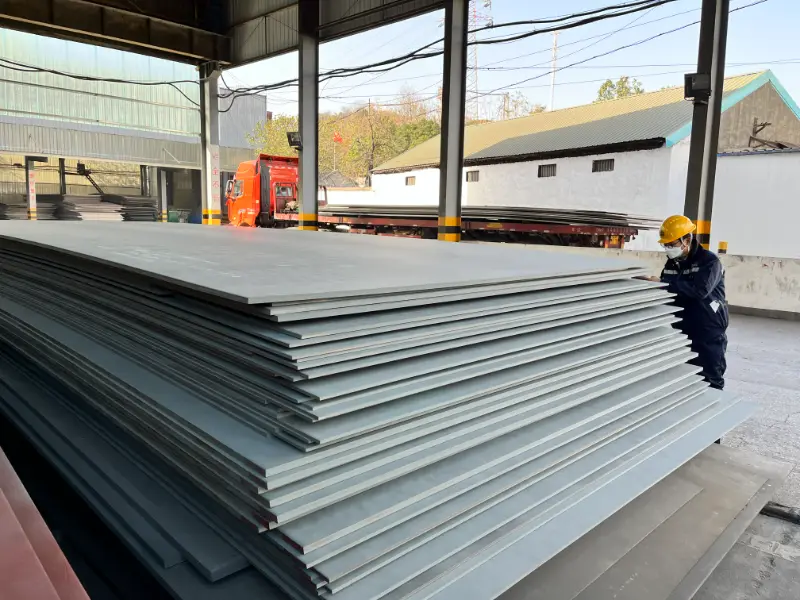
SUS440A Stainless Steel Plate/Coil
SUS440A Stainless Steel Plate/Coil: High-Carbon Martensitic Grade for Wear-Resistant Tools & Bearings
In-depth data sheet for SUS440A stainless steel plate and coil as per JIS G4304/G4305, including chemical composition, mechanical and thermal properties, international equivalents, and application guidance for high-hardness components.
Hot rolling, cold rolling, annealing, quenching and tempering, machining (in annealed condition), grinding
- Phone : +8618037372205
- Email : [email protected]
- WhatsApp: Contact via Whtsapp
- WeChat: +8618037372205
SUS440A Stainless Steel Plate/Coil Introduction
SUS440A is a high-carbon martensitic stainless steel standardized under JIS G4304 (hot-rolled) and JIS G4305 (cold-rolled), offering superior hardness and wear resistance after heat treatment. With a carbon content of 0.60–0.75 % and chromium 16.00–18.00 %, it achieves excellent corrosion resistance in mild environments.
- Typical applications include cutlery, surgical instruments, bearings, nozzles, and valve parts.
- Delivered in the annealed condition for forming and machining, it is subsequently hardened and tempered to HRC ≥54.
- Material is available as plate, sheet, coil, and strip.
SUS440A Stainless Steel Plate/Coil Chemical Composition
The composition is in accordance with JIS G4304:2012 and JIS G4305:2012. The values represent the standard range for heat analysis; product analysis may show slight variations within permissible tolerances.
| Element | Standard Value (mass%) | Remarks |
|---|---|---|
| Carbon (C) | 0.60 – 0.75 | Key hardenability element |
| Silicon (Si) | ≤ 1.00 | Deoxidizer and strength contributor |
| Manganese (Mn) | ≤ 1.00 | Deoxidizer and improves hot workability |
| Phosphorus (P) | ≤ 0.040 | Impurity |
| Sulfur (S) | ≤ 0.030 | Impurity |
| Chromium (Cr) | 16.00 – 18.00 | Provides corrosion resistance and hardenability |
SUS440A Stainless Steel Plate/Coil Physical and Thermal Properties
The following properties are based on published data for AISI 440A / SUS440A stainless steel at room temperature unless otherwise noted. They are indicative and may vary slightly with processing.
| Property | Typical Value | Unit | Test Condition / Remarks |
|---|---|---|---|
| Density (ρ) | 7.74 | g/cm³ | At 20°C |
| Modulus of Elasticity (E) | 200 | GPa | Tension, 20°C |
| Shear Modulus (G) | 77 | GPa | Calculated from E and ν |
| Poisson's Ratio (ν) | 0.28 | - | Room temperature |
| Thermal Expansion Coefficient (α) | 10.5 | 10⁻⁶/°C | 20–100°C |
| Thermal Expansion Coefficient (α) | 11.0 | 10⁻⁶/°C | 20–200°C |
| Thermal Conductivity (λ) | 24.2 | W/(m·K) | At 100°C |
| Thermal Conductivity (λ) | 26.0 | W/(m·K) | At 500°C |
| Specific Heat Capacity | 460 | J/(kg·K) | At 20–100°C |
| Electrical Resistivity (ρ_e) | 0.60 | μΩ·m | At 20°C |
SUS440A Stainless Steel Plate/Coil Mechanical Properties
Mechanical properties depend on heat treatment condition. In the annealed delivery condition, the material is soft and ductile for forming. After quenching and tempering (hardening), high strength and hardness are achieved. The table provides standard hardness requirements and typical tensile properties after hardening.
| Property | Standard Requirement / Typical Value | Unit | Test Condition / Remarks |
|---|---|---|---|
| Hardness | ≤ 255 | HBW | Annealed condition (delivery state) |
| Hardness | ≥ 54 | HRC | Quenched & tempered (1010–1070°C oil quench, 100–180°C temper) |
| Yield Strength (Rp0.2) | ≈ 1900 | MPa | Typical after hardening (reference only, not standard required) |
| Tensile Strength (Rm) | ≈ 2000–2200 | MPa | Typical after hardening (reference only) |
| Elongation (A) | ≤ 3 | % | Typical after hardening (low ductility) |
| Impact Energy (KV) | ≤ 5 | J | Typical after hardening (room temperature, brittle) |
SUS440A Stainless Steel Plate/Coil Completely Equivalent Material Standards & Substitution Grades
| Country/Region | Standard | Grade/Designation | Remarks |
|---|---|---|---|
| Japan | JIS G4304 / G4305 | SUS440A | Original standard grade |
| USA | ASTM A240 / A276 | 440A (UNS S44002) | Direct equivalent; same chemistry |
| China | GB/T 20878 / GB/T 4237 | 68Cr17 (new), 7Cr17 (old) | Chemically identical (C 0.60-0.75, Cr 16-18) |
| International | ISO 15510 | X68Cr17 | Corresponding grade |
| Germany | DIN EN 10088-2 | X70CrMo15 (1.4109) | Closest European grade, but contains Mo 0.5-1.0% and slightly lower Cr; not an exact match |
SUS440A Stainless Steel Plate/Coil Application Introduction
SUS440A is selected when high hardness and moderate corrosion resistance are required. It is widely employed in the manufacture of precision wear parts, cutting tools, and medical devices. Always refer to the annealed state for forming and machining, followed by hardening and tempering to achieve the final service hardness.
Product Applications: Knife blades and scissors, Surgical forceps, scalpels, and dental tools, Ball bearings and roller bearings, Industrial knives and shear blades, Valve seats and stems, High-pressure injection nozzles
Processed into products: Shaft sleeves and bushings, Bearing rings and balls, Cutting tools (non-high-speed steel), Pump pistons and cylinders, Die inserts for plastic molding, Syringe needles and lancets
Application industries: Medical and surgical instruments, Cutlery and kitchenware, Bearing manufacturing, Pump and valve components, Nozzle production, General engineering (wear plates, shafts)
SUS440A Stainless Steel Plate/Coil Similar or Alternative Material Recommendations
| Country/Region | Standard | Grade | Remarks |
|---|---|---|---|
| Japan | JIS G4304 | SUS440C | Higher carbon (0.95-1.20%), greater hardness, lower toughness |
| Japan | JIS G4304 | SUS440B | Intermediate carbon (0.75-0.95%), balanced hardness and toughness |
| Japan | JIS G4304 | SUS420J2 | Lower carbon (0.26-0.40%), improved ductility and corrosion resistance, lower wear resistance |
| USA | ASTM A240 | 440C (S44004) | Higher carbon version of 440A; max hardness up to 60 HRC |
| Europe | EN 10088-2 | X105CrMo17 (1.4125) | High carbon, Mo-bearing martensitic; suitable for extreme wear applications |
Notes:
The material is magnetic in all conditions. Annealing should be performed at 800–920°C followed by slow cooling. Hardening is typically done by austenitizing at 1010–1070°C and oil quenching, followed by tempering at 100–180°C to achieve ≥54 HRC. Higher tempering temperatures (e.g., 300–370°C) should be avoided due to potential embrittlement. Welding is not generally recommended; if necessary, preheat at 200–300°C and use austenitic filler materials. For maximum corrosion resistance, a polished surface finish is advised. SUS440A may show slightly lower corrosion resistance compared to 440C due to the absence of molybdenum.
- Share



