
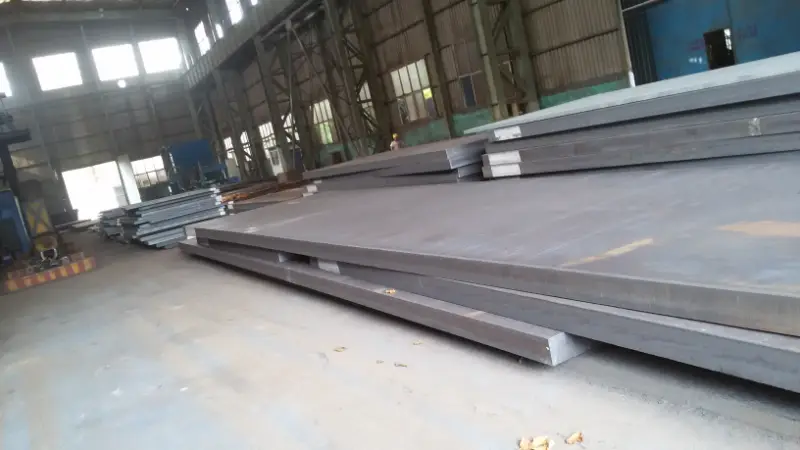
SUS420J1 Martensitic Stainless Steel Plate/Coil
SUS420J1 Martensitic Stainless Steel Plate / Coil Data Sheet – JIS G4304 & G4305
Comprehensive data for SUS420J1 stainless steel to JIS G4304/G4305: chemical composition, mechanical and physical properties, equivalent grades, and application guidance.
Hot rolling, cold rolling, annealing, quenching & tempering, machining, welding (with precautions)
- Phone : +8618037372205
- Email : [email protected]
- WhatsApp: Contact via Whtsapp
- WeChat: +8618037372205
SUS420J1 Martensitic Stainless Steel Plate/Coil Introduction
SUS420J1 is a martensitic stainless steel specified in JIS G4304 (hot-rolled) and JIS G4305 (cold-rolled) for plates, sheets and coils. It offers a balanced combination of moderate carbon content (0.16–0.25%) and 12–14% chromium, providing hardenability through heat treatment while retaining good corrosion resistance in mild environments. In the annealed condition it is relatively soft and formable, allowing fabrication before hardening. After quenching and tempering, the alloy achieves high strength, good wear resistance, and moderate toughness. It is widely used for cutlery, valve parts, shafts, and medical instruments. The steel is typically supplied in the annealed condition and can be further processed by machining, hot or cold forming, and welding under controlled conditions.
SUS420J1 Martensitic Stainless Steel Plate/Coil Chemical Composition
The ladle analysis limits for SUS420J1 according to JIS G4304 and JIS G4305 are shown below. Nickel is not a specified addition but may be present as a residual element up to 0.60%. All other elements are controlled to ensure martensitic transformation and corrosion performance.
| Element | Standard Value (wt%) | Remarks |
|---|---|---|
| C | 0.16 – 0.25 | Key hardenability element |
| Si | ≤ 1.00 | Deoxidiser |
| Mn | ≤ 1.00 | Hot workability and deoxidation |
| P | ≤ 0.040 | Impurity – kept low for toughness |
| S | ≤ 0.030 | Impurity – low for machinability and corrosion |
| Cr | 12.00 – 14.00 | Corrosion resistance and ferrite stabiliser |
| Ni | ≤ 0.60 (residual) | Not added; may appear as impurity |
SUS420J1 Martensitic Stainless Steel Plate/Coil Thermal and Electrical Physical Properties
The following physical properties are typical for SUS420J1 in the annealed condition. These values are collected from reliable material data sheets and are representative for general engineering calculations.
| Property | Standard Requirement Value | Unit | Test Condition |
|---|---|---|---|
| Density (ρ) | 7.70 | g/cm³ | At 20°C |
| Elastic modulus (E) | 200 | GPa | At 20°C |
| Shear modulus (G) | 77 | GPa | At 20°C, calculated from E and ν |
| Poisson's ratio (ν) | 0.27 – 0.30 | – | At 20°C |
| Thermal expansion coefficient (α) | 11.0 | 10⁻⁶/K | 20–100°C |
| Thermal expansion coefficient (α) | 11.5 | 10⁻⁶/K | 20–200°C |
| Thermal expansion coefficient (α) | 12.0 | 10⁻⁶/K | 20–400°C |
| Thermal conductivity (λ) | 23.0 | W/(m·K) | At 100°C |
| Thermal conductivity (λ) | 25.0 | W/(m·K) | At 500°C |
| Specific heat capacity (cp) | 460 | J/(kg·K) | At 20–100°C |
| Electrical resistivity (ρe) | 0.55 | µΩ·m | At 20°C |
SUS420J1 Martensitic Stainless Steel Plate/Coil Mechanical Properties
The values below are the minimum requirements in the annealed condition as specified in JIS G4304/G4305. After appropriate hardening and tempering, significantly higher strength can be obtained. Typical quenched-and-tempered mechanical properties are included as a reference but are not part of the standard delivery condition.
| Property | Standard Requirement / Typical Value | Unit | Test Condition / Remarks |
|---|---|---|---|
| Tensile strength (Rm) | ≥ 520 | MPa | Annealed condition, plate/sheet |
| Yield strength (ReH) | ≥ 225 | MPa | Annealed condition, 0.2% offset |
| Elongation (A) | ≥ 18 | % | Gauge length 50 mm, annealed, thickness ≤ 3 mm |
| Elongation (A) | ≥ 23 | % | Gauge length 50 mm, annealed, thickness 3–6 mm |
| Brinell hardness | ≤ 229 | HBW | Annealed condition |
| Tensile strength (Rm) – QT | 750 – 950 | MPa | Typical after oil quench from 980–1030°C and tempering at 150–370°C |
| Yield strength (ReH) – QT | ≥ 550 | MPa | Typical after QT, tempering temperature dependent |
| Elongation (A) – QT | 12 – 20 | % | Typical after QT, varies with tempering |
| Hardness – QT | 22 – 32 | HRC | Typical after QT, depending on tempering |
SUS420J1 Martensitic Stainless Steel Plate/Coil Complete Equivalent Material Standards and Substitutable Grades
| Country / Region | Standard | Grade | Remarks |
|---|---|---|---|
| European Union | EN 10088-2 / EN 10088-3 | 1.4021 (X20Cr13) | Identical chemistry, equivalent mechanical properties |
| International | ISO 15510 | X20Cr13 | Same nominal composition |
| China | GB/T 20878, GB/T 1220 | 20Cr13 (old 2Cr13) | Closely matches SUS420J1 |
| Japan | JIS G4303 | SUS420J1 | Bars – same grade |
| Korea | KS D 3705 | STS420J1 | Direct equivalent |
| Germany | DIN 17440 | 1.4021 | Historical equivalent |
| Italy | UNI 6900 | X20Cr13 | Chemical match |
| Sweden | SS 14 23 03 | 2303 | Same Cr series, compatible |
SUS420J1 Martensitic Stainless Steel Plate/Coil Application Introduction
SUS420J1 combines good corrosion resistance in fresh water, steam, and mild chemical environments with the ability to achieve high strength through heat treatment. After quenching and tempering it offers excellent wear resistance and is suitable for components requiring a martensitic stainless steel with moderate hardness and toughness.
Product Applications: Knife blades and scissors, Dental and surgical scissors, forceps, Valve stems, seats and discs, Pump shafts and wear rings, Mould inserts for corrosive plastics, Springs and spring washers, Bolts, nuts and studs for corrosive environments, Ruling pens, compasses, drawing instruments
Processed into products: Blades (cutting, shearing), Valve trim components (stem, ball, seat), Shafts, spindles and axles, Bushings and wear plates, Small fasteners with strength requirements, Collets and chucks, Mould cavities and cores, Gauge blocks and measuring jaws
Application industries: Cutlery and kitchenware, Medical and surgical instruments, Pumps, valves and fluid handling, Steam and gas turbine blades, Plastic injection moulds, General mechanical engineering, Automotive components (shafts, fasteners), Measuring tools and gauges
SUS420J1 Martensitic Stainless Steel Plate/Coil Similar / Closely Related Alternative Materials
| Country / Region | Standard | Grade | Remarks |
|---|---|---|---|
| Japan | JIS G4304 / G4305 | SUS420J2 | Higher carbon (0.26–0.40%), higher hardness after heat treatment but lower toughness and weldability |
| USA | ASTM A276 / A240 | Type 420 (UNS S42000) | Carbon range ≥ 0.15%, may cover SUS420J1 but typically supplied with higher carbon; verify exact limits |
| Japan | JIS G4304 | SUS410 | Lower carbon (≤ 0.15%), better ductility and weldability but lower strength and wear resistance |
| European Union | EN 10088-2 | 1.4006 (X12Cr13) | Lower carbon martensitic stainless, improved toughness, used when less hardness is acceptable |
| China | GB/T 1220 | 30Cr13 | Higher carbon (0.26–0.35), closer to SUS420J2, for higher hardness tools |
Notes:
Heat treatment: For hardening, heat to 980–1030°C, then quench in oil or air. Tempering between 150–370°C achieves high hardness; avoid tempering in 370–560°C range to prevent embrittlement. Welding: Pre-heat at 200–300°C, use austenitic filler (e.g., 308L) if post-weld heat treatment is not possible; otherwise use matching filler and full anneal. Corrosion: Best resistance in hardened and polished condition. Not suitable for strong acids or chloride-rich environments without cathodic protection. Forming: Can be cold formed in annealed condition, but springback is high; hot forming recommended at 950–1100°C followed by slow cooling and re-annealing.
- Share



