
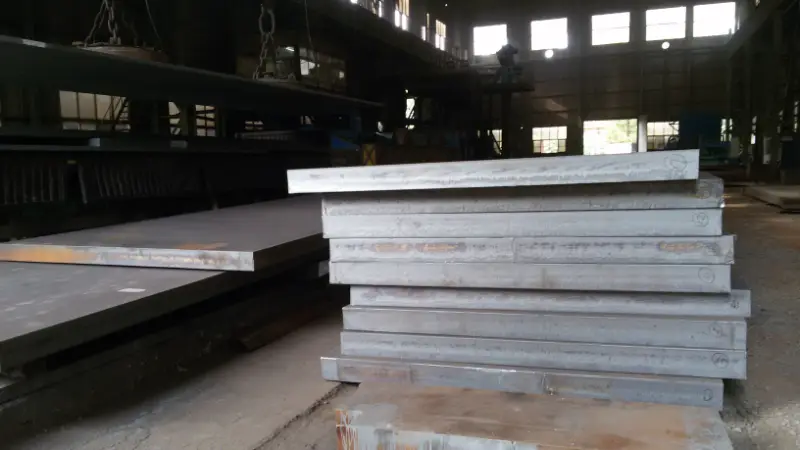
SUS321 Austenitic Stainless Steel Plate/Coil
SUS321 Austenitic Stainless Steel Plate/Coil - JIS G4304 & JIS G4305
Comprehensive data and properties of SUS321 stainless steel plate/coil under Japanese JIS standards, including chemistry, mechanics, and equivalents.
Hot rolling, Cold rolling, Forming, Welding, Machining, Deep drawing
- Phone : +8618037372205
- Email : [email protected]
- WhatsApp: Contact via Whtsapp
- WeChat: +8618037372205
SUS321 Austenitic Stainless Steel Plate/Coil Introduction
SUS321 is a titanium-stabilized austenitic stainless steel specified in JIS G4304 (hot-rolled) and JIS G4305 (cold-rolled) standards. The addition of titanium prevents chromium carbide precipitation during welding or high-temperature service (427–816°C), thereby maintaining excellent intergranular corrosion resistance. It exhibits good high-temperature strength and oxidation resistance up to about 800°C, and cannot be hardened by heat treatment. Typical mechanical properties in the solution-annealed condition include a minimum tensile strength of 520 MPa and a minimum 0.2% yield strength of 205 MPa with elongation over 40% in thin gauges. The material is non-magnetic in the annealed state, but may become slightly magnetic after cold working.
- Outstanding resistance to intergranular attack
- Good creep strength at elevated temperatures
- Easy to form and weld
- Used where post-weld annealing is not practical
SUS321 Austenitic Stainless Steel Plate/Coil Chemical Composition
Chemical composition according to JIS G4304/G4305 for SUS321. Titanium is added to stabilize carbon and protect chromium from forming carbides, preventing intergranular corrosion. All values are weight percent.
| Element | Standard Value (%) | Remarks |
|---|---|---|
| Carbon (C) | ≤0.08 | |
| Silicon (Si) | ≤1.00 | |
| Manganese (Mn) | ≤2.00 | |
| Phosphorus (P) | ≤0.045 | |
| Sulfur (S) | ≤0.030 | |
| Nickel (Ni) | 9.00–13.00 | |
| Chromium (Cr) | 17.00–19.00 | |
| Titanium (Ti) | ≥5×C | Typically Ti ≥0.20% for carbon ≤0.04% |
SUS321 Austenitic Stainless Steel Plate/Coil Thermal and Electrical Physical Properties
Physical properties of SUS321 at room temperature and elevated temperatures. These values are typical for solution-annealed material and are not mandatory in product standards.
| Property | Typical Value | Unit | Test Condition |
|---|---|---|---|
| Density (ρ) | 8.03 | g/cm³ | At 20°C |
| Elastic Modulus (E) | 193 | GPa | At 20°C |
| Shear Modulus (G) | 77 | GPa | At 20°C, estimated |
| Poisson's Ratio (ν) | 0.27 | - | At 20°C, estimated |
| Thermal Expansion Coefficient (α) | 16.6 | 10⁻⁶/K | 20–100°C |
| Thermal Expansion Coefficient (α) | 17.3 | 10⁻⁶/K | 20–300°C |
| Thermal Expansion Coefficient (α) | 18.0 | 10⁻⁶/K | 20–500°C |
| Thermal Conductivity (λ) | 16.3 | W/m·K | At 100°C |
| Thermal Conductivity (λ) | 21.5 | W/m·K | At 500°C |
| Specific Heat Capacity (c) | 500 | J/kg·K | 0–100°C |
| Electrical Resistivity (ρ_e) | 0.72 | μΩ·m | At 20°C |
SUS321 Austenitic Stainless Steel Plate/Coil Mechanical Properties
Room temperature tensile properties and hardness for SUS321 in solution-annealed condition, as per JIS G4304/G4305.
- Values for elongation depend on plate thickness; thinner sections exhibit higher ductility.
- Hardness is typically tested using Brinell, Rockwell B, or Vickers methods.
| Property | Standard Requirement | Unit | Test Condition |
|---|---|---|---|
| Tensile Strength (Rm) | ≥520 | MPa | Solution annealed, all thicknesses |
| Yield Strength (ReH, 0.2% offset) | ≥205 | MPa | Solution annealed, all thicknesses |
| Elongation (A) – thickness ≤8 mm | ≥40 | % | Gauge length 50 mm, solution annealed |
| Elongation (A) – 8 mm < thickness ≤25 mm | ≥30 | % | Gauge length 50 mm, solution annealed |
| Elongation (A) – 25 mm < thickness ≤75 mm | ≥25 | % | Gauge length 50 mm, solution annealed |
| Hardness (HBW) | ≤187 | - | Solution annealed |
| Hardness (HRB) | ≤90 | - | Solution annealed |
| Hardness (HV) | ≤200 | - | Solution annealed |
SUS321 Austenitic Stainless Steel Plate/Coil Completely Equivalent Material Standards and Replaceable Designations
| Country/Region | Standard | Designation | Remarks |
|---|---|---|---|
| Japan | JIS G4304/G4305 | SUS321 | Original designation |
| USA | ASTM A240/A240M | 321 (UNS S32100) | Direct equivalent |
| European Union | EN 10088-2 | 1.4541 (X6CrNiTi18-10) | Direct equivalent |
| China | GB/T 3280 | 06Cr18Ni11Ti | Direct equivalent |
| International | ISO 15510 | X6CrNiTi18-10 | Direct equivalent |
| Korea | KS D 3698 | STS321 | Direct equivalent |
| Russia | GOST 5632 | 08Kh18N10T | Similar composition, minor deviations |
SUS321 Austenitic Stainless Steel Plate/Coil Application Introduction
SUS321 is selected when fabrication includes welding or exposure to 430–870°C without the possibility of post-weld annealing. It provides better intergranular corrosion resistance than standard 304 while retaining good formability and weldability. Typical uses include:
- High-temperature structural parts in the aerospace industry
- Chemical equipment, including tanks, reactors and piping where sensitization must be avoided
- Food processing machinery and pharmaceutical equipment requiring corrosion resistance and cleanability
- Furnace components, burner parts, and heat treatment baskets
- Expansion joints and bellows subjected to thermal cycling
Product Applications: Expansion joints, Aircraft exhaust manifolds, Boiler and heat exchanger shells, Furnace components, Chemical reactor linings, High-temperature ducting, Pressure vessels, Storage tanks
Processed into products: Bellows, Flanges, Welded pipes and tubes, Fasteners, Springs, Spool pieces, Seamless tubes, Forged fittings, Turbine blades (engine parts), Thermal oxidizer parts
Application industries: Aerospace, Chemical Processing, Petrochemical, Food & Beverage, Pharmaceutical, Power Generation, Heat Treatment, Oil & Gas
SUS321 Austenitic Stainless Steel Plate/Coil Similar or Alternative Material Recommendations
| Country/Region | Standard | Designation | Remarks |
|---|---|---|---|
| Japan | JIS G4304/G4305 | SUS304 | No Ti; susceptible to sensitization, lower intergranular corrosion resistance |
| Japan | JIS G4304/G4305 | SUS316 | Contains Mo for better pitting resistance, but not stabilized against intergranular attack |
| Japan | JIS G4304/G4305 | SUS347 | Stabilized with Nb; similar intergranular resistance but may be preferred for thicker sections |
| USA | ASTM A240 | 321H (UNS S32109) | Higher carbon content (0.04–0.10%) for increased high-temperature strength |
| USA | ASTM A240 | 304H (UNS S30409) | High-carbon 304 for high-temperature strength, lacks Ti stabilization |
Notes:
Welding: SUS321 can be welded by all common methods without preheating. Post-weld annealing is generally not required owing to the titanium stabilization, though stress relief may be beneficial. Filler metals matching the composition (e.g., ER321 for GTAW) are recommended to maintain corrosion resistance. Machining: The material work hardens; use sharp tools, rigid setups, and appropriate coolants. High-temperature use: Prolonged exposure between 425–540°C may reduce toughness (885°F/475°C embrittlement) – the usual limitation for ferritic grades is less pronounced but still should be considered. It is not recommended for service above 870°C under heavy load due to oxidation and scaling. Corrosion: Resists intergranular attack up to 815°C in most environments but may be attacked by highly oxidizing acids. Not resistant to stress corrosion cracking in chloride-containing environments above about 60°C.
- Share



