
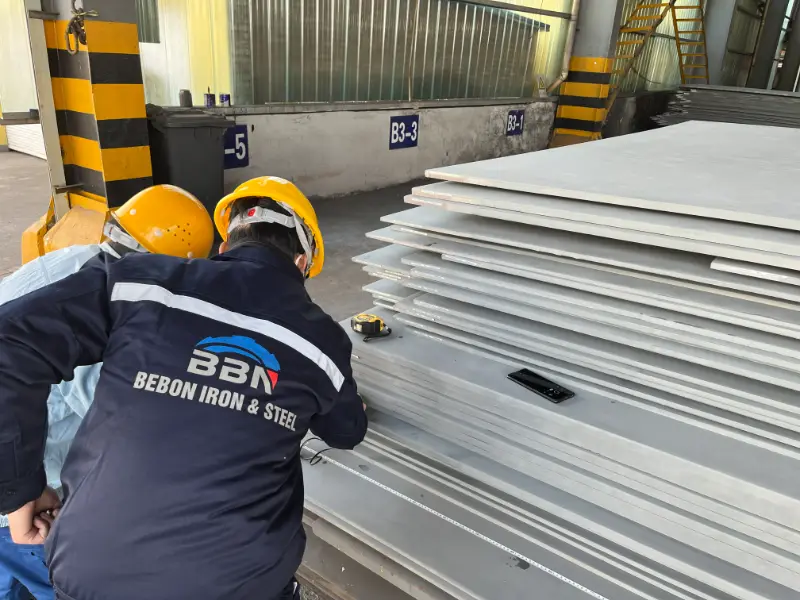
SUS317LN Austenitic Stainless Steel Plate/Coil: JIS G4304/G4305
SUS317LN Austenitic Stainless Steel Plate/Coil: JIS G4304/G4305 - Properties, Equivalents & Applications
Comprehensive material data for SUS317LN austenitic stainless steel plate and coil according to JIS G4304 and G4305, including chemical composition, mechanical and physical properties, international equivalents, and application guidance.
Hot rolling, cold rolling, pickling, annealing, solution heat treatment, welding (manual/automatic), forming, machining
- Phone : +8618037372205
- Email : [email protected]
- WhatsApp: Contact via Whtsapp
- WeChat: +8618037372205
SUS317LN Austenitic Stainless Steel Plate/Coil: JIS G4304/G4305 Introduction
SUS317LN is a molybdenum-bearing, nitrogen-alloyed austenitic stainless steel specified in JIS G4304 (hot-rolled stainless steel plates) and JIS G4305 (cold-rolled stainless steel plates). Compared to the conventional SUS317L grade, the addition of 0.10–0.22% nitrogen significantly increases strength while maintaining excellent corrosion resistance.
The alloy features high chromium (18–20%), nickel (11–15%) and molybdenum (3–4%) contents, providing outstanding resistance to pitting and crevice corrosion in chloride-containing environments and acidic media. Its lean carbon content (£0.030%) minimizes sensitization during welding.
- Superior resistance to sulfuric acid, phosphoric acid and other reducing acids
- Excellent intergranular corrosion resistance after welding, without the need for post-weld heat treatment
- Higher yield and tensile strength than SUS317L, enabling lighter structural design
- Good formability and weldability for demanding chemical and offshore applications
SUS317LN Austenitic Stainless Steel Plate/Coil: JIS G4304/G4305 Chemical Composition
The table lists the standard chemical composition limits for SUS317LN according to JIS G4304/G4305. Nitrogen is controlled within a defined range to enhance strength and preserve ductility. All elements contribute to the corrosion resistance, weldability and mechanical properties of this fully austenitic grade.
| Element | Required Value | Remarks |
|---|---|---|
| C | ≤0.030 | mass% |
| Si | ≤1.00 | mass% |
| Mn | ≤2.00 | mass% |
| P | ≤0.045 | mass% |
| S | ≤0.030 | mass% |
| Ni | 11.00~15.00 | mass% |
| Cr | 18.00~20.00 | mass% |
| Mo | 3.00~4.00 | mass% |
| N | 0.10~0.22 | mass% |
SUS317LN Austenitic Stainless Steel Plate/Coil: JIS G4304/G4305 Thermal and Electrical Physical Properties
These physical property values are typical for SUS317LN in the annealed condition at room temperature unless a different temperature range is indicated. They serve as engineering references and may vary slightly with exact composition and heat treatment.
| Property | Typical Value | Unit | Test Condition |
|---|---|---|---|
| Density (ρ) | 8.0 | g/cm³ | 20°C |
| Elastic modulus (E) | 200 | GPa | 20°C |
| Shear modulus (G) | 77 | GPa | 20°C |
| Poisson's ratio (ν) | 0.30 | - | 20°C |
| Coefficient of thermal expansion (α) | 16.0 | 10⁻⁶/K | 20~100°C |
| Coefficient of thermal expansion (α) | 17.0 | 10⁻⁶/K | 20~300°C |
| Thermal conductivity (λ) | 14 | W/(m·K) | at 100°C |
| Specific heat capacity | 500 | J/(kg·K) | 20°C |
| Electrical resistivity (ρ_e) | 0.74 | µΩ·m | 20°C |
SUS317LN Austenitic Stainless Steel Plate/Coil: JIS G4304/G4305 Mechanical Properties
The mechanical properties shown below are the minimum values for SUS317LN in solution-annealed condition per JIS G4304. Elongation requirements vary with plate thickness. Hardness values are applicable to all thickness ranges. The 180° bend test covers thin material. All tests are performed at room temperature on transverse specimens unless stated otherwise.
| Property | Required Value | Unit | Test Condition |
|---|---|---|---|
| Yield strength (ReH, 0.2% proof) | ≥245 | MPa | Room temperature, transverse, solution annealed |
| Tensile strength (Rm) | ≥550 | MPa | Room temperature, transverse, solution annealed |
| Elongation after fracture (A) | ≥40 | % | Gauge length 50 mm, thickness ≤25 mm |
| Elongation after fracture (A) | ≥35 | % | Gauge length 50 mm, thickness 25 mm < t ≤50 mm |
| Elongation after fracture (A) | ≥30 | % | Gauge length 50 mm, thickness 50 mm < t ≤75 mm |
| Brinell hardness (HBW) | ≤217 | - | Solution annealed, all thicknesses |
| Rockwell hardness (HRB) | ≤95 | - | Solution annealed, all thicknesses |
| Bend test (180°) | d=2a (no cracks) | - | Bend angle 180°, thickness ≤8 mm, solution annealed |
SUS317LN Austenitic Stainless Steel Plate/Coil: JIS G4304/G4305 Fully Equivalent Material Standards and Replaceable Designations
| Country/Region | Standard | Designation | Remarks |
|---|---|---|---|
| Japan | JIS G4304 / G4305 | SUS317LN | Base specification |
| United States | ASTM A240 / A240M | UNS S31753 (317LN) | Plate, sheet and strip |
| European Union | EN 10088-2 | 1.4434 (X2CrNiMoN18-13-4) | Sheet, plate and strip |
| China | GB/T 3280-2015 | S31753 (022Cr19Ni13Mo4N) | Cold-rolled stainless steel sheet and strip |
| International | ISO 15510 | X2CrNiMoN18-13-4 | Stainless steels – Chemical composition |
SUS317LN Austenitic Stainless Steel Plate/Coil: JIS G4304/G4305 Application Introduction
SUS317LN is especially suitable for corrosive environments requiring high mechanical strength and reliability. Its combination of resistance to pitting, crevice corrosion and intergranular corrosion makes it a preferred choice in industrial equipment exposed to chloride and acidic media. Typical service conditions include contact with sulfuric acid, phosphoric acid, organic acids, and marine atmospheres. The alloy can be formed into a wide range of components and is readily joined by standard fusion welding processes.
Product Applications: Pressure vessels and storage tanks, Shell-and-tube heat exchangers, Condensers and evaporators, Piping systems and piping spools, Flanges, fittings and gaskets, Reactors and autoclaves, Cryogenic and high-temperature structures
Processed into products: Tube sheets and baffle plates, Welded pipe and seamless tubes, Valve bodies, balls and seats, Pump casings and impellers, Agitator blades and shafts, Fasteners (bolts, studs) and springs, Expansion bellows and flexible hoses, Lining and cladding for carbon steel vessels
Application industries: Chemical processing and petrochemical, Oil & gas (offshore and onshore), Pulp and paper (bleaching and digesters), Marine engineering and shipbuilding, Desalination and water treatment, Food, beverage and pharmaceutical production, Flue gas desulfurization (FGD) and environmental protection
SUS317LN Austenitic Stainless Steel Plate/Coil: JIS G4304/G4305 Similar or Alternative Materials Recommendation
| Country/Region | Standard | Designation | Remarks |
|---|---|---|---|
| Japan | JIS G4304 | SUS317L | Same Cr-Ni-Mo base but without nitrogen addition; lower strength, comparable corrosion resistance in many acids |
| United States | ASTM A240 | UNS S31703 (317L) | Equivalent to SUS317L; used where nitrogen's strengthening effect is not needed |
| European Union | EN 10088-2 | 1.4438 (X2CrNiMo18-14-3) | Low-carbon molybdenum austenitic stainless steel; lower strength vs SUS317LN |
| Japan | JIS G4304 | SUS316LN | Similar nitrogen-strengthened concept but with lower Mo (2–3%); slightly reduced pitting corrosion resistance |
| United States | ASTM A240 | UNS S31653 (316LN) | Corresponds to SUS316LN; good for less severe chloride environments |
Notes:
Heat treatment: Solution annealing at 1020–1100°C followed by water quenching or rapid air cooling. Avoid slow cooling to prevent sensitization and precipitation of chromium carbides.
Corrosion resistance: The alloy is resistant to intergranular corrosion in the as-welded condition for thicknesses up to approx. 25 mm, as per tests according to JIS G0571 (Streicher) or ASTM A262 Practice E.
Workability: Cold forming characteristics are similar to other austenitic grades; heavy forming may require intermediate annealing due to high work hardening. Machining requires sharp tools, rigid setups and adequate cooling. Welding: Suitable for TIG, MIG, SMAW and SAW. Filler metal AWS ER/ER317L or similar nitrogen-containing filler can be used. Post-weld annealing is generally not necessary for cross sections up to moderate thickness.
- Share



