
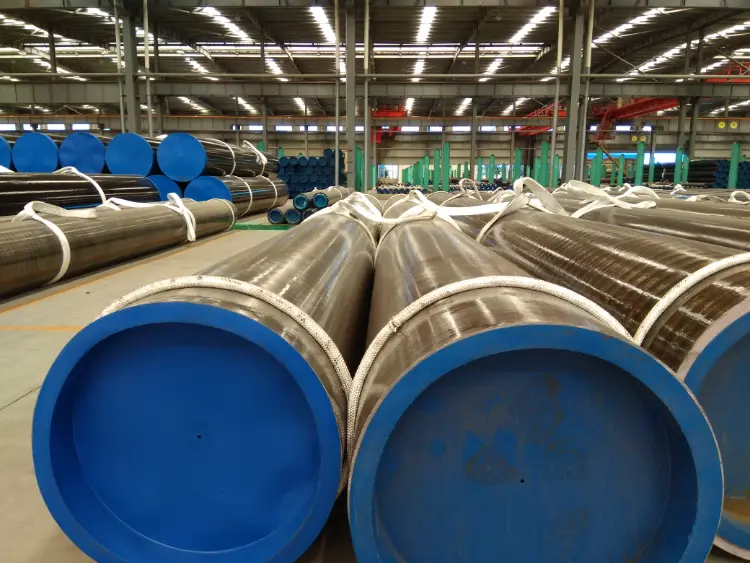
SUS316Ti Stainless Steel Pipe
JIS G4305 SUS316Ti Stainless Steel Pipe – Titanium Stabilized Austenitic Grade for High-Temperature Corrosion Resistance
Comprehensive technical data for SUS316Ti stainless steel pipe as per JIS G4305. Includes chemical composition, mechanical properties, physical constants, international equivalents, and application examples for the titanium-stabilized austenitic grade.
Welding, cold forming, hot forming, machining (with appropriate tools), solution annealing
- Phone : +8618037372205
- Email : [email protected]
- WhatsApp: Contact via Whtsapp
- WeChat: +8618037372205
SUS316Ti Stainless Steel Pipe Introduction
SUS316Ti is a titanium-stabilized austenitic stainless steel specified in JIS G4305 (cold-rolled stainless steel plate, sheet and strip, also widely referenced for pipe products). The addition of titanium improves intergranular corrosion resistance after heating in the critical temperature range (425–900 °C), making it suitable for welded structures that cannot be solution annealed. It offers excellent resistance to a wide range of chemical environments, particularly those containing chlorides, and exhibits good creep strength at elevated temperatures. The steel is essentially the Japanese equivalent of 316Ti (UNS S31635, EN 1.4571) and is chosen for applications requiring long-term stability in corrosive and high-temperature services such as chemical processing equipment, heat exchangers, and exhaust systems.
SUS316Ti Stainless Steel Pipe Chemical Composition per JIS G4305
The chemical composition of SUS316Ti is defined by JIS G4305. It features a controlled carbon content with titanium stabilization (Ti ≥ 5 × C) to prevent chromium carbide precipitation and ensure intergranular corrosion resistance after welding or elevated temperature exposure. Molybdenum provides pitting and crevice corrosion resistance in chloride environments.
| Chemical Element | Standard Value (wt%) | Remarks |
|---|---|---|
| Carbon (C) | ≤0.08 | |
| Silicon (Si) | ≤1.00 | |
| Manganese (Mn) | ≤2.00 | |
| Phosphorus (P) | ≤0.045 | |
| Sulfur (S) | ≤0.030 | |
| Nickel (Ni) | 10.00 – 14.00 | |
| Chromium (Cr) | 16.00 – 18.00 | |
| Molybdenum (Mo) | 2.00 – 3.00 | |
| Titanium (Ti) | ≥5 × C, usually up to 0.70 | Stabilizing element |
SUS316Ti Stainless Steel Pipe Thermal and Electrical Physical Properties
Physical properties for SUS316Ti at room temperature unless otherwise noted. These values are typical for the fully austenitic microstructure and guide design for thermal and electrical applications.
| Property | Typical Value | Unit | Test Condition / Remarks |
|---|---|---|---|
| Density (ρ) | 8.0 | g/cm³ | At 20 °C |
| Modulus of Elasticity (E) | 193 | GPa | At 20 °C; decreases with temperature |
| Shear Modulus (G) | 74 | GPa | Calculated from E and Poisson's ratio |
| Poisson's Ratio (ν) | 0.30 | - | Room temperature |
| Mean Thermal Expansion Coefficient (α) | 16.5 (20–100 °C); 17.5 (20–200 °C); 18.5 (20–400 °C) | 10⁻⁶/K | Temperature range indicated |
| Thermal Conductivity (λ) | 15.0 at 20 °C; 16.3 at 100 °C; 21.5 at 500 °C | W/(m·K) | Typical values |
| Specific Heat Capacity (cp) | 500 | J/(kg·K) | At 20 °C |
| Electrical Resistivity (ρe) | 0.75 | Ω·mm²/m | At 20 °C |
SUS316Ti Stainless Steel Pipe Mechanical Properties – Solution Annealed Condition
Mechanical properties according to JIS G4305 for cold-rolled plate/sheet (thickness ≤ 8 mm) in the solution annealed condition. Actual pipe properties may vary slightly depending on the pipe standard (e.g., JIS G3459), but these values are representative. Note: Elongation and strength values depend on product form and thickness; the table lists the minimum requirements.
| Property | Standard Requirement | Unit | Test Condition |
|---|---|---|---|
| Tensile Strength (Rm) | ≥520 | MPa | Room temperature, solution annealed, thickness ≤8 mm |
| Yield Strength (Rp0.2) | ≥205 | MPa | Room temperature, solution annealed |
| Elongation (A) | ≥40 | % | Gauge length 50 mm, thickness ≤8 mm |
| Hardness | ≤187 (HBW) | HBW | Solution annealed; may also be specified as ≤90 HRB or ≤200 HV |
| Elongation for thickness 8–20 mm | ≥35 | % | Plate thickness 8–20 mm |
| Tensile Strength for pipe (typical) | 520–680 | MPa | Typical range for seamless pipe per JIS G3459 |
SUS316Ti Stainless Steel Pipe Fully Equivalent Material Standards and Replaceable Grade Recommendations
| Country/Region | Standard | Grade | Remarks |
|---|---|---|---|
| International/UNS | UNS | S31635 | Unified Numbering System designation |
| USA | ASTM A240 / A312 | TP316Ti | Plate, sheet, strip (A240); seamless/welded pipe (A312) |
| European Union | EN 10088-2 / EN 10088-3 | 1.4571 (X6CrNiMoTi17-12-2) | Full equivalent for sheet/plate and bar |
| ISO | ISO 15510 | X6CrNiMoTi17-12-2 | International standard |
| China | GB/T 3280 / GB/T 14976 | 06Cr17Ni12Mo2Ti (new); older 0Cr18Ni12Mo2Ti | Stainless steel plate and seamless pipe |
SUS316Ti Stainless Steel Pipe Application Introduction
SUS316Ti is optimized for welded constructions that operate in corrosive environments at elevated temperatures (up to ~850 °C for dry applications).
Typical segments include:
- Chemical and petrochemical processing equipment
- Food and pharmaceutical production
- Seawater and chloride-containing environments (when crevice conditions are controlled)
- Heat exchangers and boilers
- Exhaust systems and manifolds
It is frequently chosen where intergranular corrosion resistance after welding is critical and post-weld heat treatment is impractical.
Product Applications: Seamless and welded stainless steel pipes (JIS G3459, JIS G3468), Welded tubes for heat exchangers, Pressure vessels and reactors, Tanks and storage containers, Fittings and flanges, Expansion joints and bellows
Processed into products: Heat exchanger tubes and shells, Reactor internal components and agitators, Piping systems for hot acids, organic solvents, and chlorides, Exhaust manifolds and mufflers, Sterilization and CIP (clean-in-place) equipment, Desalination plant tubing, Brewery and dairy piping
Application industries: Chemical processing, Petrochemical and refining, Pharmaceutical manufacturing, Food and beverage processing, Pulp and paper, Power generation (heat exchangers, condensers), Automotive (exhaust systems), Marine and offshore (moderate chloride exposure)
SUS316Ti Stainless Steel Pipe Similar or Closely Related Materials for Potential Substitution
| Country/Region | Standard | Grade | Remarks |
|---|---|---|---|
| Japan | JIS G4304 / G4305 | SUS316 | 316 without titanium stabilization; lower resistance to intergranular corrosion after welding |
| Japan | JIS G4303 / G4305 | SUS316L | Low-carbon version (≤0.03% C); often used as weldable alternative without Ti, but lower high-temperature strength |
| Japan | JIS G4305 | SUS321 | Titanium-stabilized grade with lower Mo (no Mo); used for similar intergranular corrosion resistance but less pitting resistance |
| Europe | EN 10088-2 | 1.4404 (X2CrNiMo17-12-2) | 316L grade; sometimes substituted where Ti stabilization is not required |
| USA | ASTM A240 | TP316 | Equivalent to SUS316, no titanium; can be replaced if solution annealing is feasible |
Notes:
- For optimal corrosion resistance, a solution annealing treatment at 1000–1100 °C followed by rapid quenching is recommended, even for welded components if possible.
- Titanium stabilization minimizes sensitization; however, the steel may be susceptible to sigma phase embrittlement after long exposures at 600–850 °C.
- Typical pipe standards for SUS316Ti in Japan include JIS G3459 (corrosion-resistant alloy pipe) and JIS G3468 (large diameter welded stainless steel pipe).
- Always verify the exact delivery condition and applicable standard with the supplier, as mechanical properties may differ for pipe products.
- Share



