
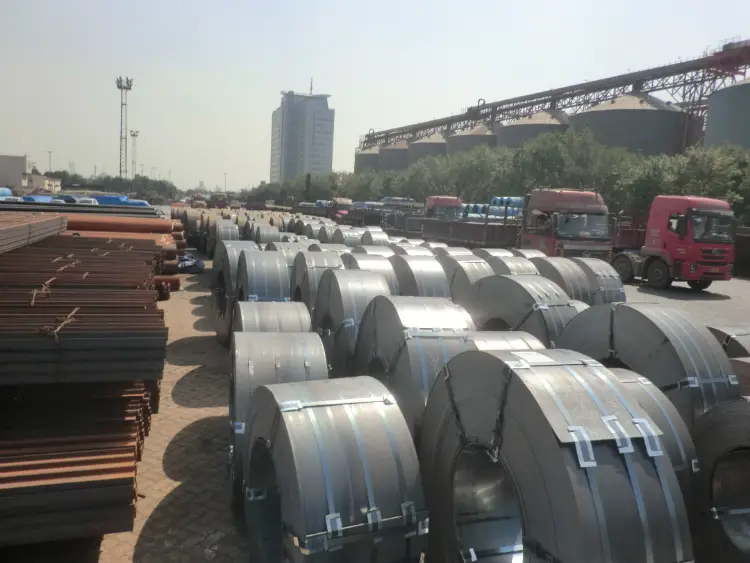
LR DH50 Shipbuilding Steel Coil
LR DH50 Shipbuilding Steel Coil: Ultimate Extra High Strength Steel for Marine Structures
Comprehensive data on LR DH50 (DH500) extra high strength shipbuilding steel coil: chemical composition, mechanical & thermal properties, full international equivalents, and application expertise. Certified by Lloyd's Register.
Quenching & Tempering (Q&T); Thermo‑Mechanical Controlled Processing + Tempering (TMCP+T); Suitable for thermal cutting, cold forming, welding (LR‑approved consumables mandatory)
- Phone : +8618037372205
- Email : [email protected]
- WhatsApp: Contact via Whtsapp
- WeChat: +8618037372205
LR DH50 Shipbuilding Steel Coil Introduction
LR DH50, formally designated as DH500, is an extra high strength structural steel certified by Lloyd's Register (LR) for critical marine and offshore engineering applications. Manufactured via quenching & tempering (Q&T) or thermo-mechanical controlled processing + tempering (TMCP+T), this grade guarantees a minimum yield strength of 500 MPa, outstanding toughness at -20°C, and excellent weldability when proper procedures are followed.
- High strength-to-weight ratio enables lighter, more efficient structures
- Low‑temperature impact toughness ensures reliability in Arctic and ice‑class operations
- Stringent LR Rules for Materials chemistry and mechanical testing ensure batch‑to‑batch consistency
DH50 is the go‑to choice for hulls, decks, offshore platform members, and other heavy‑duty components where safety and performance are non‑negotiable.
LR DH50 Shipbuilding Steel Coil Chemical Composition
Typical ladle analysis requirements per LR Rules for DH500 extra high strength steel. A lean carbon base combined with micro‑alloying (Nb, V, Ti, Al) ensures a fine grain structure and excellent weldability. Limits on P, S and residual elements are tightly controlled to maximise toughness. Carbon equivalent (CEV) is restricted to guarantee cold cracking resistance during welding.
| Element | Standard Value | Remarks |
|---|---|---|
| C | ≤ 0.18 | Ladle analysis |
| Si | ≤ 0.55 | |
| Mn | 1.00 – 1.60 | Higher manganese for strength and hardenability |
| P | ≤ 0.025 | Stringent control for low‑temperature toughness |
| S | ≤ 0.025 | |
| Al (acid soluble) | ≥ 0.015 | Grain refining and deoxidation |
| Nb | 0.02 – 0.05 | Grain refinement and precipitation strengthening |
| V | 0.05 – 0.10 | Precipitation strengthening |
| Ti | ≤ 0.02 | Grain refinement, also fixes nitrogen |
| Ni | ≤ 0.40 | Residual element; beneficial for toughness |
| Cr | ≤ 0.25 | Residual element |
| Mo | ≤ 0.25 | Residual element; increases hardenability |
| Cu | ≤ 0.35 | Residual element |
| N | ≤ 0.012 | Total nitrogen; tied up by Al and Ti |
| CEV (IIW) | ≤ 0.43 | Carbon equivalent = C + Mn/6 + (Cr+Mo+V)/5 + (Ni+Cu)/15 |
LR DH50 Shipbuilding Steel Coil Thermal and Electrical Physical Properties
Physical properties of LR DH50/DH500 at room temperature (20°C) and over a typical operating range. These values are representative for quenched & tempered low‑alloy steels and are suitable for basic design calculations. Slight variations may occur depending on exact heat chemistry and tempering temperature. The steel is non‑magnetic (ferromagnetic) below the Curie point.
| Property | Typical Value | Unit | Test Condition |
|---|---|---|---|
| Density, ρ | 7850 | kg/m³ | at 20°C |
| Elastic Modulus, E | 205 | GPa | at 20°C |
| Shear Modulus, G | 80 | GPa | at 20°C |
| Poisson's Ratio, ν | 0.30 | – | at 20°C |
| Thermal Expansion Coefficient, α | 12.0 × 10⁻⁶ | K-1 | 20 – 100°C |
| Thermal Conductivity, λ | 45 | W/(m·K) | at 20°C |
| Specific Heat Capacity, cp | 500 | J/(kg·K) | at 20°C |
| Electrical Resistivity, ρe | 0.20 × 10⁻⁶ | Ω·m | at 20°C |
LR DH50 Shipbuilding Steel Coil Mechanical Properties
Mechanical properties of LR DH50/DH500 shipbuilding steel coil and plate are validated by tensile and impact tests on specimens prepared in accordance with LR Rules. Values refer to ambient temperature testing unless stated otherwise. Properties depend on thickness; the table presents typical minimum requirements for thickness t ≤ 50 mm. The required Charpy V‑notch energy is tested at -20°C (longitudinal) to certify D‑grade toughness.
| Property | Standard Requirement | Unit | Test Condition |
|---|---|---|---|
| Yield Strength, ReH | ≥ 500 | MPa | Transverse (t ≤ 50 mm); for t > 50–100 mm min. 480 MPa |
| Tensile Strength, Rm | 610 – 770 | MPa | Transverse; gauge length 5.65√S0 |
| Elongation, A5 | ≥ 16 | % | Transverse; 5.65√S0 gauge length |
| Charpy Impact, KV2 | ≥ 27 (average) / ≥ 20 (single) | J | Longitudinal; -20°C; specimen 10×10 mm |
| Charpy Impact, KV2 | ≥ 20 (average) / ≥ 14 (single) | J | Transverse; -20°C |
| Bend Test | No cracks or discontinuities | – | 180° bend; mandrel diameter = 3×t (t≤25 mm), 4×t (t>25–50 mm) |
LR DH50 Shipbuilding Steel Coil Fully Equivalent Material Standards and Replaceable Grades
The following classification society grades are considered direct equivalents to LR DH50/DH500. They share essentially the same chemical composition limits, mechanical property requirements, and delivery condition (Q&T or TMCP+T). Mutual recognition is usually possible under IACS member cross‑certification.
| Country/Region | Standard | Grade | Remarks |
|---|---|---|---|
| United Kingdom / International | Lloyd's Register Rules for Materials | DH50 / DH500 | Original certified grade; this data sheet |
| United States | American Bureau of Shipping (ABS) Rules | DH50 / DH500 | Equivalent extra high strength grade for marine applications |
| Norway / Germany | DNV GL Rules for Classification of Ships (now DNV) | NV D50 / VL D50 | Direct substitute; often written as D500 |
| France | Bureau Veritas (BV) Rules for Materials | DH500 | Equivalent designation with identical mechanical requirements |
| China | China Classification Society (CCS) Rules for Materials | DH500 | Fully equivalent grade for Chinese shipbuilding |
| Italy | Registro Italiano Navale (RINA) Rules | DH500 | Same minimum yield and impact requirements |
| Japan | Nippon Kaiji Kyokai (ClassNK) Rules | KD50 / K D500 | Equivalent; 'K' prefix denotes NK extra high strength |
| South Korea | Korean Register (KR) Rules | DH50 / DH500 | Fully equivalent as per KR rules |
| Russia | Russian Maritime Register of Shipping (RS) Rules | DH500 | Equivalent for ice-class and heavy structures |
LR DH50 Shipbuilding Steel Coil Application Introduction
LR DH50 extra high strength steel is tailored for applications where reducing structural weight while maintaining extreme load capacity is essential. Its high yield strength (500 MPa+) allows designers to down‑gauge plates and profiles, directly translating into lower fuel consumption, higher payloads, or enhanced stability. The steel's superior low‑temperature toughness makes it a first choice for ice‑class vessels and Arctic offshore units. All fabrication (cutting, forming, welding) must follow LR‑approved workshop procedures; preheating and interpass temperature control are mandatory to avoid cold cracking. Common end‑products include hull sections, deck plates, web frames, stringers, and heavy foundation plates.
Product Applications: Hull plates of high‑speed crafts and patrol boats, Icebreaker bow and stem plates, Jack‑up rig legs and spud cans, Semi‑submersible platform columns and pontoons, Crane pedestals and heavy‑lift gear foundations, Mooring and towing brackets, Subsea structural frames, Deck stringers and sheer strakes, Longitudinal stiffeners for bottom and side shells
Processed into products: Watertight bulkhead plates (longitudinal and transverse), Web frames and girders in engine rooms, Stringers and stiffeners in cargo holds, Keel plates and bottom shell plating, Structural nodes for topside modules, Winch foundation plates and pad‑eyes, Helicopter deck substructures, Fatigue‑critical brackets and doublers
Application industries: Shipbuilding (commercial and naval), Offshore oil & gas exploration and production, Renewable offshore energy (wind turbine substructures), Heavy civil engineering and bridge construction (limited to marine environments), Port and crane manufacturing
LR DH50 Shipbuilding Steel Coil Similar/Alternative Material Recommendations
These steels offer comparable yield strength levels or are often used in similar high‑load structural contexts. They are not always drop‑in replacements due to differences in toughness guarantee, weldability, or certification scope; always verify LR compatibility before substitution.
| Country/Region | Standard | Grade | Remarks |
|---|---|---|---|
| Europe | EN 10225-1 | S500G2+M (or S500Q) | Offshore structural steel with similar strength (500 MPa yield) and toughness; Q&T or TMCP supplied |
| Europe | EN 10025-6 | S500Q/QL/QL1 | General structural Q&T plate; not certified for marine class but often used in port and heavy engineering |
| USA | ASTM A514 / A517 | Grade S | High‑yield quenched & tempered alloy plate (690 MPa) with good toughness; significantly higher strength, requires weld procedure adjustment |
| China | GB/T 712 | DH500 | Chinese shipbuilding steel standard; technically identical to LR DH500 |
| International | API 2W / 2Y | Grade 50 (345 MPa) / 60 (415 MPa) | Offshore structural steel with lower yield strength; not a direct equivalent but used for less critical members |
| International | ISO 19902 | S500G2 | Fixed steel offshore structures; similar strength level; may require additional qualification for maritime classification |
Notes:
Certification: All LR DH50 material is supplied with an LR 3.2 inspection certificate, verifying chemical composition, tensile and impact tests as per the Rules. Welding: Use only LR‑approved consumables and qualified welding procedures. Minimum preheat temperature typically 100–150°C, depending on CEV and thickness. Post‑weld heat treatment (PWHT) is not mandatory for thicknesses < 50 mm, but stress relieving may be advisable for highly restrained joints. Further guidance: Always consult the latest edition of the Lloyd's Register Rules for Materials and the specific ship/offshore structure design for permissible stress levels and fabrication tolerances. For sour service or H₂S exposure, additional testing per NACE MR0175/ISO 15156 may be required.
- Share



