
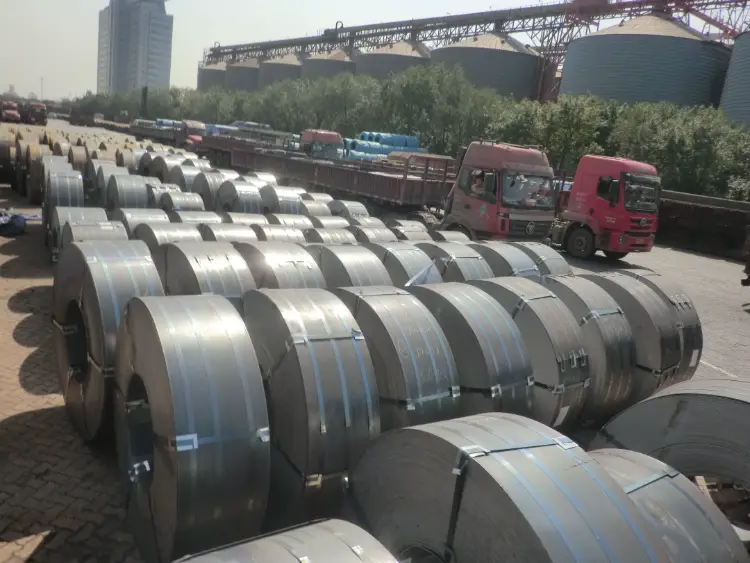
LR AH50 Shipbuilding Steel Coil
LR AH50 Shipbuilding Steel Coil: High-Strength Hull Structural Steel with 500 MPa Minimum Yield
Comprehensive data sheet for LR AH50 shipbuilding steel coil including chemical composition, mechanical properties, and physical characteristics per Lloyd's Register rules.
Cutting, forming, welding, machining, bending, shot blasting, and painting.
- Phone : +8618037372205
- Email : [email protected]
- WhatsApp: Contact via Whtsapp
- WeChat: +8618037372205
LR AH50 Shipbuilding Steel Coil Introduction
LR AH50 is a high-strength hull structural steel grade certified by Lloyd's Register, designed for use in ship and offshore construction. It is produced via thermomechanical controlled processing (TMCP) or normalizing and delivers a minimum yield strength of 500 MPa with excellent weldability and toughness at 0°C. The grade meets the requirements of IACS UR W11 and is available in coil form for efficient fabrication of plates, sections, and structural components.
LR AH50 Shipbuilding Steel Coil Chemical Composition
The following chemical limits are specified by Lloyd's Register for grade AH50 in accordance with IACS UR W11. Residual elements are controlled to ensure weldability and toughness. Aluminum is used as a grain refiner; other microalloying elements (Nb, V, Ti) may be added for strengthening.
| Chemical Element | Specified Value (%) | Remarks |
|---|---|---|
| Carbon (C) | ≤ 0.20 | Max |
| Silicon (Si) | 0.10 - 0.55 | Ladle analysis |
| Manganese (Mn) | 0.90 - 1.70 | High Mn for strength |
| Phosphorus (P) | ≤ 0.030 | Max |
| Sulfur (S) | ≤ 0.030 | Max |
| Copper (Cu) | ≤ 0.35 | Max |
| Chromium (Cr) | ≤ 0.25 | Max |
| Nickel (Ni) | ≤ 0.40 | Max |
| Molybdenum (Mo) | ≤ 0.08 | Max |
| Vanadium (V) | ≤ 0.10 | Max |
| Niobium (Nb) | ≤ 0.05 | Max |
| Titanium (Ti) | ≤ 0.02 | Max |
| Aluminum (Al) total | ≥ 0.015 | Min, if used for grain refinement |
| Nitrogen (N) | ≤ 0.012 | Max, if sufficient Al present |
LR AH50 Shipbuilding Steel Coil Thermal and Electrical Physical Properties
The values below are typical for low‑alloy structural steels and are not part of the LR specification but are widely used in engineering calculations. They are valid at room temperature unless otherwise noted.
| Property | Typical Value | Unit | Test Condition / Remarks |
|---|---|---|---|
| Density (ρ) | 7.85 | g/cm³ | At 20°C |
| Elastic modulus (E) | 205 | GPa | At 20°C, tension |
| Shear modulus (G) | 80 | GPa | Estimated from E and ν |
| Poisson's ratio (ν) | 0.3 | - | Within elastic range |
| Thermal expansion coefficient (α) | 11.7 × 10⁻⁶ | K⁻¹ | Average 0–100°C |
| Thermal conductivity (λ) | 50 | W/(m·K) | At 20°C |
| Specific heat capacity (c_p) | 460 | J/(kg·K) | At 20°C |
| Electrical resistivity (ρ_e) | 0.13 – 0.17 | ×10⁻⁶ Ω·m | At 20°C |
LR AH50 Shipbuilding Steel Coil Mechanical Properties
Mechanical properties apply to TMCP or normalized condition for thicknesses up to 50 mm. Charpy impact tests are performed on longitudinal specimens at 0°C. Bend test diameter depends on thickness. Values are minimum unless a range is indicated.
| Property | Standard Requirement | Unit | Test Condition |
|---|---|---|---|
| Yield strength (ReH) | ≥ 500 | MPa | Through-thickness, for t ≤ 100 mm |
| Tensile strength (Rm) | 610 - 770 | MPa | Transverse or longitudinal, room temperature |
| Elongation (A) | ≥ 16 | % | Gauge length 5.65√So |
| Charpy V‑notch impact energy | ≥ 27 | J | Longitudinal, 0°C, average of 3 tests |
| Charpy V‑notch impact energy (transverse) | ≥ 20 | J | Transverse, 0°C, when specified |
| Bend test (180° bend) | No cracks | - | Mandrel diameter 3t (t ≤ 25 mm), 4t (t > 25 mm) |
LR AH50 Shipbuilding Steel Coil Exact Equivalent Material Standards and Substitutable Grades
| Country / Region | Standard | Grade | Remarks |
|---|---|---|---|
| International | IACS UR W11 | AH50 | Unified requirement followed by all IACS members |
| USA | ABS Rules | AH50 | Identical to IACS AH50 |
| France | BV Rules | AH50 | Identical to IACS AH50 |
| China | CCS Rules | AH50 | Identical to IACS AH50 |
| Norway/Germany | DNV Rules | AH50 | Identical to IACS AH50 |
| South Korea | KR Rules | AH50 | Identical to IACS AH50 |
| Japan | NK Rules | AH50 | Identical to IACS AH50 |
| Italy | RINA Rules | AH50 | Identical to IACS AH50 |
LR AH50 Shipbuilding Steel Coil Application Introduction
AH50 steel in coil form is widely processed into plates and sections for the shipbuilding and offshore industries. Its high strength allows lighter designs without compromising safety, and the 0°C impact toughness covers most service conditions. Typical processing includes cutting, forming by cold or hot working, and extensive welding.
Product Applications: Hulls of container ships, bulk carriers, tankers, passenger ships, Deck plates, bottom shell plates, side shell plates, Offshore platform jackets, topside modules, flare booms, Monopile and transition pieces for offshore wind turbines
Processed into products: Main deck and bottom longitudinal stiffeners, Transverse bulkheads and web frames, Hatch coamings and covers, Brackets, rudder horns, stern frames, Structural members in ice‑class ships (when supplemented by appropriate class notation)
Application industries: Shipbuilding (commercial and naval), Offshore oil & gas platforms, Renewable marine energy (wind turbine foundations), Heavy structural engineering in marine environments
LR AH50 Shipbuilding Steel Coil Similar or Alternative Grade Recommendations
| Country / Region | Standard | Grade | Remarks |
|---|---|---|---|
| International | IACS UR W11 | DH50 | Higher toughness: Charpy at -20°C instead of 0°C |
| International | IACS UR W11 | EH50 | Very high toughness: Charpy at -40°C |
| International | IACS UR W11 | FH50 | Ultra‑high toughness: Charpy at -60°C |
| International | IACS UR W11 | AH46 | Slightly lower yield strength (≥460 MPa), otherwise similar |
Notes:
Certification: All deliveries must be accompanied by a Lloyd's Register material certificate (Form 3.1 or 3.2 per EN 10204). Welding: Approved welding consumables and procedures according to LR Rules are required. The steel is cusually supplied with primed surfaces for temporary corrosion protection during construction.
- Share



