
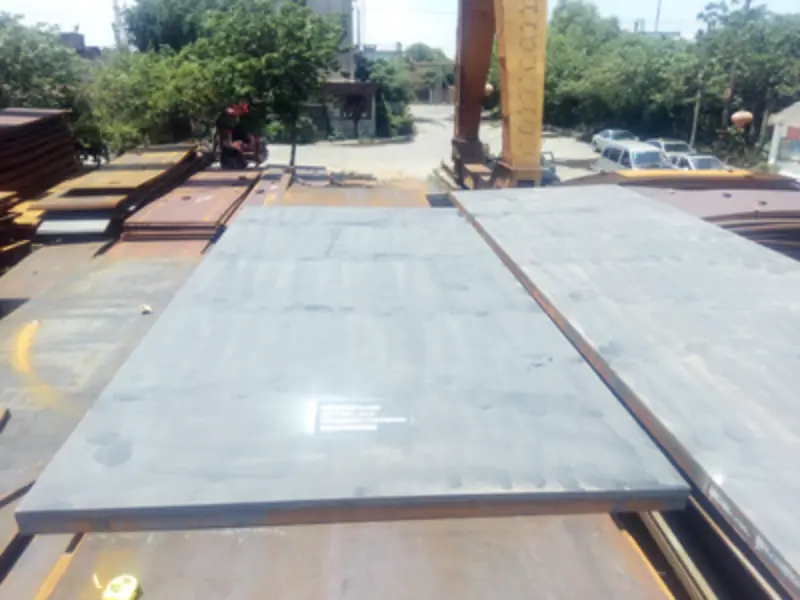
SUS301 Austenitic Stainless Steel Plate/Coil
SUS301 Austenitic Stainless Steel Plate/Coil - JIS G4304 & G4305 High-Strength Grade
Comprehensive data on SUS301 stainless steel: chemical composition, mechanical & physical properties, international equivalents, and typical applications for plate and coil per JIS G4304/G4305 standards.
Hot rolling, cold rolling, solution annealing, temper rolling, stamping, bending, welding, deep drawing
- Phone : +8618037372205
- Email : [email protected]
- WhatsApp: Contact via Whtsapp
- WeChat: +8618037372205
SUS301 Austenitic Stainless Steel Plate/Coil Introduction
SUS301 is a metastable austenitic stainless steel standardized in JIS G4304 (hot-rolled plates) and JIS G4305 (cold-rolled sheets/coils). Its chemical composition is balanced to provide a fully austenitic structure after solution annealing, and the grade is renowned for its exceptional work-hardening rate. Key characteristics:
- High strength achievable by cold working, while retaining adequate ductility.
- Good corrosion resistance in mildly corrosive environments, comparable to Type 304 in the annealed condition.
- Excellent formability in the soft annealed state, suitable for deep drawing, bending, and stamping.
- Available in a wide range of temper-rolled conditions (1/4H, 1/2H, 3/4H, H, EH) for spring and structural applications.
- Non-magnetic in the annealed condition, becoming slightly magnetic after cold working due to martensite formation.
SUS301 Austenitic Stainless Steel Plate/Coil Chemical Composition
Heat analysis limits according to JIS G4304 and JIS G4305. SUS301 relies on balanced chromium and nickel contents to maintain an austenitic structure while promoting deformation-induced martensite for high work-hardening rates. Nitrogen is intentionally limited to avoid excessive austenite stabilization.
| Element | Standard Value | Remarks |
|---|---|---|
| Carbon (C) | ≤ 0.15 | Max. |
| Silicon (Si) | ≤ 1.00 | Max. |
| Manganese (Mn) | ≤ 2.00 | Max. |
| Phosphorus (P) | ≤ 0.045 | Max. |
| Sulfur (S) | ≤ 0.030 | Max. |
| Nickel (Ni) | 6.00 – 8.00 | |
| Chromium (Cr) | 16.00 – 18.00 | |
| Nitrogen (N) | ≤ 0.10 | Max. |
SUS301 Austenitic Stainless Steel Plate/Coil Thermal and Electrical Physical Properties
The following properties are typical for SUS301 in the solution-annealed condition at room temperature unless otherwise noted. Values may vary slightly with cold working and temperature. The material exhibits moderate thermal expansion and low thermal conductivity, typical of austenitic stainless steels.
| Property | Typical Value | Unit | Test Condition / Temperature |
|---|---|---|---|
| Density (ρ) | 7.93 | g/cm³ | 20 °C |
| Modulus of Elasticity (E) | 193 | GPa | 20 °C |
| Shear Modulus (G) | 74 | GPa | 20 °C (approx.) |
| Poisson's Ratio (ν) | 0.29 – 0.30 | – | 20 °C |
| Thermal Expansion Coef. (α) | 16.9 | 10⁻⁶/°C | 20–100 °C |
| Thermal Expansion Coef. (α) | 17.3 | 10⁻⁶/°C | 20–200 °C |
| Thermal Expansion Coef. (α) | 17.8 | 10⁻⁶/°C | 20–300 °C |
| Thermal Conductivity (λ) | 16.3 | W/m·K | 100 °C |
| Thermal Conductivity (λ) | 21.5 | W/m·K | 500 °C |
| Specific Heat Capacity (cp) | 500 | J/kg·K | 0–100 °C |
| Electrical Resistivity (ρe) | 0.72 | µΩ·m | 20 °C |
SUS301 Austenitic Stainless Steel Plate/Coil Mechanical Properties
Mechanical properties depend strongly on the delivery condition. Values for solution-annealed products comply with JIS G4304/G4305 for soft grade. For cold-rolled temper grades, the minimum strengths and typical elongation are per JIS G4305 (cold-rolled sheet/strip). Hardness is often reported in HRB, HV, or HBW; typical ranges are provided. Work hardening dramatically increases tensile and yield strengths while reducing ductility.
| Property | Standard Requirement | Unit | Test Condition |
|---|---|---|---|
| Tensile Strength (Rm) | ≥ 520 | MPa | Solution annealed, room temperature |
| Yield Strength (ReH / Rp0.2) | ≥ 205 | MPa | Solution annealed, room temperature |
| Elongation (A50 mm) | ≥ 40 | % | Solution annealed, thickness ≤ 3 mm, gauge length 50 mm |
| Hardness (HBW) | ≤ 218 | HBW | Solution annealed |
| Hardness (HRB) | ≤ 95 | HRB | Solution annealed |
| Hardness (HV) | ≤ 207 | HV | Solution annealed |
| Tensile Strength (Rm) | ≥ 860 | MPa | 1/4H temper (cold-rolled), thickness 0.3–3.0 mm |
| Yield Strength (Rp0.2) | ≥ 510 | MPa | 1/4H temper, thickness 0.3–3.0 mm |
| Elongation (A50 mm) | ≥ 25 | % | 1/4H temper, thickness 0.3–3.0 mm |
| Tensile Strength (Rm) | ≥ 930 | MPa | 1/2H temper (cold-rolled), thickness 0.3–3.0 mm |
| Yield Strength (Rp0.2) | ≥ 510 | MPa | 1/2H temper, thickness 0.3–3.0 mm |
| Elongation (A50 mm) | ≥ 10 | % | 1/2H temper, thickness 0.3–3.0 mm |
| Tensile Strength (Rm) | ≥ 1130 | MPa | 3/4H temper (cold-rolled), thickness 0.3–3.0 mm |
| Yield Strength (Rp0.2) | ≥ 745 | MPa | 3/4H temper, thickness 0.3–3.0 mm |
| Elongation (A50 mm) | ≥ 5 | % | 3/4H temper, thickness 0.3–3.0 mm |
| Tensile Strength (Rm) | ≥ 1320 | MPa | H temper (full hard), typical |
| Yield Strength (Rp0.2) | ≥ 1030 | MPa | H temper, typical |
SUS301 Austenitic Stainless Steel Plate/Coil Complete Equivalent Material Standards & Substitute Grades
| Country/Region | Standard | Grade | Remarks |
|---|---|---|---|
| USA | ASTM A666 (or A240/A240M) | 301 (UNS S30100) | Austenitic stainless steel, closest match |
| European Union | EN 10088-2 | 1.4310 (X12CrNi17-7) | Similar composition, slightly wider C range accepted |
| China | GB/T 3280 / GB/T 1220 | 12Cr17Ni7 (former 1Cr17Ni7) | Direct equivalent in Chinese standard |
| International | ISO 15510 | X5CrNi17-7 | Similar, lower carbon typical (0.07 max.) |
| Russia | GOST 5632 | 12Х17Н7 (12Cr17Ni7) | Equivalent to SUS301 |
SUS301 Austenitic Stainless Steel Plate/Coil Application Introduction
SUS301 is chosen where a combination of high strength, good formability, and moderate corrosion resistance is needed. The grade is extensively used in spring manufacturing because cold working can raise tensile strength well above 1300 MPa. It also finds application in structural parts that benefit from reduced weight due to high strength.
- Precautions: Avoid prolonged exposure at 400–800 °C to prevent sensitization; post-forming stress relief can be performed at 200–350 °C.
- Magnetism: Annealed SUS301 is non-magnetic but becomes magnetic after cold working.
- Welding: Use standard procedures, but avoid if maximum temper strength must be preserved.
Product Applications: Precision springs (coil, leaf, spiral), Constant force springs, Metal clips and clamps, Electronic connectors and terminals, Snap‑action discs for keyboards and switches, Wave springs and Belleville washers, Automotive hose clamps, Conveyor belt stiffeners, Railway car body sheets
Processed into products: Spring washers (e.g., for bolt assemblies), Battery contacts (AA, AAA, coin cell holders), Keypad domes (membrane switches), Constant force springs (cable retractors), Locking clips for automotive upholstery, Hose clamps (worm-drive and spring type), Flexible shaft cores (medical endoscopes, control cables), Retaining rings and circlips, Shield fingers (EMI gaskets), Wiper blade springs
Application industries: Automotive (exhaust hangers, trim, hose clamps, structural clips), Electronics (spring contacts, battery terminals, snap domes, shielding), Railway vehicles (body panels, interior trim, structural frames – often SUS301L), General engineering (springs, fasteners, conveyor belts, metal gaskets), Medical instruments (flexible shafts, orthodontic wires), Aerospace (clamps, brackets, non-critical springs)
SUS301 Austenitic Stainless Steel Plate/Coil Similar / Alternative Material Recommendations
| Country/Region | Standard | Grade | Remarks |
|---|---|---|---|
| Japan | JIS G4304/G4305 | SUS304 (AISI 304) | Lower strength, higher corrosion resistance, no significant work-hardening peaks |
| Japan | JIS G4304/G4305 | SUS302 (AISI 302) | Higher carbon for increased strength, similar work-hardening, more stable austenite |
| Japan | JIS G4304/G4305 | SUS301L | Low-carbon variant with improved weldability and intergranular corrosion resistance, used in railway cars |
| Europe | EN 10088-2 | 1.4319 (X5CrNi17-7) | Lower carbon version of 301, softer but better corrosion resistance |
| USA | ASTM A666 | 301LT (low temperature grade) | Designed for cryogenic applications, retains toughness |
Notes:
Special ordering: Cold-rolled temper designations (1/4H, 1/2H, etc.) must be specified when ordering. Surface finishes: Common options for cold-rolled strip include bright annealed (BA), 2B, and dull-polished finishes. For spring applications, surface quality can affect fatigue life; specify smooth, defect-free surface if needed. Passivation is recommended after mechanical processing to restore corrosion resistance.
- Share



