
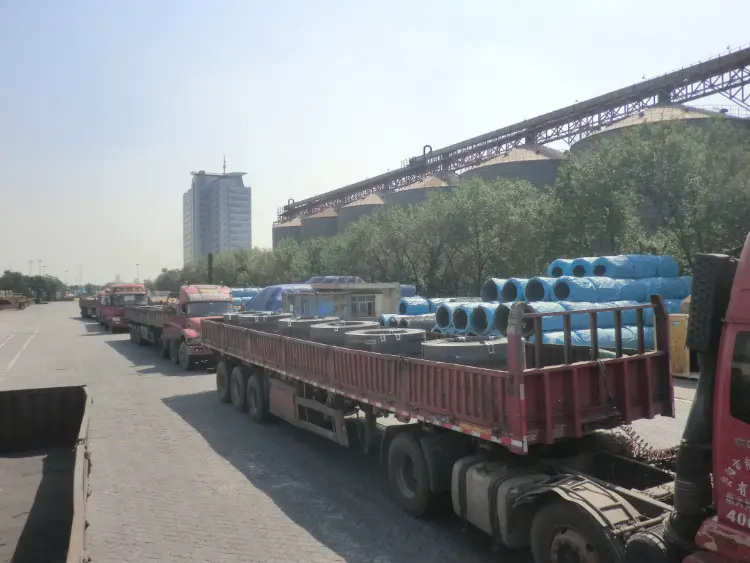
Q245NHYJ Weather Resistant Steel Coil
Q245NHYJ Weather Resistant Steel Coil - TB/T 1979-2014 Grade Data & International Equivalents
Comprehensive technical data for Q245NHYJ weathering steel coil under TB/T 1979-2014, including chemical composition, mechanical properties, thermal/electrical performance, equivalent grades, and application guidance.
Hot rolling, cold rolling, pickling and oiling, stamping, bending, welding, machining, normalising
- Phone : +8618037372205
- Email : [email protected]
- WhatsApp: Contact via Whtsapp
- WeChat: +8618037372205
Q245NHYJ Weather Resistant Steel Coil Introduction
Q245NHYJ is a high‑strength, low‑alloy weather‑resistant structural steel covered by the Chinese railway standard TB/T 1979‑2014 (Atmospheric Corrosion Resisting Steel for Railway Rolling Stock). It is designed for welded structures exposed to the atmosphere, particularly in railway vehicles. The alloying concept, based on Cu‑Cr‑Ni additions, promotes the formation of a dense, adherent protective oxide layer (patina) that significantly reduces further corrosion.
- Minimum yield strength: 245 MPa in the as‑rolled or normalised condition
- Good low‑temperature toughness (‑40°C impact energy ≥ 27 J)
- Excellent weldability and formability
- Supplied as hot‑rolled coil, plate and strip
Note: Although often queried under GB/T 18982‑2003, Q245NHYJ is not listed in that standard. The data provided here strictly conform to TB/T 1979‑2014. Information on the nearest GB/T 18982‑2003 equivalent is given in the general notes.
Q245NHYJ Weather Resistant Steel Coil Chemical Composition
The chemical composition of Q245NHYJ is tailored to achieve a balance of strength, toughness and atmospheric corrosion resistance. Copper, chromium and nickel are the primary weathering elements that promote the formation of a stable, protective rust layer. Low carbon content ensures good weldability, while microalloy additions (V, Nb, Ti) contribute to grain refinement and precipitation strengthening.
| Chemical Element | Standard Value (wt%) | Remarks |
|---|---|---|
| Carbon (C) | ≤ 0.12 | max |
| Silicon (Si) | 0.17 – 0.50 | |
| Manganese (Mn) | 0.30 – 0.60 | |
| Phosphorus (P) | ≤ 0.025 | max |
| Sulfur (S) | ≤ 0.020 | max |
| Copper (Cu) | 0.20 – 0.45 | Corrosion resistance element |
| Chromium (Cr) | 0.40 – 0.65 | Corrosion resistance element |
| Nickel (Ni) | 0.10 – 0.40 | Improves toughness and patina adhesion |
| Molybdenum (Mo) | ≤ 0.30 | max |
| Vanadium (V) | ≤ 0.08 | max, optional microalloy |
| Niobium (Nb) | ≤ 0.05 | max, optional microalloy |
| Titanium (Ti) | ≤ 0.05 | max, optional microalloy |
| Aluminium (Alt, acid‑soluble) | 0.015 – 0.060 | Deoxidation and grain refinement |
| Nitrogen (N) | ≤ 0.012 | max |
Q245NHYJ Weather Resistant Steel Coil Thermal & Electrical Physical Properties – Typical Reference Values
These physical properties are representative for Q245NHYJ as a low‑alloy ferritic‑pearlitic steel. They are not specified in TB/T 1979‑2014 but are derived from measurements on similar Cu‑Cr‑Ni weathering steels. Values may vary slightly with composition and processing. These data can be used for design calculations, finite element modelling, and welding simulations.
| Property | Typical Value | Unit | Test Condition |
|---|---|---|---|
| Density (ρ) | 7.85 | g/cm³ | at 20°C |
| Elastic Modulus (E) | 206 | GPa | at 20°C, tension |
| Shear Modulus (G) | 79.3 | GPa | at 20°C (calculated) |
| Poisson's Ratio (ν) | 0.30 | – | at 20°C |
| Thermal Expansion Coefficient (α) | 12.2 × 10⁻⁶ | K⁻¹ | 20 – 100°C |
| Thermal Expansion Coefficient (α) | 12.8 × 10⁻⁶ | K⁻¹ | 20 – 200°C |
| Thermal Expansion Coefficient (α) | 13.5 × 10⁻⁶ | K⁻¹ | 20 – 400°C |
| Thermal Conductivity (λ) | 52 | W/m·K | at 20°C |
| Specific Heat Capacity (cₚ) | 460 | J/kg·K | at 20°C |
| Electrical Resistivity (ρₑ) | 0.22 | µΩ·m | at 20°C |
Q245NHYJ Weather Resistant Steel Coil Mechanical Properties – Typical Reference Values
The mechanical properties listed below are guaranteed for the delivery condition (typically hot‑rolled or normalised) and correspond to the requirements of TB/T 1979‑2014. Yield strength and elongation vary with thickness. Impact energy is measured on longitudinal Charpy‑V specimens at ‑40°C, ensuring adequate low‑temperature toughness for railway applications. Bending tests confirm ductility and formability.
| Property | Standard Requirement | Unit | Test Condition / Thickness Range |
|---|---|---|---|
| Yield Strength (ReH) | ≥ 245 | MPa | Thickness ≤ 16 mm |
| Yield Strength (ReH) | ≥ 235 | MPa | 16 mm < thickness ≤ 40 mm |
| Yield Strength (ReH) | ≥ 225 | MPa | 40 mm < thickness ≤ 60 mm |
| Tensile Strength (Rm) | 400 – 540 | MPa | All thicknesses |
| Elongation after fracture (A) | ≥ 24 | % | Thickness ≤ 25 mm, gauge length 5.65√So |
| Elongation after fracture (A) | ≥ 23 | % | 25 mm < thickness ≤ 40 mm |
| Elongation after fracture (A) | ≥ 22 | % | 40 mm < thickness ≤ 60 mm |
| Bend Test | d = 2a | – | Thickness ≤ 16 mm, 180° bend, no crack |
| Bend Test | d = 3a | – | 16 mm < thickness ≤ 100 mm, 180° |
| Impact Energy (KV) | ≥ 27 | J | ‑40°C, longitudinal Charpy‑V notch |
Q245NHYJ Weather Resistant Steel Coil Fully Equivalent Materials & Recommended Replacement Grades
The following international grades are considered functionally equivalent to Q245NHYJ in terms of yield strength, tensile range, and atmospheric corrosion resistance. They can be used as direct substitutes in many applications, but verification according to the specific design code is advised.
| Country/Region | Standard | Grade | Remarks |
|---|---|---|---|
| Japan | JIS G3114 | SMA400AW | Closest match – same strength level (ReH≥245 MPa, Rm 400-540 MPa) with Cu‑Cr‑Ni weathering alloying for welded structures. |
| Europe | EN 10025‑5 | S235J2W | Slightly lower minimum yield (235 MPa), tensile 360‑510 MPa, with Cu‑Cr‑Ni‑P weathering; suitable for less demanding strength requirements. |
| Germany (former) | DIN 5512‑1 (withdrawn?) | S235J2W+N | Equivalent to EN grade; often used in European railway stock. |
| China | GB/T 4171‑2008 | Q265GNH | Higher strength grade (ReH 265 MPa) but same concept; may be substituted with re‑engineering. |
Q245NHYJ Weather Resistant Steel Coil Application Introduction
Q245NHYJ steel is purpose‑built for railway rolling stock and other transport applications where long service life under atmospheric exposure is required without painting. Its moderate strength and excellent weldability make it suitable for large, thin‑walled structures.
- Railway industry – passenger coach bodies, freight wagon underframes, side walls, roofs, hoppers
- Intercity and metro trains – interior framing, outer skins
- Containers and shelters – exposed structural panels
- Infrastructure – foot bridges, noise barriers, lighting poles
Product Applications: Hot‑rolled pickled and oiled coil, Railway vehicle body panels, Structural beams and pillars, Corrugated roof and side sheets, Welded sub‑assemblies for wagons
Processed into products: Passenger coach side frames and roof arcs, Freight wagon underframe solebars and crossties, End walls and door panels, Collision posts, corner posts, Reinforcing plates and gussets, Welded bracket assemblies, Floor plates and stair treads
Application industries: Railway rolling stock manufacturing, Freight wagon and carriage building, Intercity / high‑speed train body shells, Structural engineering (bridges, shelters), Container and modular housing
Q245NHYJ Weather Resistant Steel Coil Similar / Closely Related Weathering Steel Grades
These materials exhibit comparable corrosion resistance and weldability but differ mainly in strength level. They can be considered when Q245NHYJ is unavailable, with possible adjustments to section thickness or design.
| Country/Region | Standard | Grade | Remarks |
|---|---|---|---|
| China | TB/T 1979‑2014 | Q295NHYJ | Higher yield (295 MPa) grade of the same family; excellent low‑temperature toughness. |
| China | GB/T 4171‑2008 | Q295NH | For welded structures; minimum yield 295 MPa; may require thickness reassessment. |
| USA | ASTM A588 | Grade A | Yield strength 345 MPa (≤100mm), Cu‑Cr‑Ni‑V weathering; often used in bridges and buildings; over‑matching strength may affect stiffness. |
| Europe | EN 10025‑5 | S355J2W | Yield 355 MPa; very popular for structural weathering applications; can replace Q245NHYJ if global geometry permits weight savings. |
| Japan | JIS G3114 | SMA490AW | Yield ≥365 MPa; higher strength weathering steel widely used in welded structures. |
Notes:
Standard Clarification: The grade Q245NHYJ is defined by TB/T 1979‑2014, not GB/T 18982‑2003. The latter (Atmospheric Corrosion Resisting Steel for Welded Structure) does not include this exact designation. The GB/T 18982‑2003 family contains grades such as Q235NH, Q295NH, Q355NH, but none with the "YJ" suffix. If procurement is bound to GB/T 18982‑2003, the closest equivalent would be Q235NH (yield 235 MPa) or a custom‑tailored version with higher Cu/Ni content. The data above faithfully represent Q245NHYJ as per the railroad standard. For railway projects, always refer to TB/T 1979‑2014 or the applicable version.
- Share



