
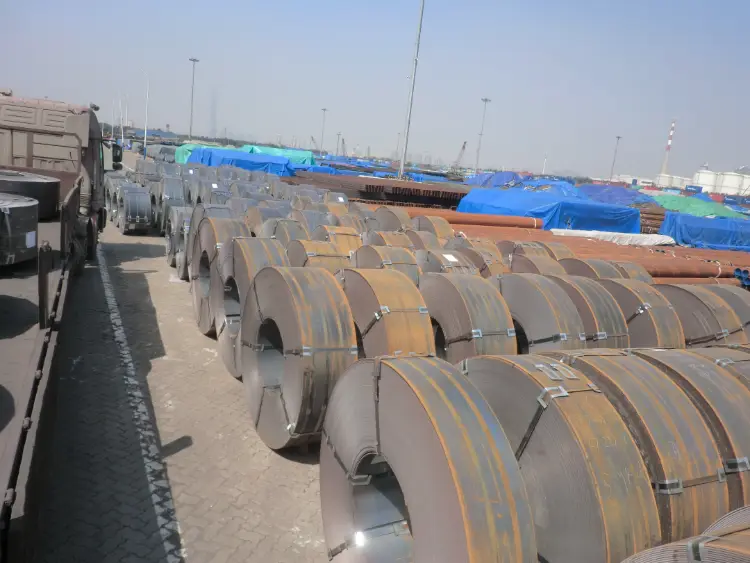
Q310GNHJ Weather Resistant Steel Coil
Q310GNHJ Weather Resistant Steel Coil: Container & Structure Solution as per GB/T 18982-2003
Explore Q310GNHJ weather resistant steel coil according to GB/T 18982-2003, its chemical composition, mechanical properties, thermal data, full equivalents, and application guide for containers, railway vehicles, and architectural structures.
Hot rolling, controlled rolling, normalizing, cold forming (optional subsequent processing)
- Phone : +8618037372205
- Email : [email protected]
- WhatsApp: Contact via Whtsapp
- WeChat: +8618037372205
Q310GNHJ Weather Resistant Steel Coil Introduction
Q310GNHJ is a high-weather-resistance structural steel for containers specified in GB/T 18982-2003. It is alloyed with copper, chromium, and nickel to form a stable, protective rust patina under atmospheric exposure, eliminating the need for painting in many applications. Key features:
- Minimum yield strength of 310 MPa (≤16 mm thickness)
- Excellent weldability and cold-forming capability
- Good impact toughness at -20 °C (KV2 ≥27 J)
- Superior atmospheric corrosion resistance – 2 to 8 times that of carbon steel
- Supplied typically as hot-rolled coil, plate, or strip
This grade is widely used in container manufacturing, railway wagons, transmission tower structures, and architectural cladding demanding durability and low maintenance.
Q310GNHJ Weather Resistant Steel Coil Chemical Composition
The alloy design of Q310GNHJ weather resistant steel relies on Cu, Cr, Ni, and Si additions to promote formation of a dense protective rust layer. Phosphorus is kept low to ensure toughness. Nickel is limited to avoid excessive cost while improving resistance in marine environments. The composition complies with GB/T 18982-2003 for container steel.
| Element | Specified Value (wt.%) | Remarks |
|---|---|---|
| Carbon (C) | ≤ 0.12 | Ladle analysis |
| Silicon (Si) | 0.25 – 0.75 | |
| Manganese (Mn) | 0.20 – 0.50 | |
| Phosphorus (P) | ≤ 0.030 | |
| Sulfur (S) | ≤ 0.030 | |
| Copper (Cu) | 0.25 – 0.50 | |
| Chromium (Cr) | 0.30 – 1.25 | |
| Nickel (Ni) | ≤ 0.65 | |
| Aluminum (Al) | ≥ 0.020 (optional) | For complete deoxidation |
| Nitrogen (N) | ≤ 0.009 (optional) | If needed for property stability |
| Others (Nb, V, Ti) | May be added singly or in combination | For grain refinement; limits by standard |
Q310GNHJ Weather Resistant Steel Coil Thermal & Electrical Physical Properties
Physical properties are representative for low-alloy weather resistant steels (0.12% C, typical alloy content). They vary slightly with composition and heat treatment. Values are provided for design calculations and are not mandatory in the standard. Density, thermal expansion, and thermal conductivity closely resemble ordinary structural steel.
| Property | Typical Value | Unit | Test Condition |
|---|---|---|---|
| Density (ρ) | 7.85 | g/cm³ | 20 °C |
| Modulus of elasticity (E) | 206 | GPa | 20 °C, tension |
| Shear modulus (G) | ~80 | GPa | 20 °C, calculated |
| Poisson's ratio (ν) | ~0.30 | - | 20 °C |
| Thermal expansion coefficient (α) | 12.0 | 10⁻⁶/K | 20 °C – 100 °C |
| Thermal expansion coefficient (α) | 13.6 | 10⁻⁶/K | 20 °C – 300 °C |
| Thermal conductivity (λ) | ~45 | W/(m·K) | 100 °C |
| Thermal conductivity (λ) | ~40 | W/(m·K) | 300 °C |
| Specific heat capacity (cp) | ~460 | J/(kg·K) | 100 °C |
| Specific heat capacity (cp) | ~540 | J/(kg·K) | 300 °C |
| Electrical resistivity (ρ_e) | ~0.25 | μΩ·m | 20 °C |
Q310GNHJ Weather Resistant Steel Coil Mechanical Properties
Mechanical properties are determined at ambient temperature on transverse specimens taken from hot-rolled products in delivery condition. Impact energy is guaranteed at -20°C (J-suffix) to ensure safety in cold environments. Bend test verifies formability. All values are minimum unless otherwise stated, according to GB/T 18982-2003.
| Property | Specification Value | Unit | Test Condition |
|---|---|---|---|
| Upper yield strength (ReH) | ≥ 310 | MPa | Thickness ≤ 16 mm, transverse |
| Upper yield strength (ReH) | ≥ 300 | MPa | Thickness > 16 mm ≤ 40 mm, transverse |
| Tensile strength (Rm) | 440 – 580 | MPa | Thickness ≤ 40 mm, transverse |
| Elongation after fracture (A5) | ≥ 22 | % | Thickness ≤ 16 mm, gauge length 5.65√S0, transverse |
| Elongation after fracture (A5) | ≥ 21 | % | Thickness > 16 mm ≤ 40 mm, transverse |
| Impact energy (KV2) at -20 °C | ≥ 27 | J | Charpy-V, longitudinal, average of three tests |
| Cold bending test (d = bend diameter, a = thickness) | d = 2a, 180° no cracks | - | Thickness ≤ 16 mm, transverse |
| Cold bending test | d = 3a, 180° no cracks | - | Thickness > 16 mm ≤ 40 mm, transverse |
Q310GNHJ Weather Resistant Steel Coil Full Equivalent Material Standards & Substitutable Grades
| Country / Region | Standard | Grade | Remarks |
|---|---|---|---|
| China | GB/T 4171 | Q310GNH | Identical composition and mechanical properties; not specifically for containers, but technically interchangeable. |
| Japan | JIS G3125 | SPA-H | Higher yield (min 355 MPa) and tensile (min 490 MPa); similar weathering alloys; may require redesign if substituted. |
| EU | EN 10025-5 | S355J0W / S355J2W | Yield min 355 MPa; impact levels J0/J2, may match -20°C toughness; composition not identical but achieve comparable weathering resistance. |
| USA | ASTM A242 | Type 1 | Yield min 345 MPa; higher strength; chemistry differs slightly; commonly used for similar applications. |
| International | ISO 5952 | S355J0W / S355J2W | Equivalent to EN grades, higher strength. |
Q310GNHJ Weather Resistant Steel Coil Application Introduction
Q310GNHJ is specifically designed for unpainted or minimally painted applications in atmospheric exposure. Its self-protecting rust layer slows further corrosion, making it ideal for:
- Dry freight containers and their structural frames
- Railway freight car bodies and components
- Corrosion-resistant building panels, roof sheeting, and curtain walls
- Transmission and telecommunication towers
- Highway guardrails and bridge components (non-primary load-bearing)
Product Applications: ISO dry freight containers, Open-top containers and flat racks, Railway boxcars and hopper cars, Prefabricated building modules, Exterior cladding and roofing sheets, Lattice transmission towers, Sound barrier walls and highway crash barriers, Outdoor sculptures and urban furniture
Processed into products: Container floor framing, corner posts, side panels, Wagon body sheets, underframe, door frames, Tower legs and bracing angles, Roll-formed purlins and girts, Pressed and welded structural brackets, Ductile bolted / riveted assemblies, Cold-bent sections and trapezoidal profiles
Application industries: Container manufacturing, Railway vehicle and wagon building, Architecture and construction (facades, roofing), Power transmission (towers), Shipbuilding (superstructure, non-critical parts), Industrial and civil engineering
Q310GNHJ Weather Resistant Steel Coil Closely Related Alternative Materials
| Country / Region | Standard | Grade | Remarks |
|---|---|---|---|
| Japan | JIS G3125 | SPA-C | Cold-rolled weather resistant steel, lower strength, used for cladding and light-gauge profiles. |
| USA | ASTM A588 | Grade A | Yield min 345 MPa, higher nickel content, used in structural bridges. |
| EU | EN 10025-5 | S235J0W / S235J2W | Yield min 235 MPa; lower strength but similar corrosion resistance; can be used for less stressed components. |
| China | GB/T 4171 | Q355GNH | Higher strength (min 355 MPa) weathering steel, otherwise comparable in chemistry and use. |
| Germany | DIN 17100 (historic) | WTSt 37-3 (obsolete) | Old weathering steel grade; now replaced by EN standards. |
Notes:
Performance relies on alternating wet/dry cycles for patina formation. For continuous immersion or highly polluted environments, protective coating may be necessary. Welding consumables must be compatible (e.g., AWS E7018 or weathering-specific electrodes). Preheating (100–150 °C) is recommended for plate thicknesses above 20 mm. Surface preparation for painting requires removal of loose rust, but sound patina may be left intact. Always consult the latest GB/T 18982-2003 for thickness and testing tolerances.
- Share



