
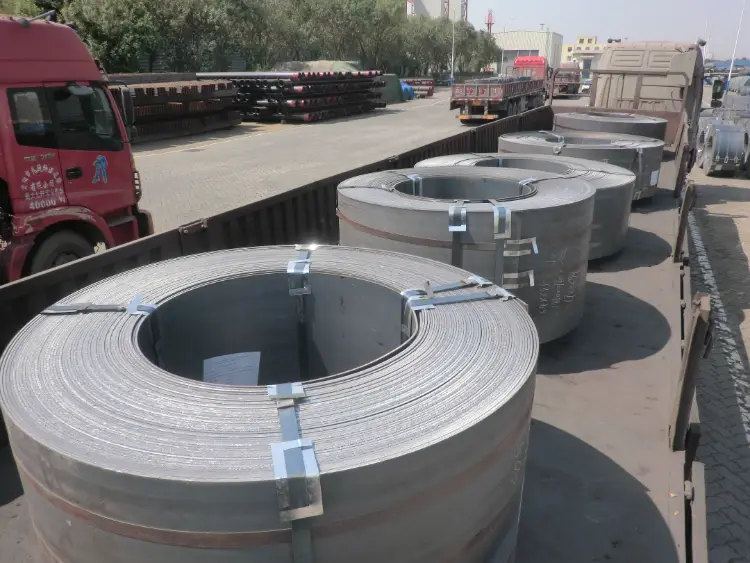
Q310GNHLJ Weather Resistant Steel Coil per GB/T 18982-2003
Q310GNHLJ Weather Resistant Steel Coil per GB/T 18982-2003 - Full Data & Equivalents
Comprehensive technical profile for Q310GNHLJ weather resistant steel coil (coil/sheet/strip) according to Chinese standard GB/T 18982-2003. Includes verified chemical composition, mechanical and thermo-physical properties, international equivalents, similar alloys, and application guidance for container and structural engineering.
Hot rolling, controlled rolling, cold forming, welding, stamping, bending
- Phone : +8618037372205
- Email : [email protected]
- WhatsApp: Contact via Whtsapp
- WeChat: +8618037372205
Q310GNHLJ Weather Resistant Steel Coil per GB/T 18982-2003 Introduction
Q310GNHLJ is a high-performance weather resistant structural steel specifically developed for container manufacturing, standardized under GB/T 18982-2003 (Corrosion resistant steel plates and strips for containers). It belongs to the Cu-Cr-Ni atmospheric corrosion resistant steel family, offering enhanced resistance to atmospheric corrosion by forming a dense, protective oxide layer. With a minimum yield strength of 310 MPa and good weldability, this grade is delivered primarily as hot-rolled coil, sheet or strip in as-rolled or controlled-rolled condition. Its balanced chemistry (Cu, Cr, Ni) ensures service life extension in outdoor environments without painting, making it ideal for freight containers, railway wagons, and exposed structural applications.
Q310GNHLJ Weather Resistant Steel Coil per GB/T 18982-2003 Chemical Composition
The chemical requirements are in accordance with GB/T 18982-2003 for Q310GNHLJ. Phosphorus (P), copper (Cu), chromium (Cr) and nickel (Ni) are alloyed to achieve atmospheric corrosion resistance. The steel is fully killed and fine-grained. Values are ladle analysis; product analysis tolerances shall comply with the standard.
| Element | Standard Value (wt%) | Remarks |
|---|---|---|
| C | ≤ 0.12 | Carbon |
| Si | 0.25 – 0.75 | Silicon |
| Mn | 0.20 – 0.50 | Manganese |
| P | 0.070 – 0.12 | Phosphorus – corrosion resistance element |
| S | ≤ 0.020 | Sulfur |
| Cu | 0.20 – 0.50 | Copper – weather resistant |
| Cr | 0.30 – 1.25 | Chromium – weather resistant |
| Ni | ≤ 0.65 | Nickel |
| Alt (total Al) | ≥ 0.020 | Aluminium (if added), for grain refinement |
| Others | As agreed | Microalloying elements (Nb, V, Ti) may be added by agreement to achieve mechanical properties |
Q310GNHLJ Weather Resistant Steel Coil per GB/T 18982-2003 Thermal & Electrical Physical Properties
The following physical properties are typical for Cu-Cr-Ni weather resistant structural steels at room temperature and are provided for design guidance. Actual values may vary slightly with processing history. These data are not specified in the product standard but represent accepted engineering approximations for this alloy class.
| Property | Typical Value | Unit | Test Condition / Remarks |
|---|---|---|---|
| Density (ρ) | 7.85 | g/cm³ | At 20°C |
| Elastic modulus (E) | 206 | GPa | At 20°C, tensile loading |
| Shear modulus (G) | 79.3 | GPa | Calculated from E and ν |
| Poisson's ratio (ν) | 0.30 | - | At 20°C |
| Thermal expansion coefficient (α) | 12.0 × 10⁻⁶ | K⁻¹ | 20°C – 100°C |
| Thermal expansion coefficient (α) | 12.5 × 10⁻⁶ | K⁻¹ | 20°C – 200°C |
| Thermal expansion coefficient (α) | 13.1 × 10⁻⁶ | K⁻¹ | 20°C – 300°C |
| Thermal conductivity (λ) | 45 | W/(m·K) | At 20°C |
| Specific heat capacity (c) | 460 | J/(kg·K) | At 20°C |
| Electrical resistivity (ρₑ) | 0.25 × 10⁻⁶ | Ω·m | At 20°C |
Q310GNHLJ Weather Resistant Steel Coil per GB/T 18982-2003 Mechanical Properties
Mechanical properties are determined on longitudinal specimens in accordance with GB/T 228.1 and GB/T 229. Values apply to product thickness t in the delivery condition. For coiled material, testing is performed on flattened samples. Impact test temperature is 0°C (Q310GNHLJ indicates quality level for 0°C impact).
| Property | Standard Requirement | Unit | Test Condition / Remarks |
|---|---|---|---|
| Yield Strength (ReH / ReL) | ≥ 310 | MPa | t ≤ 12 mm (all thickness range per standard) |
| Tensile Strength (Rm) | 440 – 560 | MPa | t ≤ 12 mm |
| Elongation after fracture (A) | ≥ 22 | % | Gauge length proportional, t ≤ 12 mm |
| Bend test (180°) | d = 1a | - | Bend diameter = thickness, for t ≤ 6 mm |
| Bend test (180°) | d = 1.5a | - | Bend diameter = 1.5 × thickness, for 6 mm < t ≤ 10 mm |
| Impact energy (KV₂) at 0°C | ≥ 24 | J | Longitudinal Charpy V-notch, average of 3 specimens (single min. ≥ 17 J) |
Q310GNHLJ Weather Resistant Steel Coil per GB/T 18982-2003 Equivalent Material Standards & Substitutable Grades
| Country/Region | Standard | Grade | Remarks |
|---|---|---|---|
| Japan | JIS G3125:2015 | SPA-C | Closest strength level (min. YS 315 MPa, TS 450–590 MPa). Weather resistant steel for structural use. Chemical composition differs slightly (Cu 0.25–0.60, Cr 0.30–1.00, Ni ≤ 0.65). Engineering assessment for direct substitution is recommended. |
| China (Taiwan) | CNS 4622 / CNS 14677 | TA440 | Weather resistant hot-rolled steel for general structures, minimum YS 325 MPa. Comparable atmospheric corrosion resistance, but elemental ranges may vary. |
Q310GNHLJ Weather Resistant Steel Coil per GB/T 18982-2003 Application Introduction
Q310GNHLJ was specifically developed for shipping containers and other exposed structures where low maintenance and long-term atmospheric corrosion resistance are critical. Its good formability, weldability, and consistent mechanical properties support automated production lines. In container manufacturing, it is used for frames, panels, and roof bows. Beyond containers, the steel finds use in railway wagons, architectural facades, bridge structural members, and any application where painting can be minimised or eliminated while maintaining structural integrity.
Product Applications: 20 ft and 40 ft ISO containers, Swap bodies and container chassis, Railway freight wagons (side walls, roofs), Pre-painted or bare architectural panels, Lightweight bridge decking, Outdoor storage tanks and silos
Processed into products: Container corner posts & rails, Container side panels & roof sheets, Door frames & sills, Wagon body side stakes & end walls, Structural brackets & gussets, Welded box sections & hollow profiles
Application industries: Container manufacturing (ISO dry freight & special containers), Railway vehicle & wagon building, Architectural cladding & building envelopes, Bridge engineering (secondary structural elements), Shipbuilding & offshore (non-marine atmospheric exposure), Tower & mast structures
Q310GNHLJ Weather Resistant Steel Coil per GB/T 18982-2003 Similar / Alternative Weather Resistant Steels
| Country/Region | Standard | Grade | Remarks |
|---|---|---|---|
| China | GB/T 18982-2003 | Q345GNHLJ | Higher strength variant from same standard, min. YS 345 MPa, otherwise similar chemistry and corrosion resistance. Often used for heavy-duty containers. |
| USA | ASTM A588/A588M | Grade A (or Grade B) | High-strength low-alloy structural steel with min. YS 345 MPa (Grade A). Contains Cu, Cr, Ni with atmospheric corrosion resistance. Widely used in bridges and structures. |
| EU | EN 10025-5:2019 | S355J0W (1.8958) | Structural steel with improved atmospheric corrosion resistance, min. YS 355 MPa. Chemistry: Cu 0.25–0.55, Cr 0.35–0.85, Ni ≤ 0.65. Suitable for welded structures, often used as an alternative with higher strength. |
| Japan | JIS G3125 | SPA-H | Hot-rolled weather resistant steel with min. YS 355 MPa, TS 490–640 MPa. Higher strength and similar corrosion performance; can be considered where 310 MPa grade is over-designed. |
Notes:
- Corrosion protection: A stable patina forms after 6-18 months of exposure; initial flash rust is normal. Accelerated weathering treatments may be applied at request.
- Welding: Can be welded by all common methods (GMAW, SMAW, SAW) with matching weathering electrodes (e.g., AWS E7018-W1 or equivalent) to preserve corrosion resistance of the joint.
- Cold forming: Bend radii should follow guidelines for structural steels (inner radius ≥ 1.5t for t ≤ 12 mm) to avoid cracking. Hot forming above 900°C may alter mechanical properties and requires re-testing.
- Surface condition: Supplied as hot-rolled, pickled and oiled, or dry, as per agreement. Surface defects are not acceptable beyond those permitted in the standard.
- Documentation: Inspection certificate EN 10204 3.1 or equivalent shall be furnished with each consignment, showing ladle analysis and mechanical test results.
- Share



