
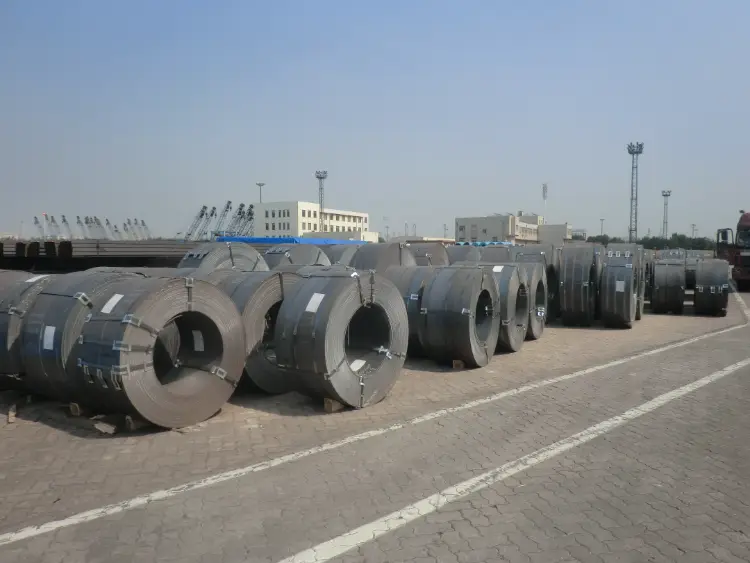
Q325NHYJ Weather Resistant Steel Coil per GB/T 18982
Q325NHYJ Weather Resistant Steel Coil per GB/T 18982-2003
Comprehensive material data for Q325NHYJ weathering steel coil: chemical composition, mechanical properties, physical properties, international equivalents and application guide.
Hot rolling, cold rolling, pickling, slitting, blanking, forming, welding, punching
- Phone : +8618037372205
- Email : [email protected]
- WhatsApp: Contact via Whtsapp
- WeChat: +8618037372205
Q325NHYJ Weather Resistant Steel Coil per GB/T 18982 Introduction
Q325NHYJ is a weather-resistant structural steel grade specified in GB/T 18982-2003 for manufacturing shipping containers. The designation indicates minimum yield strength of 325 MPa and use for container applications (NHYJ). It exhibits enhanced atmospheric corrosion resistance due to the deliberate addition of alloying elements such as Cu, Cr, Ni, and P. This hot- or cold-rolled steel coil is characterized by good strength, formability, and weldability, making it ideal for thin-gauge (typically 0.6–2.0 mm) structural components exposed to outdoor environments. The self-protecting patina eliminates the need for painting in many applications.
Q325NHYJ Weather Resistant Steel Coil per GB/T 18982 Chemical Composition
The chemical composition according to GB/T 18982-2003 is designed to achieve balanced mechanical properties and long-term atmospheric corrosion resistance. Copper, chromium, nickel, and elevated phosphorus promote the formation of a dense, adherent protective oxide layer. Microalloying elements (Ti, RE) may be added by agreement for grain refinement.
| Element | Specified Value | Remark |
|---|---|---|
| C | ≤ 0.12 | |
| Si | 0.25 – 0.75 | |
| Mn | ≤ 0.60 | |
| P | 0.07 – 0.12 | |
| S | ≤ 0.020 | |
| Cu | 0.25 – 0.50 | |
| Cr | 0.30 – 1.25 | |
| Ni | ≤ 0.65 | |
| Ti | ≤ 0.12 (optional) | If added for grain refinement |
| RE | ≤ 0.15 (optional) | Rare earth additions by agreement |
Q325NHYJ Weather Resistant Steel Coil per GB/T 18982 Physical Properties
The physical data below represent typical values for low-alloy weathering steel of similar composition. No specific physical property requirements are mandated in GB/T 18982-2003. These values serve as a guide for design calculations and are valid at room temperature unless otherwise noted.
| Property | Typical Value | Unit | Condition / Temperature |
|---|---|---|---|
| Density (ρ) | 7.85 | g/cm³ | Room temperature |
| Modulus of elasticity (E) | 210 | GPa | Room temperature |
| Shear modulus (G) | 80 | GPa | Room temperature |
| Poisson's ratio (ν) | 0.3 | Room temperature | |
| Thermal expansion coefficient (α) | 11.5 × 10⁻⁶ | /K | 20–100 °C |
| Thermal conductivity (λ) | 45 | W/(m·K) | Room temperature |
| Specific heat capacity (c) | 0.46 | J/(g·K) | 20 °C |
| Electrical resistivity (ρ_e) | 0.15 | Ω·mm²/m | Room temperature |
Q325NHYJ Weather Resistant Steel Coil per GB/T 18982 Mechanical Properties
Mechanical properties are determined on transverse test pieces from the coil/ sheet in the as-delivered condition. For thickness ≤ 2.0 mm, the values below represent the minimum requirements of GB/T 18982-2003. No impact test is specified for this grade.
| Property | Specified Value | Unit | Test Condition |
|---|---|---|---|
| Yield strength (ReL) | ≥ 325 | MPa | Transverse, gauge length L0=50 mm |
| Tensile strength (Rm) | ≥ 450 | MPa | Transverse, gauge length L0=50 mm |
| Elongation after fracture (A) | ≥ 22 | % | L0=50 mm, transverse |
| Bend test (180°) | d = a (no cracks) | Bend diameter = thickness a |
Q325NHYJ Weather Resistant Steel Coil per GB/T 18982 International Equivalent Standards and Substitutable Grades
| Country/Region | Standard | Grade | Remark |
|---|---|---|---|
| Europe | EN 10025-5 | S355J2W (+N/+AR) | Similar weathering steel, min. YS 355 MPa, TS 470–630 MPa, elongation ≥22% |
| USA | ASTM A588 / A588M | Grade A | High-strength low-alloy weathering steel, min. YS 345 MPa, TS ≥485 MPa |
| Japan | JIS G3125 | SPA-H | Superior atmospheric corrosion resisting rolled steel, min. YS 355 MPa, TS ≥490 MPa |
Q325NHYJ Weather Resistant Steel Coil per GB/T 18982 Application Introduction
Q325NHYJ is primarily developed for the transportation and construction sectors where high corrosion resistance and reduced maintenance are critical. Its formability and weldability enable cost-effective manufacturing of lightweight structures. The steel develops a stable, self-healing patina that eliminates the need for painting in many atmospheric environments.
Product Applications: Dry cargo containers – side walls, corrugated panels, roof sheets, Refrigerated container inner frames, Open-top container structural members, Railway wagon side panels and underframes, Prefabricated modular buildings
Processed into products: Container side sheet / wall panel, Container roof sheet, Container front / rear end frame, Container door header and sill, Railway vehicle body side plate, Architectural standing seam panels, Highway guardrail components
Application industries: Shipping container manufacturing (20 ft, 40 ft, and special containers), Railway freight cars and rolling stock, Architecture and building engineering (cladding, roofing, facades), Infrastructure (noise barriers, sign structures, bridges)
Q325NHYJ Weather Resistant Steel Coil per GB/T 18982 Similar or Close-Substitute Materials
| Country/Region | Standard | Grade | Remark |
|---|---|---|---|
| China | GB/T 4171 | Q355GNH | Weathering structural steel, min. YS 355 MPa, similar corrosion resistance |
| China | GB/T 18982-2003 | Q345GNHJ | Higher strength container steel variant (YS ≥345 MPa) within the same standard |
| Europe | EN 10025-5 | S355K2W | Similar weathering steel with improved low-temperature toughness |
Notes:
For cold-rolled Q325NHYJ coils, the product is typically provided in skin-passed and oiled condition to improve surface quality and prevent corrosion during storage. For welded containers, the weld zones may require protective coating to maintain equivalent corrosion resistance. The phosphorus content is intentionally higher than standard structural steels to promote the protective patina; this can influence weldability and requires appropriate welding consumables.
- Share



