
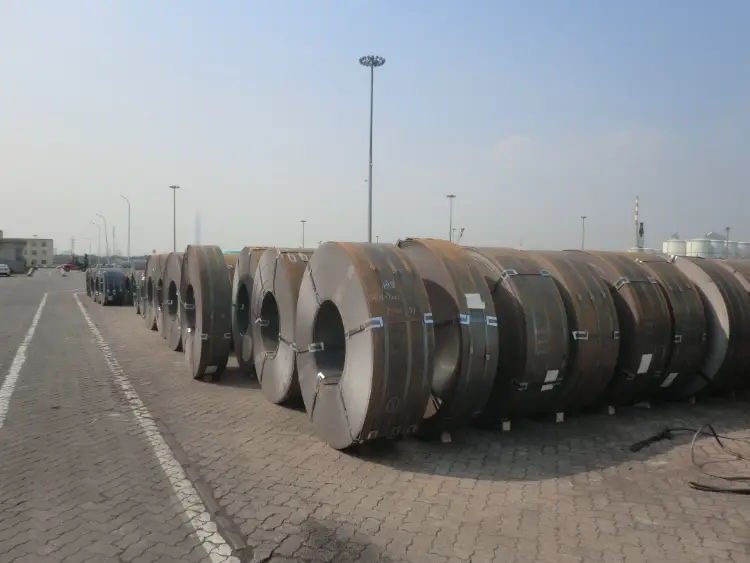
EN10025-5 S235J0W Weathering Steel Coil
EN10025-5 S235J0W Weathering Steel Coil - Properties, Equivalents & Applications
Comprehensive technical data for EN10025-5 S235J0W weathering steel coil including chemical composition, mechanical properties, thermal and electrical characteristics, international equivalent grades, and recommended applications in construction, bridges, and containers.
Hot rolling, normalizing rolling, cold forming, welding, bolting, riveting
- Phone : +8618037372205
- Email : [email protected]
- WhatsApp: Contact via Whtsapp
- WeChat: +8618037372205
EN10025-5 S235J0W Weathering Steel Coil Introduction
S235J0W is a hot-rolled structural weathering steel defined in EN 10025-5. It features improved atmospheric corrosion resistance due to the addition of alloying elements such as copper and chromium. With a minimum yield strength of 235 MPa and Charpy impact energy of 27 J at 0 °C (J0), it offers reliable weldability and toughness for structural applications exposed to the weather.
- Key properties: resistant to atmospheric corrosion, good weldability, and moderate strength.
- Typical forms: coils, plates, strips, and structural sections.
- Delivery condition: hot-rolled, or normalized rolled as agreed.
EN10025-5 S235J0W Weathering Steel Coil Chemical Composition
The alloying elements Cu and Cr provide enhanced corrosion resistance by forming a stable patina. Other elements are controlled to ensure good weldability and toughness. Nitrogen may be bound by Al or other elements to meet impact requirements.
| Element | Standard Value (wt%) | Remarks |
|---|---|---|
| Carbon (C) | ≤ 0.13 | Ladle analysis |
| Silicon (Si) | ≤ 0.40 | |
| Manganese (Mn) | 0.20 – 0.60 | |
| Phosphorus (P) | ≤ 0.035 | |
| Sulfur (S) | ≤ 0.035 | |
| Copper (Cu) | 0.25 – 0.55 | Key element for weather resistance |
| Chromium (Cr) | 0.40 – 0.80 | Key element for weather resistance |
| Nickel (Ni) | ≤ 0.65 | |
| Nitrogen (N) | ≤ 0.009 | Al killed or equivalent |
EN10025-5 S235J0W Weathering Steel Coil Thermal and Electrical Physical Properties
The following physical properties are typical for S235J0W weathering steel at room temperature unless otherwise specified. These values are not mandatory in the material standard but are useful for design calculations. Slight variations may occur depending on actual processing conditions.
| Property | Typical Value | Unit | Test Condition / Remarks |
|---|---|---|---|
| Density (ρ) | 7.85 | g/cm³ | At 20 °C |
| Modulus of elasticity (E) | 210 | GPa | At 20 °C |
| Shear modulus (G) | ≈ 81 | GPa | At 20 °C |
| Poisson's ratio (ν) | ≈ 0.3 | – | At 20 °C |
| Thermal expansion coefficient (α) | 11.1 | 10⁻⁶/K | 20 – 100 °C |
| Thermal expansion coefficient (α) | 12.5 | 10⁻⁶/K | 20 – 200 °C |
| Thermal expansion coefficient (α) | 13.5 | 10⁻⁶/K | 20 – 400 °C |
| Thermal conductivity (λ) | ≈ 36 – 54 | W/(m·K) | At 20 °C, typical for structural steel |
| Specific heat capacity | ≈ 460 | J/(kg·K) | At 20 – 100 °C |
| Electrical resistivity (ρ_e) | ≈ 0.16 – 0.25 | µΩ·m | At 20 °C |
EN10025-5 S235J0W Weathering Steel Coil Mechanical Properties
The mechanical properties are based on the nominal thickness ranges specified in EN 10025-5. Charpy V-notch impact energy of 27 J min is guaranteed at 0 °C for longitudinal test pieces. Bending test is performed at room temperature with a 180° bend angle.
| Property | Standard Value | Unit | Test Condition / Remarks |
|---|---|---|---|
| Yield strength (ReH) | ≥ 235 | MPa | Nominal thickness ≤ 16 mm |
| Yield strength (ReH) | ≥ 225 | MPa | 16 mm < thickness ≤ 40 mm |
| Yield strength (ReH) | ≥ 215 | MPa | 40 mm < thickness ≤ 63 mm |
| Yield strength (ReH) | ≥ 215 | MPa | 63 mm < thickness ≤ 80 mm |
| Yield strength (ReH) | ≥ 215 | MPa | 80 mm < thickness ≤ 100 mm |
| Tensile strength (Rm) | 360 – 510 | MPa | Thickness < 3 mm |
| Tensile strength (Rm) | 360 – 510 | MPa | 3 mm ≤ thickness ≤ 100 mm |
| Tensile strength (Rm) | 350 – 500 | MPa | 100 mm < thickness ≤ 150 mm |
| Elongation (A) | ≥ 26 | % | Thickness ≥ 3 mm, L₀ = 5.65√S₀, longitudinal |
| Elongation (A80) | ≥ 18 | % | Thickness < 3 mm, L₀ = 80 mm, longitudinal |
| Impact energy (KV) | ≥ 27 | J | at 0 °C, longitudinal, Charpy V-notch |
| Bend test (mandrel diameter) | 1×thickness | – | Thickness ≤ 16 mm, 180° bend |
| Bend test (mandrel diameter) | 2×thickness | – | 16 mm < thickness ≤ 100 mm, 180° bend |
EN10025-5 S235J0W Weathering Steel Coil Truly Equivalent Standard & Grade Substitutes
| Country / Region | Standard | Grade | Remarks |
|---|---|---|---|
| European Union | EN 10025-5:2004 | S235J0W | Original standard, direct equivalent |
| Germany | DIN EN 10025-5:2005 | S235J0W | Identical adoption of EN |
| United Kingdom | BS EN 10025-5:2004 | S235J0W | Identical adoption of EN |
| France | NF EN 10025-5:2005 | S235J0W | Identical adoption of EN |
| Italy | UNI EN 10025-5:2005 | S235J0W | Identical adoption of EN |
| Sweden | SS-EN 10025-5 | S235J0W | Identical adoption of EN |
| Spain | UNE EN 10025-5:2006 | S235J0W | Identical adoption of EN |
| International (ISO) | ISO 4952:2003 | Fe 235W (or S235W) | Similar weathering concept but may have different impact designation; check for 0 °C toughness |
EN10025-5 S235J0W Weathering Steel Coil Application Introduction
S235J0W weathering steel is designed for structural applications where long-term atmospheric corrosion resistance and reduced maintenance are required. Thanks to the formation of a stable, adherent oxide layer (patina) upon exposure to the environment, painting is often unnecessary. It is readily weldable and can be processed by standard fabrication methods.
- Main industries: construction, civil engineering, transportation, and container manufacturing.
- Typical products: welded structural frameworks, bridges, architectural exposed steel, shipping containers, silos, and chimney shells.
- Common components: beams, columns, angles, channels, plates for gussets, stiffeners, and welded fabrications; also used for decorative perforated panels and cladding.
Product Applications: Welded structural frames, Weathering steel bridges, Open-air sculptures and artworks, Shipping containers and intermodal boxes, Silos, hoppers, and chutes, Chimney shells and ducting
Processed into products: Hot-rolled I-beams, H-columns, channels, and angles, Stiffeners, brackets, and connection plates, Perforated façade panels and sunscreens, Corner castings and container corner posts, Folded sheet metal parts for architectural trim, Welded box girders and tubular structures
Application industries: Bridge construction, Building and civil engineering structures, Architectural façades and exposed steelwork, Railway vehicle bodies and components, Container manufacturing (shipping, storage), Power plant and industrial stacks
EN10025-5 S235J0W Weathering Steel Coil Similar / Alternative Materials in Other Standards
| Country / Region | Standard | Grade | Remarks |
|---|---|---|---|
| European Union | EN 10025-5 | S235J2W | Higher toughness: ≥27 J at -20 °C; otherwise same strength and chemistry |
| European Union | EN 10025-5 | S355J0W | Higher strength grade (≥355 MPa) with comparable weathering resistance and 0 °C impact |
| USA | ASTM A588 / A588M | Grade A | Similar weathering steel (yield ≥345 MPa) with Cu, Cr, Ni, but strength a step higher; widely used for bridges and structures |
| USA | ASTM A242 / A242M | Type 1 | Weathering steel with yield ≥345 MPa and enhanced corrosion resistance, typically used for architectural and structural applications |
| Japan | JIS G3114 | SMA400AW | Weathering steel with 0 °C impact (A), minimum yield 235 MPa, similar corrosion concept |
| Japan | JIS G3114 | SMA400BW | Weathering steel with 0 °C impact (B), minimum yield 235 MPa |
| China | GB/T 4171 | Q235NH | Equivalent weathering steel with minimum yield 235 MPa and 0 °C impact; Ni content may vary |
Notes:
Welding: No preheating is generally required for S235J0W when welded with matching weathering electrodes (e.g., AWS E7018-W2 or similar) to maintain corrosion resistance of the joint.
Surface treatment: The natural patina develops over 1–3 years depending on climate; wetting/drying cycles are essential. In aggressive marine environments, periodic inspection is recommended.
Forming: Suitable for cold forming; minimum bend radii should follow the recommendations of EN 10025-1, taking the thickness and orientation into account.
Availability: Commonly supplied as hot-rolled coil, slit strip, and cut-to-length plates. Thickness ranges up to 150 mm (plates) and up to 12.5 mm (coil) are typical.
- Share



