
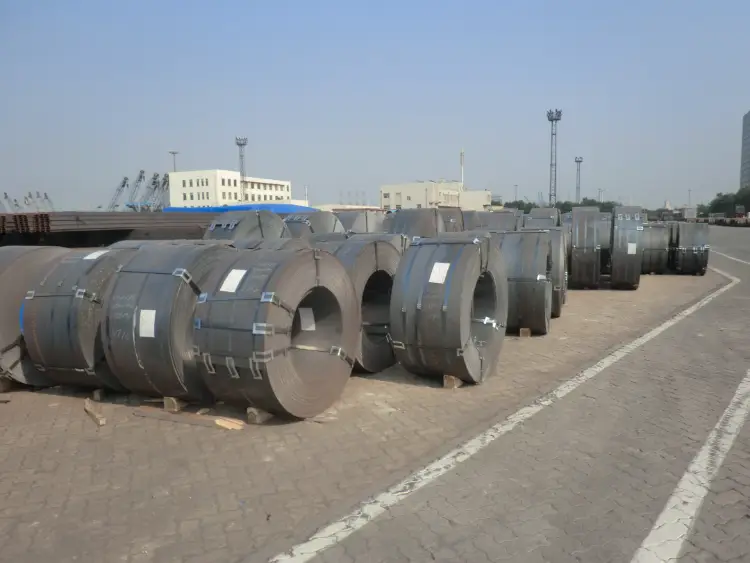
EN10025-5 S235J2W Weathering Steel Coil
EN10025-5 S235J2W Weathering Steel Coil: Composition, Properties & Equivalents
Comprehensive technical data for EN10025-5 S235J2W weather-resistant structural steel coil, including chemical composition, mechanical properties, thermal properties, and international equivalents.
Hot Rolling, Cold Forming, Machining, Welding
- Phone : +8618037372205
- Email : [email protected]
- WhatsApp: Contact via Whtsapp
- WeChat: +8618037372205
EN10025-5 S235J2W Weathering Steel Coil Introduction
EN10025-5 S235J2W is a structural weathering steel grade defined under the European standard EN 10025-5. It is designed for improved atmospheric corrosion resistance through the formation of a stable, protective oxide layer (patina) when exposed to the weather, often eliminating the need for painting. This grade offers a minimum yield strength of 235 MPa and is characterized by its good weldability and toughness, verified by impact testing at -20°C (J2 quality). Typical applications include steel structures exposed to the elements, such as bridges, facades, and containers.
EN10025-5 S235J2W Weathering Steel Coil Chemical Composition
The chemical composition according to EN 10025-5 for S235J2W is designed to enhance its atmospheric corrosion resistance. Key alloying elements like copper, chromium, and nickel are added to promote the formation of a dense, adherent patina layer that protects the steel substrate from further corrosion.
| Element | Standard Value (max %) | Remarks |
|---|---|---|
| Carbon (C) | 0.13 | Maximum value |
| Silicon (Si) | 0.25 - 0.55 | Required range |
| Manganese (Mn) | 0.20 - 0.60 | Required range |
| Phosphorus (P) | 0.040 | Maximum value |
| Sulfur (S) | 0.035 | Maximum value |
| Chromium (Cr) | 0.40 - 0.80 | Required range |
| Nickel (Ni) | 0.65 max | Maximum value |
| Copper (Cu) | 0.25 - 0.55 | Required range |
| Nitrogen (N) | 0.012 | Maximum value |
| Aluminum (Al total) | 0.020 min | Minimum value if nitrogen-binding elements are present. Can be replaced by other suitable elements. |
EN10025-5 S235J2W Weathering Steel Coil Thermal and Electrical Physical Properties
These values are typical for structural steels and are provided for general design guidance. Properties like thermal expansion influence design allowances in large structures, while density is critical for weight calculations. Exact values can vary slightly based on the final microstructure.
| Property | Standard Required Value | Unit | Test Condition |
|---|---|---|---|
| Density (ρ) | 7.85 | kg/dm³ | At ambient temperature |
| Modulus of Elasticity (E) | 210 | GPa | At ambient temperature |
| Shear Modulus (G) | 81 | GPa | At ambient temperature |
| Poisson's Ratio (ν) | 0.3 | – | At ambient temperature |
| Thermal Expansion Coefficient (α) | 12.0 x 10⁻⁶ | K⁻¹ | Temperature range 20°C to 100°C |
| Thermal Conductivity (λ) | 44 | W/(m·K) | At 100°C |
| Specific Heat Capacity | 460 | J/(kg·K) | At ambient temperature |
| Electrical Resistivity (ρ_e) | 0.25 | Ω·mm²/m | At ambient temperature |
EN10025-5 S235J2W Weathering Steel Coil Mechanical Properties
The mechanical properties of S235J2W are guaranteed for hot-rolled coil products. The impact energy test is mandatory for the J2 quality designation, indicating a minimum absorbed energy of 27 Joules at a test temperature of -20°C.
| Property | Standard Required Value | Unit | Test Condition |
|---|---|---|---|
| Yield Strength (ReH) | 235 min | MPa | Nominal thickness ≤ 16 mm |
| Yield Strength (ReH) | 225 min | MPa | Nominal thickness > 16 mm to ≤ 40 mm |
| Tensile Strength (Rm) | 360 - 510 | MPa | Nominal thickness ≤ 3 mm |
| Tensile Strength (Rm) | 360 - 510 | MPa | Nominal thickness > 3 mm to ≤ 40 mm |
| Elongation after fracture (A) | 21 min | % | Nominal thickness > 1.5 mm to ≤ 2 mm (longitudinal) |
| Elongation after fracture (A) | 22 min | % | Nominal thickness > 2 mm to ≤ 2.5 mm (longitudinal) |
| Elongation after fracture (A) | 24 min | % | Nominal thickness > 2.5 mm to < 3 mm (longitudinal) |
| Elongation after fracture (A80mm) | 24 min | % | Nominal thickness ≥ 3 mm to ≤ 40 mm (longitudinal) |
| Impact Energy (KV) | 27 min | J | Longitudinal, test temperature -20°C |
EN10025-5 S235J2W Weathering Steel Coil Recommendations for Exactly Equivalent Material Standards and Substitutable Grades
| Country/Region | Standard | Grade | Remarks |
|---|---|---|---|
| International | ISO 4952:2003 | S235W | Structurally equivalent, improved atmospheric corrosion resistance. |
| Germany, EU | DIN EN 10025-5 | 1.8961 | Material number for S235J2W. |
| Italy, EU | UNI EN 10025-5 | S235J2W | Identical adoption of the European standard. |
EN10025-5 S235J2W Weathering Steel Coil Application Introduction
S235J2W weathering steel is primarily selected for its enhanced resistance to atmospheric corrosion, which allows for uncoated (bare) applications where the material is directly exposed to the weather. It also performs well in painted applications by reducing under-creep corrosion at damage sites. Its good low-temperature impact toughness makes it suitable for outdoor winter conditions. It is delivered in a hot-rolled condition, suitable for welded and bolted constructions.
Product Applications: Steel Bridges (pedestrian and vehicular), Rolled and Welded Sections (H, I, angles, channels), Weathering Steel Coils for corrugated sheeting, Corten Steel Facade Panels, ISO Shipping Containers, Roadway Sound-Reducing Barriers
Processed into products: Structural bridge girders and columns, Welded hollow sections for masts and poles, Laser-cut architectural cladding elements, Bolted truss assemblies, Formed sheet metal profiles for roofing and siding, Welded containers and tanks
Application industries: Bridge and Highway Construction, Architectural Facades and Civil Engineering, Shipping Container and Freight Wagon Manufacturing, Transmission and Telecommunication Tower Construction, Agricultural Equipment and Structures
EN10025-5 S235J2W Weathering Steel Coil Recommendations for Similar/Comparable Substitute Materials
| Country/Region | Standard | Grade | Remarks |
|---|---|---|---|
| USA | ASTM A588/A588M | Grade A | Widely used weathering steel with a 345 MPa min. yield strength, higher strength than S235J2W. |
| Japan | JIS G3114 | SMA400AW | Japanese weathering steel for welded structures. Contains a minimum of 0.15% Cu and 0.45% Cr. Provides a similar nominal yield strength level of 235 MPa for thicknesses ≤ 40mm. |
| China | GB/T 4171, Q235NH | Q235NH | Chinese weathering structural steel with a comparable yield strength class. Check individual element ranges for exact match. |
Notes:
Welding Advice: When welding S235J2W, consumables matching the weathering steel composition should be used to ensure the weld zone achieves the same level of atmospheric corrosion resistance as the base metal. Consumables compliant with AWS A5.29 E81T1-W for flux-cored arc welding are typically suitable.
Patina Formation: Achieving a stable and aesthetically pleasing protective patina depends on the environmental exposure; wet-dry cycles are essential. For best results, the surface should be free of mill scale and contamination.
- Share



