
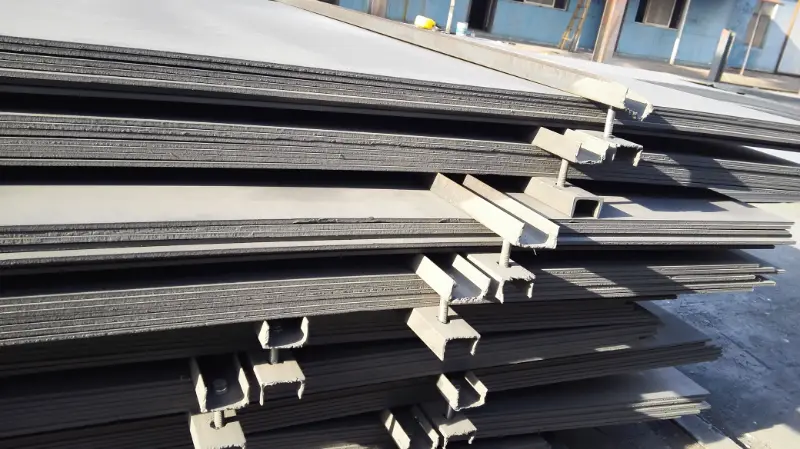
SAPH310 Hot Rolled Steel
SAPH310 Hot Rolled Steel: JIS G3113 Automotive Structural Grade, Q/BQB 310 Standard
Complete material data for SAPH310 hot-rolled steel coil under Q/BQB 310-2009 and JIS G3113-2006, covering chemical, mechanical, and thermal properties.
Hot Rolling, Pickling, Oiling, Cold Forming, Stamping, Welding, Bending
- Phone : +8618037372205
- Email : [email protected]
- WhatsApp: Contact via Whtsapp
- WeChat: +8618037372205
SAPH310 Hot Rolled Steel Introduction
SAPH310 is a hot-rolled steel grade for automotive structural use, specified in JIS G3113 and the Baosteel enterprise standard Q/BQB 310. As a member of the SAPH (Structural Automobile Plate Hot-rolled) series, it features a minimum tensile strength of 310 MPa, offering an optimal combination of formability, weldability, and structural integrity. Designed primarily for components requiring strength and reliability, SAPH310 is characterized by its controlled chemical composition with low carbon content, ensuring excellent performance in stamping, bending, and complex forming operations. It serves as a fundamental material for chassis and body parts where consistent mechanical properties and surface quality are critical.
SAPH310 Hot Rolled Steel Chemical Composition
The chemical composition of SAPH310 is strictly controlled according to JIS G3113-2006 and Q/BQB 310-2009 to ensure a fine balance between strength, weldability, and forming behavior. The maximum limits for key elements like carbon (C) and manganese (Mn) are defined to guarantee the minimum tensile strength of 310 MPa while maintaining ductility for severe forming processes. Residual elements such as phosphorus (P) and sulfur (S) are limited to minimal levels to prevent embrittlement and ensure part integrity.
| Element | Nominal Value (Max, %) | Remarks |
|---|---|---|
| Carbon (C) | ≤0.16 | Controlled for weldability and strength |
| Manganese (Mn) | ≤0.75 | Enhances strength and hardenability |
| Phosphorus (P) | ≤0.040 | Max limit to prevent cold shortness |
| Sulfur (S) | ≤0.040 | Max limit to prevent hot shortness |
| Silicon (Si) | ≤0.55 | May be specified; contributes to deoxidation |
SAPH310 Hot Rolled Steel Thermal & Electrical Physical Properties
Physical properties for SAPH310 are representative of standard low-carbon non-alloy structural steel. These properties are not mandated for standard delivery acceptance but are essential for engineering calculations related to thermal expansion, heat transfer, and structural stiffness. Values are typical for rolled steel products and may vary slightly with specific production conditions.
| Property | Typical Value | Unit | Test Condition / Remarks |
|---|---|---|---|
| Density (ρ) | Approx. 7.85 | g/cm³ | At 20 °C |
| Elastic Modulus (E) | 210 | GPa | Longitudinal, at ambient temperature |
| Shear Modulus (G) | Approx. 81 | GPa | Calculated based on E and ν |
| Poisson's Ratio (ν) | 0.29 | – | At ambient temperature |
| Thermal Expansion Coefficient (α) | 11.7 | 10⁻⁶/K | Range: 20-100 °C |
| Thermal Expansion Coefficient (α) | 12.5 | 10⁻⁶/K | Range: 20-200 °C |
| Thermal Expansion Coefficient (α) | 13.6 | 10⁻⁶/K | Range: 20-300 °C |
| Thermal Conductivity (λ) | Approx. 46 | W/(m·K) | At 20 °C |
| Specific Heat Capacity (c) | Approx. 470 | J/(kg·K) | At 20-100 °C |
| Electrical Resistivity (ρ_e) | Approx. 0.20 | Ω·mm²/m | At 20 °C |
SAPH310 Hot Rolled Steel Mechanical Properties
Mechanical property requirements for SAPH310 are specified per JIS G3113 and Q/BQB 310 for tensile and bending performance. The values shown are the mandatory minimum and maximum limits for acceptance. The elongation varies based on material thickness, reflecting the material's formability. A minimum bending radius without cracking is also a critical requirement for forming operations, ensuring the base material can withstand the intended fabrication process.
| Property | Specified Value | Unit | Test Condition |
|---|---|---|---|
| Tensile Strength (Rm) | ≥310 | MPa | JIS Z 2241, thickness applicable range |
| Yield Strength (ReH or Rp0.2) | ≥185 (typ. for t≤8mm) | MPa | JIS Z 2241, not mandatory but usually guaranteed |
| Elongation (A) | ≥33 | % | Thickness ≥1.6 to <2.0mm, JIS No.5 specimen |
| Elongation (A) | ≥35 | % | Thickness ≥2.0 to <2.5mm, JIS No.5 specimen |
| Elongation (A) | ≥37 | % | Thickness ≥2.5 to <3.15mm, JIS No.5 specimen |
| Elongation (A) | ≥39 | % | Thickness ≥3.15 to <4.0mm, JIS No.5 specimen |
| Elongation (A) | ≥42 | % | Thickness ≥4.0 to <6.3mm, JIS No.5 specimen |
| Bendability | 180° flat on itself | – | Bending dia. = 0*t, t = nominal thickness |
SAPH310 Hot Rolled Steel Exact Material Standard & Equivalent Grade Recommendations
| Country/Region | Standard | Grade | Remarks |
|---|---|---|---|
| Japan | JIS G3113-2006 | SAPH310 | Original standard, fully equivalent to Q/BQB 310 SAPH310 |
| China | Q/BQB 310-2009 | SAPH310 | Baosteel enterprise standard, identical technical specifications to JIS |
SAPH310 Hot Rolled Steel Application Introduction
SAPH310 is engineered for automotive parts requiring good formability and reliable structural performance. Its balanced properties make it suitable for moderate strength applications where complex shaping is needed. It is easily welded, making it ideal for assemblies.
Product Applications: Hot Rolled Steel Coils, Hot Rolled Pickled and Oiled Coils, Slit Strips for Tube Making, Cut-to-Length Sheets, Stamped Chassis Components, E-coat or powder coated structural assemblies
Processed into products: Automobile chassis frames and cross members, Suspension control arms and spring brackets, Wheel inner/outer rims and disc wheels, Seat frames, rails, and recliner parts, Bumper reinforcements and mounting brackets, Engine mounting brackets and sub-frames, Drum brake back plates and pedal arms, Erw steel tubes for structures and conveyors
Application industries: Automotive Manufacturing (OEM and Tier 1/2 Suppliers), Transportation and Heavy Equipment, Construction Machinery, Metal Furniture and Shelving, General Engineering and Fabrication
SAPH310 Hot Rolled Steel Similar/Approximate Substitute Material Recommendations
| Country/Region | Standard | Grade | Remarks |
|---|---|---|---|
| International | ISO 4951-1: 2021 | S310MC | Comparable minimum tensile strength (310 MPa) for mechanical engineering. Check chemical restrictions. |
| Europe | EN 10149-2: 2013 | S315MC | High-strength low-alloy for cold forming. Slightly higher min. yield, similar applications. |
| China | GB/T 20887.1-2007 | S315MC | Equivalent Chinese IS standard grade, as technically referenced from ISO 4951. |
| USA | ASTM A1011/A1011M | Grade 275 (SS/SF) | Closest structural steel grade in ASTM. Designation is by yield strength; not a direct equivalent, check formability. |
Notes:
For specific applications, pickling and oiling is highly recommended to improve surface quality for subsequent processing. JIS G3113 also includes a requirement that the steel must be free from harmful internal or external defects that would impair its use. Dimensional tolerances (thickness, width, edge shape) must be agreed upon at the time of ordering based on relevant dimensional standards (e.g., JIS G 3193). No Charpy impact test values are specified in the standard.
- Share



