
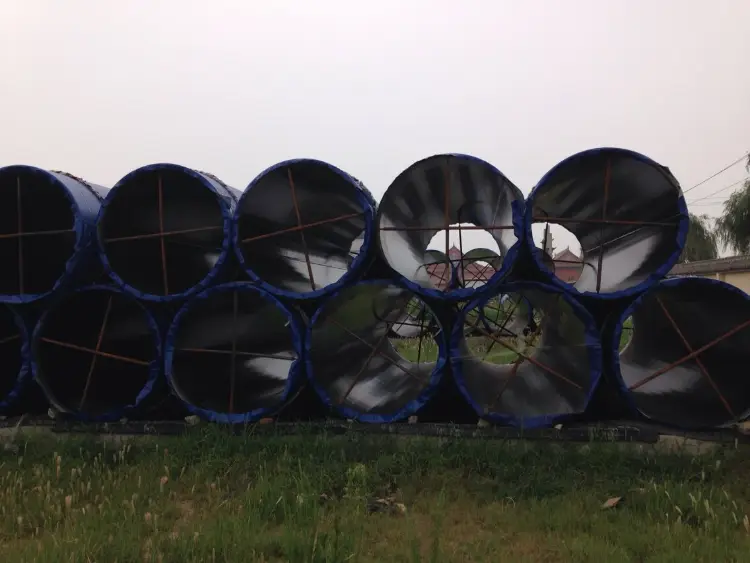
SA213 T9 Boiler Steel Pipe Material
SA213 T9 Boiler Steel Pipe: Chemical, Mechanical, Thermal Properties & International Equivalents
Comprehensive data sheet for ASTM A213 Grade T9 seamless alloy steel tube: chemical composition, mechanical and physical properties, global equivalent grades, similar materials, and application guide for superheater, reheater, and heat exchanger service up to 600°C.
Hot-finished or cold-drawn; normalizing and tempering
- Phone : +8618037372205
- Email : [email protected]
- WhatsApp: Contact via Whtsapp
- WeChat: +8618037372205
SA213 T9 Boiler Steel Pipe Introduction
SA213 T9 is a ferritic alloy steel tube grade specified in ASTM A213/A213M for seamless ferritic and austenitic alloy-steel boiler, superheater, and heat-exchanger tubes. With a nominal composition of 9% Chromium and 1% Molybdenum, T9 offers excellent resistance to oxidation and corrosion at elevated temperatures up to approximately 600°C (1112°F). It provides good creep strength and is widely used in power generation, petrochemical, and refining industries. Key features include:
- High-temperature strength and creep resistance
- Good oxidation resistance in steam and flue gas environments
- Weldable with appropriate preheat and post-weld heat treatment
The steel is typically supplied in the normalized and tempered condition, ensuring a fine-grained microstructure for optimal mechanical properties.
SA213 T9 Boiler Steel Pipe Chemical Composition
Chemical requirements for SA213 T9 seamless tube according to ASTM A213/A213M.
- Carbon and manganese levels are controlled for optimum strength and hardenability.
- Chromium and molybdenum provide high-temperature oxidation resistance and creep strength.
- Phosphorus and sulfur are limited to ensure cleanliness and ductility.
| Chemical Element | Standard Value (wt%) | Remarks |
|---|---|---|
| Carbon (C) | 0.15 max | Essential for strength |
| Manganese (Mn) | 0.30–0.60 | Deoxidizer, strength contributor |
| Phosphorus (P) | 0.025 max | Residual element, kept low for ductility |
| Sulfur (S) | 0.025 max | Residual element, low to prevent hot shortness |
| Silicon (Si) | 0.25–1.00 | Deoxidizer, improves oxidation resistance |
| Chromium (Cr) | 8.00–10.00 | Primary alloying element for oxidation and creep resistance |
| Molybdenum (Mo) | 0.90–1.10 | Enhances high-temperature strength and creep resistance |
SA213 T9 Boiler Steel Pipe Thermal and Electrical Physical Properties
Representative physical properties of SA213 T9 (9Cr-1Mo) steel at various temperatures. These values are based on published data for similar heat-treated conditions and may vary with exact composition and thermal history.
- Elastic modulus decreases with increasing temperature.
- Thermal expansion is relatively low compared to austenitic stainless steels, reducing thermal stress.
| Property | Typical Value | Unit | Test Condition / Temperature |
|---|---|---|---|
| Density (ρ) | 7.71 | g/cm³ | at 20°C |
| Elastic Modulus (E) | 200 | GPa | at 20°C |
| Elastic Modulus (E) | 196 | GPa | at 100°C |
| Elastic Modulus (E) | 190 | GPa | at 200°C |
| Elastic Modulus (E) | 184 | GPa | at 300°C |
| Elastic Modulus (E) | 176 | GPa | at 400°C |
| Elastic Modulus (E) | 167 | GPa | at 500°C |
| Elastic Modulus (E) | 157 | GPa | at 600°C |
| Poisson's Ratio (ν) | 0.29 | — | at 20°C |
| Shear Modulus (G) | 77 | GPa | at 20°C (calculated) |
| Coefficient of Thermal Expansion (α) | 10.3 | 10⁻⁶/K | 20–100°C |
| Coefficient of Thermal Expansion (α) | 10.8 | 10⁻⁶/K | 20–200°C |
| Coefficient of Thermal Expansion (α) | 11.2 | 10⁻⁶/K | 20–300°C |
| Coefficient of Thermal Expansion (α) | 11.5 | 10⁻⁶/K | 20–400°C |
| Coefficient of Thermal Expansion (α) | 11.7 | 10⁻⁶/K | 20–500°C |
| Coefficient of Thermal Expansion (α) | 12.0 | 10⁻⁶/K | 20–600°C |
| Thermal Conductivity (λ) | 26.5 | W/(m·K) | at 20°C |
| Thermal Conductivity (λ) | 26.0 | W/(m·K) | at 100°C |
| Thermal Conductivity (λ) | 25.5 | W/(m·K) | at 200°C |
| Thermal Conductivity (λ) | 25.5 | W/(m·K) | at 300°C |
| Thermal Conductivity (λ) | 25.0 | W/(m·K) | at 400°C |
| Thermal Conductivity (λ) | 24.5 | W/(m·K) | at 500°C |
| Thermal Conductivity (λ) | 24.0 | W/(m·K) | at 600°C |
| Specific Heat Capacity | 460 | J/(kg·K) | at 20°C |
| Specific Heat Capacity | 480 | J/(kg·K) | at 100°C |
| Specific Heat Capacity | 490 | J/(kg·K) | at 200°C |
| Specific Heat Capacity | 500 | J/(kg·K) | at 300°C |
| Specific Heat Capacity | 530 | J/(kg·K) | at 400°C |
| Specific Heat Capacity | 580 | J/(kg·K) | at 500°C |
| Specific Heat Capacity | 650 | J/(kg·K) | at 600°C |
| Electrical Resistivity (ρₑ) | 0.48 | μΩ·m | at 20°C |
| Electrical Resistivity (ρₑ) | 0.52 | μΩ·m | at 100°C |
| Electrical Resistivity (ρₑ) | 0.57 | μΩ·m | at 200°C |
| Electrical Resistivity (ρₑ) | 0.62 | μΩ·m | at 300°C |
| Electrical Resistivity (ρₑ) | 0.68 | μΩ·m | at 400°C |
| Electrical Resistivity (ρₑ) | 0.74 | μΩ·m | at 500°C |
| Electrical Resistivity (ρₑ) | 0.80 | μΩ·m | at 600°C |
SA213 T9 Boiler Steel Pipe Mechanical Properties
Minimum tensile, yield, and elongation requirements for SA213 T9 tubes per ASTM A213/A213M. Hardness values are maximum limits.
- Tests performed on longitudinal strip specimens in accordance with ASTM A370.
- For wall thickness under 5/16 in., elongation values differ – refer to the standard.
| Property | Standard Requirement | Unit | Test Condition |
|---|---|---|---|
| Yield Strength (ReH, 0.2% offset) | ≥205 (30 ksi) | MPa | Room temperature |
| Tensile Strength (Rm) | ≥415 (60 ksi) | MPa | Room temperature |
| Elongation (A) | ≥30 (longitudinal) | % | Standard 50 mm (2 in.) gauge length |
| Hardness (HRB) | ≤85 | HRB | Room temperature |
| Hardness (HBW) | ≤163 | HBW | Room temperature |
SA213 T9 Boiler Steel Pipe Completely Equivalent Material Standards & Replaceable Grades
| Country/Region | Standard | Grade | Remarks |
|---|---|---|---|
| USA | ASTM A213 | T9 | Seamless alloy steel tube (this grade) |
| USA | ASTM A335 | P9 | Seamless alloy steel pipe (same chemical composition) |
| European Union | EN 10216-2 | X10CrMo9-1 (1.7380) | Seamless steel tubes for pressure purposes |
| Japan | JIS G3462 | STBA26 | Alloy steel tubes for boiler and heat exchanger |
| International | ISO 9329-2 | 10CrMo9-10 | Seamless steel tubes for pressure purposes – Part 2: Non-alloy and alloy steel tubes with specified elevated temperature properties |
SA213 T9 Boiler Steel Pipe Application Introduction
SA213 T9 steel is designed for high-temperature service where oxidation resistance and creep strength are essential. Its applications span fossil fuel power plants, petrochemical furnaces, and chemical processing units.
- Excellent scaling resistance in steam and flue gas environments up to 600°C.
- Commonly used for superheater and reheater tubes in boilers.
- Also suitable for hydrogen service at elevated temperatures, provided proper Welding and PWHT are applied.
Product Applications: Boiler superheater tube bundles, Reheater tube assemblies, Heat exchanger tubes, High-pressure steam piping, Transfer line exchangers, Furnace cracking tubes
Processed into products: Superheater coils and pendants, Reheater tube panels, Economizer tubes, Steam drum connecting tubes, Radiant tubes for pyrolysis furnaces, Steam reformer tubes, Hydroprocessing heater tubes
Application industries: Power Generation (fossil fuel and nuclear), Petrochemical and Refining, Chemical Processing, Oil & Gas
SA213 T9 Boiler Steel Pipe Similar / Alternative Material Grades for Consideration
| Country/Region | Standard | Grade | Remarks |
|---|---|---|---|
| USA | ASTM A213 | T91 | Enhanced 9Cr-1Mo with V, Nb, N; higher creep strength, suitable up to ~620°C |
| USA | ASTM A213 | T92 | 9Cr-0.5Mo-1.8W-V-Nb; further improved creep rupture strength for ultra-supercritical applications |
| USA | ASTM A213 | T22 | 2.25Cr-1Mo; lower alloy cost, used up to ~580°C, less oxidation resistance |
| European Union | EN 10216-2 | X10CrMoVNb9-1 (1.4903) | Equivalent to T91; enhanced creep properties |
| China | GB/T 5310 | 10Cr9Mo1VNb | Chinese standard for T91 type steel |
| Japan | JIS G3462 | STBA27 | T91 equivalent seamless tube for high temperature service |
Notes:
T9 must be welded with preheat (200–300°C) and mandatory post-weld heat treatment (PWHT) at 730–760°C followed by slow cooling to prevent hydrogen cracking and restore toughness. The alloy is magnetic and can be cold bent with sufficient bend radii. Microstructure is tempered ferrite with fine carbides. Tubes are typically supplied in normalized (900–950°C) and tempered (700–750°C) condtition.
- For ASME Boiler and Pressure Vessel Code applications, additional NDE (nondestructive examination) may be required.
- Long-term service above 600°C may cause microstructure degradation; periodic inspection is recommended.
- Share



