
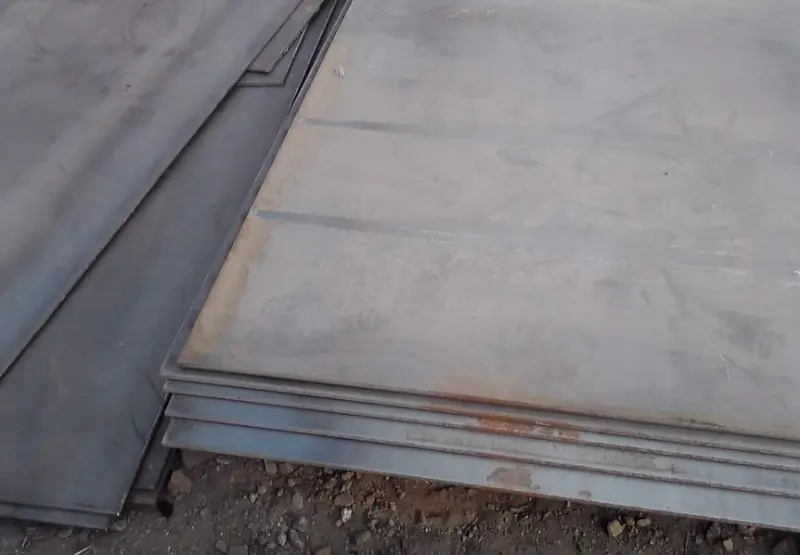
S960QL1 High-Strength Quenched & Tempered Structural Steel
EN10025-6 S960QL1 Steel for LSAW Pipe: High-Strength Quenched & Tempered Fine Grain Steel
Detailed material data for S960QL1 structural steel according to EN 10025-6, used for longitudinally submerged arc welded (LSAW) pipes. Includes chemical composition, mechanical and physical properties, equivalent grades, and application insights.
Suitable for hot forming (with subsequent heat treatment), cold forming (limited), welding (with appropriate preheat and filler materials), and machining in the tempered condition
- Phone : +8618037372205
- Email : [email protected]
- WhatsApp: Contact via Whtsapp
- WeChat: +8618037372205
S960QL1 High-Strength Quenched & Tempered Structural Steel Introduction
S960QL1 is a high-strength quenched and tempered fine grain structural steel defined in EN 10025-6. It offers a minimum yield strength of 960 MPa and is characterised by excellent toughness at low temperatures (minimum 27 J at -40°C). The grade is intended for heavily loaded welded structures such as LSAW pipes, where high strength, good weldability and reliable impact properties are essential. Controlled chemical composition with microalloying elements ensures uniform properties through thickness. Typical delivery condition is +QT (quenched and tempered).
S960QL1 High-Strength Quenched & Tempered Structural Steel Chemical Composition
Values are maximum unless a range is given. Composition applies to product thickness ≤50 mm according to EN 10025-6. Elements like Nb, V, Ti and Al are added for grain refinement and precipitation strengthening. Low sulphur and phosphorus improve ductility and toughness.
| Element | Standard Value (thickness ≤50 mm) | Remarks |
|---|---|---|
| Carbon (C) | ≤ 0.20% | Max |
| Silicon (Si) | ≤ 0.80% | Max |
| Manganese (Mn) | ≤ 1.70% | Max |
| Phosphorus (P) | ≤ 0.020% | Max |
| Sulfur (S) | ≤ 0.010% | Max |
| Chromium (Cr) | ≤ 1.50% | Max |
| Molybdenum (Mo) | ≤ 0.70% | Max |
| Nickel (Ni) | ≤ 2.0% | Max |
| Vanadium (V) | ≤ 0.12% | Max |
| Titanium (Ti) | ≤ 0.05% | Max |
| Aluminium (Al) total | ≥ 0.015% | Min for grain refinement |
| Niobium (Nb) | ≤ 0.06% | Max |
| Copper (Cu) | ≤ 0.50% | Max |
| Boron (B) | ≤ 0.005% | Max |
| Nitrogen (N) | ≤ 0.015% | Max |
S960QL1 High-Strength Quenched & Tempered Structural Steel Thermal and Electrical Physical Properties
Values are representative for quenched and tempered S960QL1 steel at room temperature unless otherwise stated. They are not mandated by EN 10025-6 but are widely accepted engineering data. Density and modulus values are essential for structural design; thermal expansion and conductivity influence welding distortion and heat transfer.
| Physical Property | Typical Value | Unit | Test Condition / Remarks |
|---|---|---|---|
| Density (ρ) | 7850 | kg/m³ | at 20°C |
| Elastic Modulus (E) | 205 | GPa | at 20°C, static |
| Shear Modulus (G) | 80 | GPa | at 20°C |
| Poisson's Ratio (ν) | 0.3 | - | elastic range |
| Thermal Expansion Coefficient (α) | 11.5 | μm/m·°C | between 20°C and 100°C |
| Thermal Expansion Coefficient (α) | 12.5 | μm/m·°C | between 20°C and 300°C |
| Thermal Conductivity (λ) | 30 | W/(m·K) | at 20°C |
| Specific Heat Capacity (Cp) | 460 | J/(kg·K) | at 20°C |
| Electrical Resistivity (ρe) | 0.25 | μΩ·m | at 20°C, typical for high-strength steel |
S960QL1 High-Strength Quenched & Tempered Structural Steel Mechanical Properties
Properties are for quenched and tempered condition as per EN 10025-6. Test specimens are taken in longitudinal direction unless otherwise noted. Impact test temperature is -40°C for grade S960QL1 (L1 suffix). Bending test uses mandrel diameter 4t, where t is the thickness of the test piece.
| Property | Required Value | Unit | Test Condition |
|---|---|---|---|
| Yield Strength (ReH) | ≥ 960 | MPa | Room temperature, thickness ≤50 mm |
| Tensile Strength (Rm) | 980 - 1150 | MPa | Room temperature, thickness ≤50 mm |
| Elongation after fracture (A) | ≥ 10 | % | Gauge length L0 = 5.65√S0, thickness ≤50 mm |
| Bend Test | d = 4 t | - | 180° bend, no cracks, t = specimen thickness |
| Impact Energy (KV) | ≥ 27 (longitudinal) | J | at -40°C, standard 10×10 mm specimen |
| Impact Energy (KV) | ≥ 27 (transverse) | J | at -40°C (optional, if agreed) |
S960QL1 High-Strength Quenched & Tempered Structural Steel Fully Equivalent Standards and Replaceable Grade Recommendations
The exact grade S960QL1 is defined exclusively in EN 10025-6. No identical international standard exists, but the following table lists the grade within the same standard and possible identical designations used in other associated documents.
| Country/Region | Standard | Grade | Remarks |
|---|---|---|---|
| European Union | EN 10025-6 | S960QL1 | Original standard, exact grade |
| International | ISO 4950-2 (withdrawn) | S960QL1 | Historically equivalent, now replaced by EN 10025-6 |
S960QL1 High-Strength Quenched & Tempered Structural Steel Application Introduction
S960QL1 steel is specifically designed for demanding welded structures that require high strength and superior toughness at sub-zero temperatures. In the form of LSAW pipes (Longitudinally Submerged Arc Welded), it is used for high-pressure transmission lines, offshore risers, and structural tubulars. The excellent strength-to-weight ratio allows for lighter designs and higher payloads. Welding must be performed according to qualified procedures, with appropriate preheating and low-hydrogen consumables to avoid cold cracking. Post-weld heat treatment is generally not required for thicknesses within the standard scope, but stress relieving may be applied if needed.
Product Applications: LSAW steel pipes for long-distance high-pressure gas/oil transmission, Welded structural hollow sections for heavy construction, Steel plates for crane booms and lattice structures, Pre-fabricated pressure vessels and storage tanks, Offshore structural components (nodes, braces, legs)
Processed into products: Longitudinally welded pipe elbows and tees, Crane telescopic boom segments, Lifting lugs and heavy-duty brackets, Welded box beams and column splices, Turret ring supports for wind turbines, Subsea manifold steel bodies
Application industries: Oil and gas (pipeline, offshore platforms, subsea equipment), Heavy lifting and construction (mobile cranes, crawler cranes, telescopic booms), Shipbuilding and marine engineering (jack-up rigs, structural hull components), Mining and quarrying machinery (heavy-duty dump bodies, excavator arms), Renewable energy (wind turbine towers, foundation nodes), General heavy mechanical engineering
S960QL1 High-Strength Quenched & Tempered Structural Steel Similar or Closely Comparable Alternative Materials
These grades offer similar minimum yield strength of 960 MPa and low-temperature toughness. Differences may exist in chemical composition, thickness ranges or available product forms. Always verify suitability for the specific application.
| Country/Region | Standard | Grade | Remarks |
|---|---|---|---|
| European Union | EN 10025-6 | S960QL | Same strength, impact at -50°C (L); very close substitute |
| European Union | EN 10025-6 | S960Q | 960 MPa yield, 27 J at -20°C (N quality); lower toughness |
| European Union | EN 10025-6 | S1100QL1 | Higher yield (≥1100 MPa), similar low-temp toughness; not directly interchangeable |
| USA | ASTM A514/A514M | Grade S | 110 ksi (approx. 758 MPa YS) quenched & tempered; lower strength, used for comparison |
| International | ISO 13033 (if exists) | S960 | Possibly harmonized high-strength structural steel; verify equivalence |
Notes:
Welding considerations: Preheating (typically 150-200°C depending on thickness and heat input) is required. Use of low-hydrogen process (SMAW, GMAW, SAW) with matching filler metals (e.g., AWS E11018-M or equivalent) is essential. The carbon equivalent (CEV) should be calculated and reported. Forming: Hot forming must be followed by a complete quenching and tempering treatment to restore mechanical properties. Cold forming is limited due to high strength; minimum bending radii should be consulted. NDT: Ultrasonic testing of plates and pipes is recommended to ensure internal soundness, especially for LSAW pipe applications. Corrosion protection: As a low-alloy steel, S960QL1 requires coating or cathodic protection when used in aggressive environments.
- Share



