
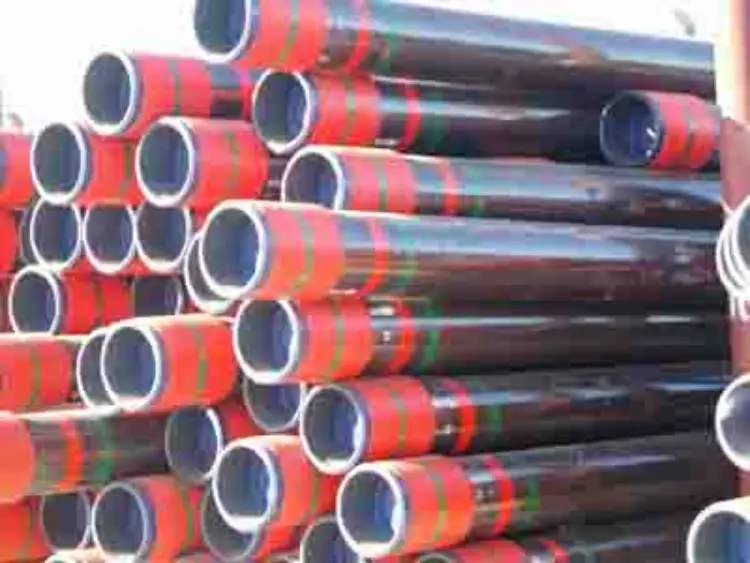
EN10025-2 S235JR Steel for LSAW Pipe
EN10025-2 S235JR Steel for LSAW Pipe - Properties and Equivalents
Comprehensive material data for S235JR steel as per EN 10025-2, used in LSAW pipes. Includes chemical composition, mechanical and physical properties, international equivalents, and application guidance.
Hot rolling; LSAW (longitudinal submerged arc welding) for pipe fabrication
- Phone : +8618037372205
- Email : [email protected]
- WhatsApp: Contact via Whtsapp
- WeChat: +8618037372205
EN10025-2 S235JR Steel for LSAW Pipe Introduction
S235JR is a non-alloy structural steel grade defined in EN 10025-2, widely employed for longitudinal submerged arc welded (LSAW) pipes. It delivers good weldability, formability, and moderate tensile strength, making it suitable for general construction, low-pressure fluid transmission, and piling applications. The steel is supplied in the hot-rolled condition with impact properties verified at +20°C (JR quality). Its chemical composition is designed for easy forming and welding without requiring pre- or post-weld heat treatment in most cases.
- Excellent balance of strength and ductility
- Cost-effective for large-diameter thick-wall pipes
- Available in a wide range of thicknesses and widths
EN10025-2 S235JR Steel for LSAW Pipe Chemical Composition
The chemical limits for S235JR according to EN 10025-2:2019 are given below. The values are maxima unless a range is stated. The steel is typically fully killed and contains fine-grain elements. Carbon equivalent (CEV) values are controlled to ensure good weldability.
| Element | Standard Value (max, wt.%) | Remarks |
|---|---|---|
| Carbon, C | ≤0.17 (t ≤ 40 mm); ≤0.20 (40 < t ≤ 100 mm); ≤0.22 (t > 100 mm) | Maximum limits depend on product thickness |
| Manganese, Mn | ≤1.40 | For all thicknesses |
| Silicon, Si | Not specified (typical ≤0.55) | Silicon content varies with deoxidation practice; usually 0.15–0.30 for fully killed steels |
| Phosphorus, P | ≤0.035 | |
| Sulfur, S | ≤0.035 | Lower levels improve formability and weldability |
| Copper, Cu | ≤0.55 | For weathering resistance, copper addition may be utilized |
| Nitrogen, N | ≤0.012 | For fully killed steel, nitrogen may be bound by aluminum; excess can cause strain aging |
| Carbon Equivalent (CEV) | ≤0.35 (typical for t ≤ 30 mm) | CEV = C + Mn/6 + (Cr+Mo+V)/5 + (Ni+Cu)/15; value based on ladle analysis for weldability |
EN10025-2 S235JR Steel for LSAW Pipe Physical Properties
Physical property data are not part of EN 10025-2 but are provided as typical values for carbon steel grade S235JR. These values are essential for design calculations involving heat transfer, electrical resistivity, and dynamic analysis. Data are applicable for uncoated steel in the as-supplied condition.
- Density: 7,850 kg/m³
- Thermal expansion coefficient: linear mean value between 20°C and 100°C
- Thermal conductivity at 20°C
| Property | Typical Value | Unit | Condition / Remarks |
|---|---|---|---|
| Density (ρ) | 7.85 | g/cm³ | At 20°C, average for carbon steel |
| Young's modulus (E) | 210 | GPa | Static modulus, elastic range |
| Shear modulus (G) | 81 | GPa | Calculated from E and Poisson ratio |
| Poisson's ratio (ν) | 0.3 | – | In elastic range |
| Thermal expansion (α) | 11.7 × 10⁻⁶ | K⁻¹ | Between 20°C and 100°C; linear coefficient |
| Thermal conductivity (λ) | 53 | W/(m·K) | At 20°C; decreases with temperature increase |
| Specific heat capacity (c) | 0.46 (460) | kJ/(kg·K) or J/(kg·K) | At 20–100°C; average value |
| Electrical resistivity (ρₑ) | 0.15 – 0.20 | µΩ·m | At 20°C; varies slightly with composition |
EN10025-2 S235JR Steel for LSAW Pipe Mechanical Properties
Mechanical properties of S235JR are derived from the EN 10025-2 standard for flat products. The yield strength (ReH), tensile strength (Rm), elongation (A), and impact energy (KV) vary with thickness. The JR quality level guarantees a minimum Charpy-V impact energy of 27 J at +20°C. Bending test requirements ensure ductility for pipe forming.
- ReH: Upper yield strength
- Rm: Tensile strength
- A: Percentage elongation after fracture (gauge length 5.65√S₀)
- KV: Charpy-V impact energy (longitudinal, specimen size 10×10 mm)
| Property | Standard Value | Unit | Test Condition / Remarks |
|---|---|---|---|
| Yield strength (ReH) | ≥235 | MPa | Thickness (t) ≤ 16 mm |
| Yield strength (ReH) | ≥225 | MPa | 16 < t ≤ 40 mm |
| Yield strength (ReH) | ≥215 | MPa | 40 < t ≤ 63 mm |
| Yield strength (ReH) | ≥215 | MPa | 63 < t ≤ 80 mm |
| Yield strength (ReH) | ≥215 | MPa | 80 < t ≤ 100 mm |
| Yield strength (ReH) | ≥195 | MPa | 100 < t ≤ 150 mm |
| Tensile strength (Rm) | 360 – 510 | MPa | t ≤ 40 mm |
| Tensile strength (Rm) | 350 – 500 | MPa | 40 < t ≤ 100 mm |
| Tensile strength (Rm) | 340 – 490 | MPa | 100 < t ≤ 150 mm |
| Elongation (A) | ≥26 | % | t ≤ 16 mm (longitudinal) |
| Elongation (A) | ≥25 | % | 16 < t ≤ 40 mm (longitudinal) |
| Elongation (A) | ≥24 | % | 40 < t ≤ 63 mm (longitudinal) |
| Elongation (A) | ≥23 | % | 63 < t ≤ 100 mm (longitudinal) |
| Elongation (A) | ≥21 | % | 100 < t ≤ 150 mm (longitudinal) |
| Impact energy (KV2) | ≥27 | J | At +20°C, longitudinal, 10×10 mm Charpy-V; for thickness >12 mm |
| Bend test (mandrel diameter) | 0.5 a | – | t ≤ 16 mm, 180° bend, transverse |
| Bend test (mandrel diameter) | 1.0 a | – | 16 < t ≤ 40 mm, 180° bend, transverse |
| Bend test (mandrel diameter) | 1.5 a | – | 40 < t ≤ 63 mm, 180° bend, transverse |
| Bend test (mandrel diameter) | 2.0 a | – | 63 < t ≤ 100 mm, 180° bend, transverse |
EN10025-2 S235JR Steel for LSAW Pipe Directly Equivalent Material Standards and Substitute Grades
| Country/Region | Standard | Grade | Remarks |
|---|---|---|---|
| European Union | EN 10025-2:2019 | S235JR | Primary designation; JR = impact at +20°C |
| International | ISO 630-2:2011 | S235B | Similar mechanics; B quality corresponds to 20°C impact |
| USA | ASTM A283/A283M | Grade C | Structural carbon steel plates; comparable tensile properties |
| USA | ASTM A36/A36M | A36 | Broadly equivalent, but A36 has wider composition limits and often higher strength |
| Japan | JIS G3101:2015 | SS400 | Similar in tensile and yield; impact properties not guaranteed |
| Germany (historical) | DIN 17100 | St37-2 | Former national standard, now superseded by EN 10025-2 |
EN10025-2 S235JR Steel for LSAW Pipe Application Introduction
S235JR LSAW pipes are manufactured from plates by longitudinal submerged arc welding, offering cost-effective solutions for large-diameter pipelines and structural applications. Due to good weldability and consistent mechanical properties, they are widely used in water, oil, and gas sectors, as well as in civil engineering.
- Typical pipe diameter range: 16" – 120" (406 mm – 3048 mm)
- Wall thickness up to 50 mm (or more) depending on mill capacity
- Surface protection: bare, coated, or lined
Product Applications: Longitudinal Submerged Arc Welded (LSAW) pipe, Spiral welded pipe (SAW) when using coil stock, Structural steel hollow sections (square/rectangular) welded, Piling pipes and casing tubes, Pipeline sections for water and low-pressure gas
Processed into products: Pipe segments for transmission pipelines, Piling sleeves and foundation pipes, Bridge arches and truss elements, Offshore jacket legs and braces, Penstock pipes for hydropower, Structural columns and beams in buildings
Application industries: Oil & Gas (low-pressure transmission, gathering lines), Water & Wastewater (main transmission, distribution), Construction & Infrastructure (piling, structural supports, bridges), Marine (offshore structural members, riser protection), Mechanical Engineering (hollow sections for machinery)
EN10025-2 S235JR Steel for LSAW Pipe Similar or Alternative Materials for Consideration
| Country/Region | Standard | Grade | Remarks |
|---|---|---|---|
| European Union | EN 10025-2 | S235J0 | Impact at 0°C; better low-temperature toughness |
| European Union | EN 10025-2 | S235J2 | Impact at -20°C; suitable for colder conditions |
| European Union | EN 10025-2 | S275JR | Higher yield strength (≥275 MPa); similar weldability |
| European Union | EN 10025-2 | S355JR | Significantly higher strength, used for weight reduction; may require preheating for welding |
| China | GB/T 700 | Q235B | Similar carbon steel; comparable mechanical properties; B quality for impact at 20°C |
| International | ISO 630-2 | S275B | Elevated strength variant; fully equivalent in many applications |
Notes:
Welding considerations: S235JR has low carbon content and a maximum carbon equivalent (CEV) typically ≤0.35, ensuring easy weldability with all standard arc welding processes (SAW, SMAW, GMAW, FCAW) without preheating for thicknesses up to approximately 30 mm. For thicker sections or high restraint, a preheat of 50–100°C may be recommended. Forming: The steel can be cold or hot bent with generous radii; the JR grade guarantees sufficient elongation for most forming operations. Corrosion protection: As a non-alloy steel, S235JR requires protective coatings (paint, galvanizing, epoxy, 3LPE) for buried or aggressive environments. Documentation: Inspection documents to EN 10204 type 2.2 or 3.1 are standard when supplied for pressure applications.
- Share



