
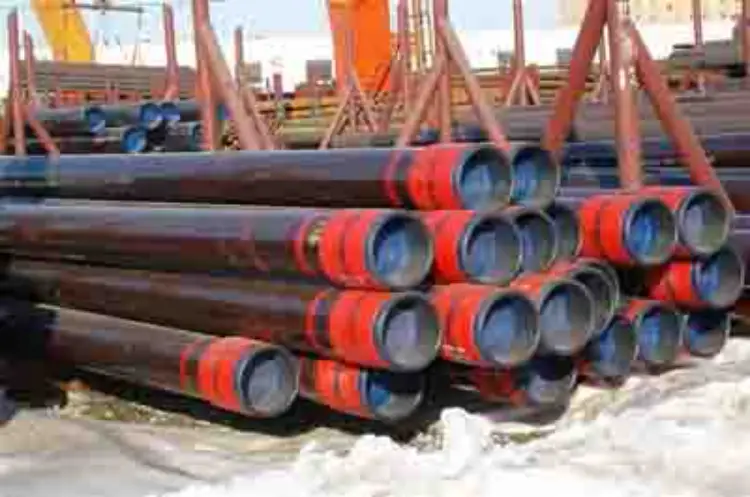
EN 10025-2 S235J0 Steel for LSAW Pipe
EN 10025-2 S235J0 Steel for LSAW Pipe: Composition, Properties & Equivalents
Comprehensive technical data for S235J0 structural steel as per EN 10025-2, widely used in LSAW (Longitudinal Submerged Arc Welded) pipes. Includes chemical composition, mechanical and thermal properties, international equivalents, and application guidance.
Hot rolling, cold forming, welding (SAW, ERW), bending, cutting
- Phone : +8618037372205
- Email : [email protected]
- WhatsApp: Contact via Whtsapp
- WeChat: +8618037372205
EN 10025-2 S235J0 Steel for LSAW Pipe Introduction
S235J0 is a non-alloy structural steel grade defined in EN 10025-2:2004 (hot rolled products of structural steels). With a minimum yield strength of 235 MPa for thicknesses up to 16 mm and guaranteed impact energy of 27 J at 0°C (designated by 'J0'), it offers a good balance of strength, weldability, and toughness. This grade is commonly supplied as plates and strips used to manufacture LSAW (Longitudinal Submerged Arc Welded) pipes for structural and pressure applications. Typical delivery conditions include as-rolled (AR) or normalized (N), and the material is suitable for cold forming and welding without preheating under normal conditions due to its low carbon content and controlled carbon equivalent.
EN 10025-2 S235J0 Steel for LSAW Pipe Chemical Composition
The chemical composition of S235J0 according to EN 10025-2:2004, Table 1. Values are maximum limits unless a range is given. The steel is fully killed (FN as a furnace or ladle analysis). For thicknesses > 150 mm, slightly adjusted limits may apply. Carbon equivalent (CEV) is typically ≤ 0.35 for weldability.
| Chemical Element | Standard Value (max, %) | Remarks |
|---|---|---|
| C (Carbon) | ≤ 0.17 | For thickness ≤ 16 mm; ≤ 0.20 for thickness > 16 mm up to 100 mm |
| Mn (Manganese) | ≤ 1.40 | For thickness ≤ 16 mm; may be ≤ 1.60 for thickness > 100 mm |
| Si (Silicon) | ≤ 0.55 | Usually > 0.10 for killed steel |
| P (Phosphorus) | ≤ 0.030 | Strict limit for weldability |
| S (Sulfur) | ≤ 0.030 | Strict limit for weldability |
| Cu (Copper) | ≤ 0.55 | Residual content; may be higher by agreement |
| N (Nitrogen) | ≤ 0.012 | For products with long product form; ≤ 0.014 for flat products (plates) |
| Al (Aluminum) | ≥ 0.015 (total) if N-binding elements agreed | Optional for fine grain practice |
| Nb + V + Ti | ≤ 0.05 (if added) | Microalloying elements not normally specified for S235J0 but limited if present |
| CEV (Carbon Equivalent) | ≤ 0.35 typical | Based on formula CEV = C + Mn/6 + (Cr+Mo+V)/5 + (Ni+Cu)/15 |
EN 10025-2 S235J0 Steel for LSAW Pipe Thermal and Electrical Physical Properties
Physical properties are not part of the EN 10025-2 normative requirements but are provided for engineering calculations. Values are typical for non-alloy structural steel at room temperature unless specified otherwise. The density corresponds to 7.85 g/cm³, and the modulus of elasticity E ≈ 210 GPa. Thermal expansion and conductivity values are crucial for welding and fire design.
| Property | Typical Value | Unit | Condition / Temperature Range |
|---|---|---|---|
| Density (ρ) | 7.85 | g/cm³ | 20°C |
| Modulus of Elasticity (E) | 210 | GPa | 20°C |
| Shear Modulus (G) | 80.8 | GPa | 20°C |
| Poisson's Ratio (ν) | 0.30 | — | 20°C |
| Thermal Expansion Coeff. (α) | 12.0 | 10⁻⁶/K | 20–100°C |
| Thermal Expansion Coeff. | 12.5 | 10⁻⁶/K | 20–200°C |
| Thermal Expansion Coeff. | 13.0 | 10⁻⁶/K | 20–300°C |
| Thermal Conductivity (λ) | 53 | W/(m·K) | 20°C |
| Thermal Conductivity | 50 | W/(m·K) | 100°C |
| Specific Heat Capacity (cp) | 460 | J/(kg·K) | 20°C |
| Specific Heat Capacity | 500 | J/(kg·K) | 200°C |
| Electrical Resistivity (ρe) | 0.15 | μΩ·m | 20°C |
EN 10025-2 S235J0 Steel for LSAW Pipe Mechanical Properties
Mechanical properties as per EN 10025-2, mandatory for the delivery condition. Values depend on product thickness. The minimum yield strength ReH and tensile strength Rm are guaranteed in the longitudinal direction. Impact energy KV is tested at 0°C for thicknesses ≥ 6 mm (or ≥ 10 mm for subsize specimens). Bend test uses mandrel diameter = 0.5a for t ≤ 16 mm.
| Property | Value | Unit | Condition / Thickness |
|---|---|---|---|
| Yield Strength (ReH) | ≥ 235 | MPa | t ≤ 16 mm |
| Yield Strength (ReH) | ≥ 225 | MPa | 16 mm < t ≤ 40 mm |
| Yield Strength (ReH) | ≥ 215 | MPa | 40 mm < t ≤ 63 mm |
| Yield Strength (ReH) | ≥ 215 | MPa | 63 mm < t ≤ 80 mm |
| Yield Strength (ReH) | ≥ 215 | MPa | 80 mm < t ≤ 100 mm |
| Yield Strength (ReH) | ≥ 195 | MPa | 100 mm < t ≤ 150 mm |
| Yield Strength (ReH) | ≥ 185 | MPa | 150 mm < t ≤ 200 mm |
| Tensile Strength (Rm) | 360 – 510 | MPa | t ≤ 3 mm |
| Tensile Strength (Rm) | 360 – 510 | MPa | 3 mm < t ≤ 100 mm |
| Tensile Strength (Rm) | 350 – 500 | MPa | 100 mm < t ≤ 150 mm |
| Tensile Strength (Rm) | 340 – 490 | MPa | 150 mm < t ≤ 250 mm |
| Elongation (A, longitudinal) | ≥ 15 | % | t ≤ 1.0 mm |
| Elongation (A, longitudinal) | ≥ 16 | % | 1.0 mm < t ≤ 1.5 mm |
| Elongation (A, longitudinal) | ≥ 17 | % | 1.5 mm < t ≤ 2.0 mm |
| Elongation (A, longitudinal) | ≥ 18 | % | 2.0 mm < t ≤ 2.5 mm |
| Elongation (A, longitudinal) | ≥ 19 | % | 2.5 mm < t ≤ 3.0 mm |
| Elongation (A, longitudinal) | ≥ 26 | % | 3.0 mm < t ≤ 40 mm |
| Elongation (A, longitudinal) | ≥ 25 | % | 40 mm < t ≤ 63 mm |
| Elongation (A, longitudinal) | ≥ 24 | % | 63 mm < t ≤ 100 mm |
| Elongation (A, longitudinal) | ≥ 22 | % | 100 mm < t ≤ 150 mm |
| Elongation (A, longitudinal) | ≥ 21 | % | 150 mm < t ≤ 200 mm |
| Elongation (A, longitudinal) | ≥ 21 | % | 200 mm < t ≤ 250 mm |
| Bend Test (mandrel diameter) | 0.5a | — | t ≤ 16 mm, transverse bend, angle 180° |
| Bend Test (mandrel diameter) | 1.0a | — | 16 mm < t ≤ 100 mm, transverse bend, angle 180° |
| Impact Energy (KV, longitudinal) | ≥ 27 | J | 0°C, thickness ≥ 10 mm (10x10 specimen) |
| Impact Energy (KV, longitudinal) | ≥ 27 | J | 0°C, thickness 6–10 mm (subsize specimen, requirement adjusted according to standard) |
EN 10025-2 S235J0 Steel for LSAW Pipe Exact Equivalent Material Grades
| Country/Region | Standard | Grade | Remarks |
|---|---|---|---|
| Europe | EN 10025-2:2004 | S235J0 | Original designation |
| International (ISO) | ISO 630-2:2020 | S235J0 / S235C | Chemically and mechanically equivalent; note that S235C implies fine grain but J0 guarantees 0°C impact |
| Germany (obsolete) | DIN 17100:1980 | St 37-3 U | Historical equivalent, now replaced by EN 10025-2 |
| France (obsolete) | NF A 35-501 | E 24-3 | Historical equivalent |
| UK (obsolete) | BS 4360:1990 | 40C | Historical equivalent with 0°C impact test |
| China | GB/T 700-2006 | Q235C | 0°C impact 27J, similar yield and tensile; slight differences in P, S limits |
| Italy | UNI 7070 | Fe 360 C | Historical |
EN 10025-2 S235J0 Steel for LSAW Pipe Application Introduction
S235J0 steel is widely used in structural applications where moderate strength and good toughness at low temperatures (down to 0°C) are required. In the form of LSAW pipes, it is employed for transporting gases, water, and structural columns. The material can be cut, welded, and formed using conventional methods. It is often chosen for its cost-effectiveness and compliance with EN 1090-2 for steel structures.
Product Applications: LSAW pipes (longitudinal submerged arc welded pipes) for piling, structural hollow sections, Structural columns and beams, Bridge girders and trusses, Crane runway beams, Storage tanks (moderate service), Sign gantries and lighting poles
Processed into products: Pipe fittings (elbows, tees) welded from S235J0 plates, Flanges for low-pressure piping, Welded tube joints, Casing pipes for underground installations, Support brackets and brackets in machinery
Application industries: Building and construction, Infrastructure (bridges, towers), Offshore and marine structural components (non-critical), Oil and gas pipeline (low pressure, structural), Water transmission pipelines, Machinery and heavy equipment frames
EN 10025-2 S235J0 Steel for LSAW Pipe Similar / Alternative Materials
| Country/Region | Standard | Grade | Remarks |
|---|---|---|---|
| USA | ASTM A36/ A36M | A36 | Tensile strength 400-550 MPa; yield ≥ 250 MPa (t ≤200mm); no impact temperature specified unless by supplemental requirement (e.g., Charpy at 0°C). Can be made equivalent with additional test. |
| Japan | JIS G3106:2008 | SM400B | Yield 245 MPa for t≤16mm; tensile 400-510 MPa; impact 27J at 0°C. Very close but slightly higher yield. |
| China | GB/T 1591-2018 | Q235B | No impact or room temperature only (20°C). Don't have 0°C guarantee; Q235C is the exact equivalent. |
| Russia | GOST 380-2005 | St3kp/ps (St3sp) | No direct 0°C guarantee; special modification required. |
| India | IS 2062:2011 | E250 Cu | Grade A has no impact; Grade B with 0°C impact test (E250B) can be similar but yield 250 MPa. |
Notes:
- For LSAW pipe manufacturing, the steel strip/plate is formed and welded with a submerged arc welding process. The heat-affected zone (HAZ) may have altered properties, but the base material S235J0 maintains its specification after welding when proper procedures are followed.
- Post-weld heat treatment is generally not required for thicknesses up to 50 mm due to the low carbon content, but refer to pressure vessel or pipeline codes (e.g., EN 13480, ASME B31.4) for specific requirements.
- Supplementary testing such as through-thickness properties (Z15/Z25/Z35) and ultrasonic inspection (EN 10160) can be ordered for critical applications.
- Corrosion protection: typically hot-dip galvanizing or painting is applied for structural steel and LSAW pipes used in atmospheric environments.
- Share



