
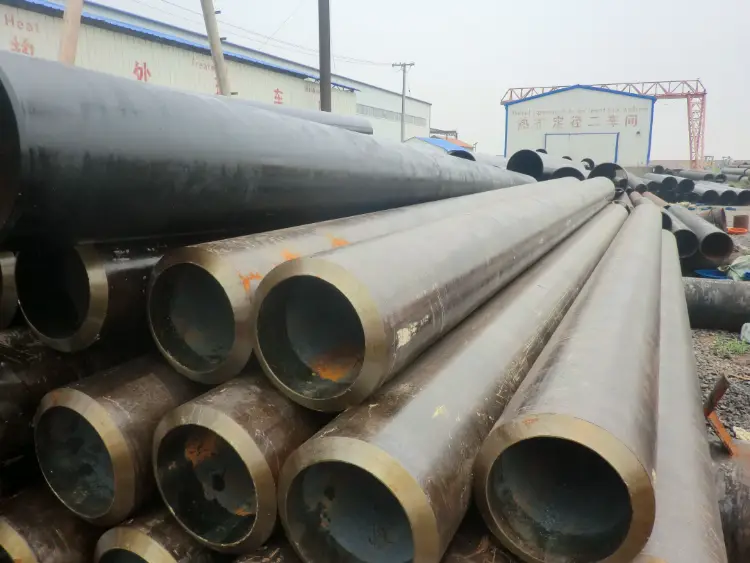
EN10025-2 S235J2 LSAW Pipe
EN10025-2 S235J2 LSAW Pipe: Non-Alloy Structural Steel for Welded Pipes
Detailed material properties, chemical composition, mechanical and physical data for S235J2 steel grade used in LSAW pipes, compliant with EN 10025-2.
LSAW pipe manufacturing (plate forming, submerged arc welding); suitable for cold bending, cutting, welding, and galvanizing
- Phone : +8618037372205
- Email : [email protected]
- WhatsApp: Contact via Whtsapp
- WeChat: +8618037372205
EN10025-2 S235J2 LSAW Pipe Introduction
S235J2 is a non-alloy structural steel in accordance with EN 10025-2. It is intended for welded structures, offering a minimum yield strength of 235 MPa for thickness ≤16 mm and guaranteed Charpy-V impact energy of 27 J at -20°C (J2 quality). This steel is commonly supplied in normalized or as-rolled condition. When used for LSAW (Longitudinally Submerged Arc Welded) pipes, the base material is typically hot-rolled plate or coil, which is formed and welded. The steel exhibits good weldability, formability, and toughness, making it suitable for structural hollow sections, pressure pipes (non-sour service), and general construction. It is delivered with a test certificate (e.g., EN 10204 type 2.2 or 3.1) as per the applicable pipe or plate standard. The chemical composition is designed to ensure weldability and toughness, with controlled carbon, manganese, and impurity levels.
EN10025-2 S235J2 LSAW Pipe Chemical Composition as per EN 10025-2:2019 for S235J2
The chemical composition is specified for ladle analysis. Elements not listed are present only as residuals. The steel is fully killed (FF) and optionally fine-grained. For thicknesses >150 mm, there may be additional requirements not shown here.
- C controls weldability and strength.
- Mn increases strength and toughness.
- P, S, N are restricted to maintain ductility and impact properties.
- Cu may improve corrosion resistance but is limited to avoid hot shortness.
| Element | Standard Value (max, %) | Remarks |
|---|---|---|
| Carbon (C) | 0.17 | For thickness ≤100 mm |
| Silicon (Si) | -- (unspecified) | Typically 0.10–0.35 for plate |
| Manganese (Mn) | 1.40 | Maximum for all thicknesses |
| Phosphorus (P) | 0.030 | Maximum |
| Sulfur (S) | 0.030 | Maximum |
| Nitrogen (N) | 0.012 | For J2 quality; if sufficient Al or other N-binding elements are present, N may be up to 0.014 |
| Copper (Cu) | 0.55 | Maximum |
| Residual elements (Cr, Ni, Mo) | Each ≤0.30; sum ≤0.75 | Not specified in standard table but typical for non-alloy steels in EN 10025-2 |
EN10025-2 S235J2 LSAW Pipe Physical and Thermal Properties
The following physical properties are not specified in EN 10025-2 but are typical for non-alloy structural steel at room temperature (20°C). These values are widely used in design and are taken from Eurocode 3 (EN 1993-1-1/-2) and materials data. Thermal expansion and conductivity vary with temperature.
| Property | Typical Value | Unit | Condition / Reference |
|---|---|---|---|
| Density (ρ) | 7850 | kg/m³ | At 20°C |
| Modulus of elasticity (E) | 210 | GPa | At 20°C |
| Shear modulus (G) | 81 | GPa | Calculated: E/[2(1+ν)] |
| Poisson's ratio (ν) | 0.3 | – | In elastic range |
| Coefficient of thermal expansion (α) | 12 × 10⁻⁶ | K⁻¹ | 20–100°C |
| Thermal conductivity (λ) | 53 | W/(m·K) | At 20°C |
| Specific heat capacity (Cₚ) | 440 – 600 | J/(kg·K) | 20–400°C, temperature dependent |
| Electrical resistivity (ρₑ) | 0.20 – 0.25 | µΩ·m | At 20°C |
EN10025-2 S235J2 LSAW Pipe Mechanical Properties
The values below are mandatory minimums from EN 10025-2:2019 for S235J2. The tensile test is performed on transverse specimens unless otherwise agreed. Impact energy is measured on Charpy-V specimens at -20°C (longitudinal for plate). For thicker sections, yield strength reduces (e.g., 16
Property Standard Value Unit Test Condition Upper yield strength (ReH) ≥235 MPa Thickness ≤16 mm, transverse Tensile strength (Rm) 360 – 510 MPa Thickness ≤100 mm Elongation (A) ≥26 % Thickness >3 mm, longitudinal; for transverse ≥24 Impact energy (KV₂) ≥27 (mean of 3), ≥24 single J -20°C, longitudinal; for thickness 5–10 mm, reduced-size specimen, values proportionally adjusted Bend test (bend angle / mandrel diameter) 180° / 2t (t ≤2 mm), 2.5t (2 – Mandrel diameter d as multiple of thickness t; no cracks allowed. As per EN 10025-2 Table 8.
EN10025-2 S235J2 LSAW Pipe Completely Equivalent Material Standards and Substitute Grades
| Country / Region | Standard | Grade | Remarks |
|---|---|---|---|
| International (ISO) | ISO 630-3 | S235J2 | Flat products; identical chemistry and mechanicals |
| European Union | EN 10025-2 | S235J2 | Original standard |
| Former British Standard (withdrawn) | BS 4360 | 40D or 43D | Historical equivalent; impact temperatures may differ |
| India (BIS) | IS 2062 | E250 C | With impact requirement at -20°C; close match but S quality may differ |
EN10025-2 S235J2 LSAW Pipe Application Introduction
S235J2 LSAW pipes are used in a wide range of structural and mechanical applications where guaranteed low-temperature toughness is required. The pipe manufacturing process (LSAW) allows for large diameters and wall thicknesses not achievable with seamless or ERW pipes. Typical uses include:
Product Applications: Structural hollow columns and beams, LSAW line pipes for water, air, and non-hazardous fluids, Foundation piles (driven or drilled), Caisson tubes, Conveyor belt idler rollers, Architectural tubing
Processed into products: Pipe piling connectors, Flanges and rings welded onto pipe, Pipe elbows and reducers (by cutting and welding), Pipe support brackets and base plates, End caps and closures, Stiffening rings
Application industries: Civil engineering and construction, Offshore and marine structural supports, Water transmission and distribution, Non-corrosive fluid transport (e.g., water, sewage), Bridge building (piling, casings), Machinery and conveyor systems, Wind energy tower sections (in non-fatigue critical parts)
EN10025-2 S235J2 LSAW Pipe Similar / Alternative Grades for Reference
| Country / Region | Standard | Grade | Remarks |
|---|---|---|---|
| European Union | EN 10025-2 | S235JR | Impact energy at +20°C; lower toughness |
| European Union | EN 10025-2 | S235J0 | Impact energy at 0°C; intermediate toughness |
| USA | ASTM A36 / A36M | A36 | Comparable strength; no specified impact test unless ordered as A36 Charpy |
| China | GB/T 700 | Q235D | Impact at -20°C, but different Mn and impurity limits; not identical |
| Japan | JIS G 3106 | SM400B | If impact at 0°C is acceptable; SM400C may be closer if -20°C is specified |
| Russia | GOST 27772 | C255 | Analogous to S235JR; for J2 use C255-1 with additional requirements |
Notes:
- For LSAW pipes, additional testing may be required per pipe standards (e.g., EN 10219, API 5L) such as hydrostatic test, non-destructive testing of weld, and dimensional tolerances.
- The carbon equivalent (CEV) is typically <0.35% to ensure good weldability without preheating for moderate thicknesses.
- Thicker sections should be ordered with '+N' (normalized) treatment to ensure toughness.
- This steel is not intended for sour service (H₂S-containing environments) per NACE MR0175 unless specifically qualified.
- Share



