
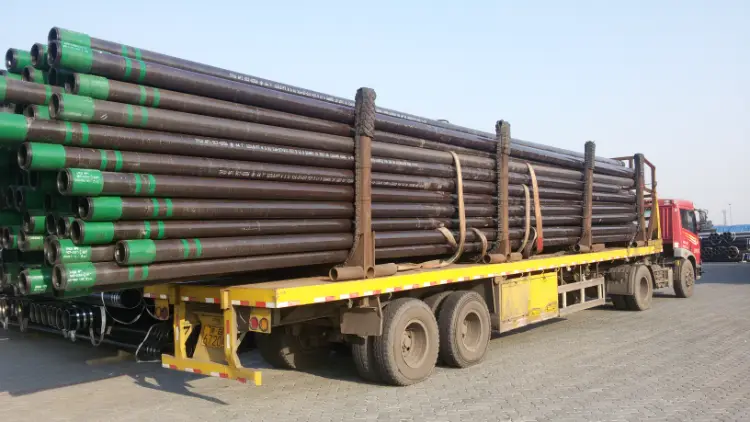
EN 10025-6 S960QL LSAW Pipe
EN 10025-6 S960QL LSAW Pipe: Ultra-High Strength Quenched & Tempered Steel
Detailed material data for S960QL structural steel used in longitudinal submerged arc welded (LSAW) pipes according to EN 10025-6, including chemical composition, mechanical and physical properties.
LSAW pipe forming from plate, submerged arc welding, heat treatment (if required), cold forming (limited), machining, and post-weld stress relief.
- Phone : +8618037372205
- Email : [email protected]
- WhatsApp: Contact via Whtsapp
- WeChat: +8618037372205
EN 10025-6 S960QL LSAW Pipe Introduction
S960QL is a quenched and tempered high-strength structural steel defined in EN 10025-6, designed for minimum yield strength of 960 MPa in thicknesses up to 50 mm. When formed into LSAW (Longitudinal Submerged Arc Welded) pipes, the material retains its excellent weldability and toughness at low temperatures (down to -40 °C for the 'L' quality). S960QL offers an outstanding strength-to-weight ratio, making it ideal for heavy-duty lifting equipment, mobile cranes, bridges, and structural applications where weight savings are critical. The fine-grained microstructure achieved through quenching and tempering ensures consistent mechanical properties and good cold-forming capability. LSAW pipes produced from this grade are typically used in structural frameworks, offshore structures, and high-pressure applications demanding both high strength and reliable notch toughness.
EN 10025-6 S960QL LSAW Pipe Chemical Composition as per EN 10025-6:2019
The chemical composition of S960QL is restricted to ensure high strength, good weldability, and low-temperature toughness. The maximum limits for CEV (Carbon Equivalent Value) are defined for different thicknesses to guarantee cold-cracking resistance during welding. Typical CEV ≤ 0.58 for thickness ≤ 50 mm.
| Element | Required Value (max %) | Remarks |
|---|---|---|
| C (Carbon) | ≤ 0.20 | Ladle analysis; for long products ≤ 0.22 |
| Si (Silicon) | ≤ 0.80 | Indicates killed steel |
| Mn (Manganese) | ≤ 1.70 | Fine-grain strengthening |
| P (Phosphorus) | ≤ 0.020 | For L quality (low temp.), ≤ 0.025 for other qualities |
| S (Sulfur) | ≤ 0.010 | Strict control for toughness |
| Cr (Chromium) | ≤ 1.50 | Hardenability element |
| Ni (Nickel) | ≤ 2.00 | Improves toughness at low temperature |
| Mo (Molybdenum) | ≤ 0.70 | Hardenability and carbide former |
| V (Vanadium) | ≤ 0.12 | Micro-alloying for grain refinement |
| Ti (Titanium) | ≤ 0.05 | Nitride former to fix nitrogen |
| N (Nitrogen) | ≤ 0.015 | Limited to avoid aging effects |
| B (Boron) | ≤ 0.005 | Optional hardenability enhancer |
| Cu (Copper) | ≤ 0.50 | Residual or added for corrosion resistance |
| Nb (Niobium) | ≤ 0.05 | Usually combined with V, total Nb+V ≤ 0.22 |
| Al (Aluminium) | ≥ 0.018 total | Grain refinement, total aluminium |
| CEV | ≤ 0.58 (t ≤ 50 mm) | Carbon Equivalent Value = C+Mn/6+(Cr+Mo+V)/5+(Ni+Cu)/15 |
EN 10025-6 S960QL LSAW Pipe Thermal and Electrical Physical Properties
The values listed are typical for quenched and tempered high-strength steels at room temperature unless otherwise indicated. They may vary slightly depending on exact composition and heat treatment. Data provided for engineering design purposes.
| Property | Typical Value | Unit | Test Condition / Standard |
|---|---|---|---|
| Density (ρ) | 7850 | kg/m³ | at 20 °C |
| Modulus of Elasticity (E) | 210 | GPa | Tensile loading at 20 °C |
| Shear Modulus (G) | 80 | GPa | Calculated from E and Poisson's ratio |
| Poisson's Ratio (ν) | 0.3 | - | Elastic range |
| Thermal Expansion Coefficient (α) | 12.0 | 10⁻⁶/K | 20 – 100 °C |
| Thermal Expansion Coefficient (α) | 13.0 | 10⁻⁶/K | 20 – 200 °C |
| Thermal Expansion Coefficient (α) | 13.5 | 10⁻⁶/K | 20 – 400 °C |
| Thermal Conductivity (λ) | 40 – 50 | W/(m·K) | At 20 °C |
| Specific Heat Capacity (c) | 460 – 480 | J/(kg·K) | At 20 °C |
| Electrical Resistivity (ρ_e) | 0.22 – 0.28 | µΩ·m | At 20 °C |
EN 10025-6 S960QL LSAW Pipe Mechanical Properties
Mechanical properties are valid for the quenched and tempered condition. For LSAW pipes, the specified values apply to the base metal away from the weld. The 'L' designation indicates guaranteed longitudinal Charpy impact energy at -40 °C. Values are for thickness ≤ 50 mm unless otherwise stated.
| Property | Required Value | Unit | Test Condition / Direction |
|---|---|---|---|
| Yield Strength (ReH) | ≥ 960 | MPa | Ambient temperature, longitudinal/transverse, t ≤ 50 mm |
| Yield Strength (ReH) | ≥ 915 | MPa | Ambient, t > 50 mm ≤ 100 mm |
| Yield Strength (ReH) | ≥ 880 | MPa | Ambient, t > 100 mm ≤ 150 mm |
| Tensile Strength (Rm) | 980 – 1150 | MPa | Ambient, t ≤ 50 mm |
| Tensile Strength (Rm) | 940 – 1100 | MPa | Ambient, t > 50 mm ≤ 100 mm |
| Tensile Strength (Rm) | 920 – 1080 | MPa | Ambient, t > 100 mm ≤ 150 mm |
| Elongation (A5, longitudinal) | ≥ 10 | % | Gauge length 5.65√S₀, t ≤ 50 mm |
| Elongation (A5, longitudinal) | ≥ 8 | % | t > 50 mm ≤ 100 mm |
| Elongation (A5, longitudinal) | ≥ 8 | % | t > 100 mm ≤ 150 mm |
| Impact Energy (KV, longitudinal) | ≥ 40 at -40 °C | J | Charpy V-notch, average of 3 tests, t ≥ 10 mm |
| Impact Energy (KV, longitudinal) | ≥ 27 at -40 °C | J | Individual test value, t ≥ 10 mm |
| Bending test (mandrel diameter) | D = 3a (t ≤ 50 mm) | - | Transverse bend, 180°, a = specimen thickness |
EN 10025-6 S960QL LSAW Pipe Exact Equivalent Material Standards and Replaceable Grades
| Country / Region | Standard | Grade | Remarks |
|---|---|---|---|
| Europe | EN 10025-6:2019 | S960QL | Exact designation; includes Q (quenched & tempered), L (low temp. toughness) |
| Germany | DIN EN 10025-6 | S960QL | Identical adoption of EN |
| United Kingdom | BS EN 10025-6 | S960QL | Identical adoption, same properties |
| Italy | UNI EN 10025-6 | S960QL | Identical adoption |
| Worldwide (proprietary) | SSAB | Strenx 960 (formerly WELDOX 960) | Proprietary brand with similar or superior guaranteed properties; not an exact standard grade |
| Worldwide (ISO concept) | ISO 4950-3 (withdrawn) | E960Q (approximate) | Old ISO standard; E960Q had similar strength but differing toughness requirements |
EN 10025-6 S960QL LSAW Pipe Application Introduction
S960QL LSAW pipes are selected where ultra-high strength, low-temperature toughness, and weldability are required. The material allows significant weight reductions compared to conventional steels, which results in lower transportation and erection costs. Typical usage includes structural components in dynamic loading environments, such as crane booms, bridges, and offshore installations. The LSAW process enables production of large-diameter, thick-walled pipes, making it suitable for compressive and bending members. Fabrication requires careful heat input control during welding and appropriate post-weld treatments.
Product Applications: LSAW structural pipes (circular and square/rectangular hollow sections), Crane booms and telescopic sections, Bridge piers and arches, Offshore platform legs and bracing, Heavy-duty conveyor frames, High-pressure penstocks
Processed into products: Welded tubular nodes and structural connections, Bearing supports and swivel rings, Lattice structures and space frames, Jack-up rig chord and rack components, Foundation piles and caissons, Mine haul truck frames and excavator booms
Application industries: Heavy lifting and transport equipment (e.g., mobile cranes, reach stackers), Civil engineering and bridge construction, Offshore oil & gas structures (jack-ups, platform legs), Wind energy (tower sections, foundations), Mining and quarrying machinery, Pile driving and foundation engineering
EN 10025-6 S960QL LSAW Pipe Similar / Comparable Alternative Materials
| Country / Region | Standard | Grade | Remarks |
|---|---|---|---|
| Europe | EN 10025-6 | S960Q | Same strength, but only guaranteed at -20 °C impact; less stringent low-temp toughness ('Q' without 'L') |
| Europe | EN 10025-6 | S890QL | Lower yield strength (890 MPa) with same low-temperature toughness; suitable if lower strength is acceptable |
| Europe | EN 10025-6 | S960M | Thermomechanical rolled version; yield 960 MPa but typical plate thickness limited; different chemical concept |
| USA | ASTM A514/A517 | Grade S | Yield strength approx. 690 MPa (lower); quenched & tempered alloy steel, not a direct replacement but used in similar applications |
| Japan | JIS G 3128 | SHY 900 (approximate) | High-strength steel for welded structures, 900 MPa class, not identical |
| China | GB/T 16270 | Q960E | Similar high-strength quenched & tempered steel with yield ≥ 960 MPa and -40 °C impact; analogous concept |
| Proprietary | Dillinger Hütte | DILLIMAX 960 | Proprietary grade with comparable properties and often used as alternative to S960QL |
Notes:
For LSAW pipes produced from S960QL, the weld seam properties must comply with EN 10225 or project specifications. Typically, the weld metal yields slightly overmatched relative to the base metal. Post-weld heat treatment (PWHT) is generally avoided for Q&T steels unless strictly controlled to prevent strength loss. Dimensional tolerances for LSAW pipes are referenced to EN 10219 (cold-formed) or EN 10210 (hot-finished) depending on the manufacturing route. When specifying, ensure the CEV and Pcm are suitable for the intended welding process. Hydrogen-induced cracking prevention is critical; low-hydrogen welding consumables and proper preheating are recommended.
- Share



