
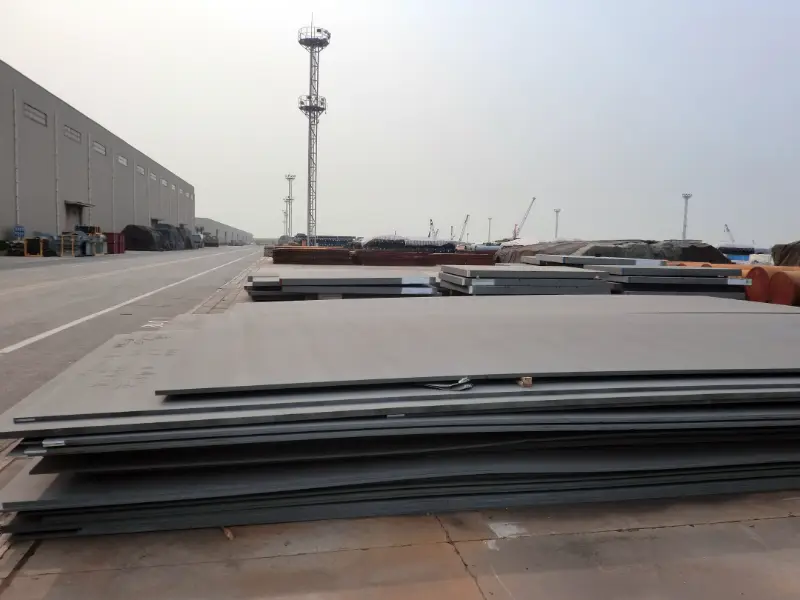
S960Q Steel under EN 10025-6
S960Q Steel under EN 10025-6: High-Strength Quenched & Tempered Steel for LSAW Pipes
Comprehensive material data for S960Q structural steel according to EN 10025-6, including chemical composition, mechanical properties, and physical performance suitable for LSAW pipe applications.
Hot rolling, quenching & tempering, cold forming, welding (LSAW, SAW), cutting, machining
- Phone : +8618037372205
- Email : [email protected]
- WhatsApp: Contact via Whtsapp
- WeChat: +8618037372205
S960Q Steel under EN 10025-6 Introduction
S960Q is a high-yield-strength structural steel grade defined in EN 10025-6 for hot-rolled weldable fine-grain steels in the quenched and tempered condition. With a minimum yield strength of 960 MPa at thicknesses up to 50 mm, it offers exceptional strength-to-weight ratio, good toughness at low temperatures (down to -20 °C), and reliable weldability.
- Delivered in the quenched and tempered (+QT) condition.
- Designed for welded structures such as heavy-duty machinery, mobile cranes, offshore platforms, and high-pressure pipelines.
- LSAW (Longitudinal Submerged Arc Welded) pipes made from S960Q plates combine the base metal's strength with stringent dimensional accuracy.
S960Q Steel under EN 10025-6 Chemical Composition
The typical ladle analysis limits for S960Q according to EN 10025-6:2019 for product thicknesses ≤ 50 mm. Grain-refining elements like Al, Nb, Ti, and V may be added. The maximum carbon equivalent (CEV) values are specified to assure weldability.
| Element | Standard Value (max, unless range) | Remarks |
|---|---|---|
| Carbon (C) | 0.20 % | Ladle analysis, thickness ≤ 50 mm |
| Silicon (Si) | 0.80 % | Maximum unless otherwise agreed |
| Manganese (Mn) | 1.70 % | Maximum |
| Phosphorus (P) | 0.020 % | Maximum |
| Sulfur (S) | 0.010 % | Maximum |
| Nitrogen (N) | 0.015 % | Maximum |
| Boron (B) | 0.005 % | Maximum |
| Chromium (Cr) | 1.50 % | Maximum |
| Copper (Cu) | 0.50 % | Maximum |
| Molybdenum (Mo) | 0.70 % | Maximum |
| Niobium (Nb) | 0.06 % | Maximum |
| Nickel (Ni) | 2.0 % | Maximum |
| Titanium (Ti) | 0.05 % | Maximum |
| Vanadium (V) | 0.12 % | Maximum |
| Zirconium (Zr) | 0.15 % | Maximum |
| Aluminium (Al, total) | ≥ 0.015 % (if added) | Minimum when used for grain refinement |
S960Q Steel under EN 10025-6 Thermal and Electrical Physical Properties
Typical physical properties of S960Q at room temperature and elevated temperatures. These values are for general engineering calculations and are not mandated by the delivery standard.
| Property | Typical Value | Unit | Test Condition |
|---|---|---|---|
| Density (ρ) | 7850 | kg/m³ | 20 °C |
| Elastic modulus (E) | 210 | GPa | 20 °C |
| Shear modulus (G) | 81 | GPa | 20 °C, calculated |
| Poisson's ratio (ν) | 0.3 | - | 20 °C |
| Thermal expansion coefficient (α) | 11.1 | 10−⁶/K | 20 to 100 °C |
| Thermal expansion coefficient (α) | 12.5 | 10−⁶/K | 20 to 200 °C |
| Thermal conductivity (λ) | 45 | W/(m·K) | 20 °C |
| Specific heat capacity (c) | 460 | J/(kg·K) | 20 °C |
| Electrical resistivity (ρe) | 0.25 | Ω·mm²/m | 20 °C |
S960Q Steel under EN 10025-6 Mechanical Properties
Mechanical properties for S960Q plates in the quenched and tempered condition, tested in longitudinal direction at room temperature in accordance with EN 10025-6. Impact energy is based on Charpy V-notch specimens at -20 °C.
| Property | Standard Requirement | Unit | Test Condition |
|---|---|---|---|
| Yield strength (ReH) | ≥ 960 | MPa | Thickness ≤ 50 mm, longitudinal |
| Tensile strength (Rm) | 980 - 1150 | MPa | Thickness ≤ 50 mm, longitudinal |
| Elongation after fracture (A) | ≥ 10 | % | Proportional test piece, L0 = 5.65√S0, longitudinal |
| Charpy impact energy (KV) | ≥ 27 | J | At -20 °C, longitudinal, average of 3 specimens |
| Bend test (bend angle 180°, mandrel diameter) | 4 × t | mm | Thickness ≤ 16 mm |
| Bend test (bend angle 180°, mandrel diameter) | 5 × t | mm | Thickness > 16 to ≤ 40 mm |
| Bend test (bend angle 180°, mandrel diameter) | 6 × t | mm | Thickness > 40 mm |
S960Q Steel under EN 10025-6 Identical / Direct Equivalent Material Standards and Alternative Designations
| Country/Region | Standard | Grade | Remarks |
|---|---|---|---|
| European Union | EN 10025-6 | S960Q | Original designation |
| Germany | DIN EN 10025-6 | S960Q | Adopted European standard |
| France | NF EN 10025-6 | S960Q | Adopted European standard |
| United Kingdom | BS EN 10025-6 | S960Q | Adopted European standard |
| International | ISO 630-6 | S960Q | Based on EN 10025-6; impact temperature -20 °C |
S960Q Steel under EN 10025-6 Application Introduction
S960Q combines very high strength with adequate toughness, making it suitable for weight-critical, dynamically loaded welded structures. LSAW pipes produced from this steel are used where high internal pressure and harsh environmental conditions demand exceptional mechanical performance.
- Typical industries: heavy cranes, offshore oil & gas, pressure vessel fabrication, bridge building.
- Good cold formability can be expected provided the minimum bending radii are observed.
- Welding requires low-hydrogen processes and control of heat input to preserve the tempered microstructure.
Product Applications: LSAW steel pipes for subsea and onshore pipelines, Hollow structural sections (HSS) for lattice booms, Welded beams and columns for high-rise structures, Pressure vessels and storage tanks, Heavy-duty chassis and frames
Processed into products: Pipe elbows, tees, reducers (LSAW pipeline accessories), Crane telescopic boom sections, Offshore jacket legs and braces, Hydraulic cylinder bodies, Mining dump truck frames and shovel booms
Application industries: Crane and lifting equipment manufacturing, Offshore engineering (jack-up rigs, platforms), Hydraulic and high-pressure piping systems, Bridge construction and heavy steel structures, Mining and earth-moving machinery
S960Q Steel under EN 10025-6 Similar / Comparable Materials
| Country/Region | Standard | Grade | Remarks |
|---|---|---|---|
| European Union | EN 10025-6 | S960QL | Similar strength, lower impact temperature (-40 °C) and slightly tighter alloy limits |
| European Union | EN 10025-6 | S890Q | Minimum yield 890 MPa; used when 960 MPa is not required |
| European Union | EN 10025-6 | S1100Q | Higher strength (1100 MPa min yield) but reduced toughness and stricter welding requirements |
| USA | ASTM A514 / A517 | Grade F, Grade Q | Quenched & tempered alloy steel plates; strength ranges overlap, but specific grades must be compared |
| Japan | JIS G 3128 | SHY 685 / SHY 700 | High tensile strength steels for welded structures; lower strength levels but comparable technology |
Notes:
Welding recommendation: Preheating (75–150 °C) and interpass temperature control are essential. Use of matching electrodes (e.g., AWS A5.28 ER110S-G) or undermatching fillers may be appropriate depending on design. Post-weld heat treatment (PWHT) is generally avoided as it can reduce the tempered martensite/bainite strength.
Available documentation: Inspection certificates 3.1 per EN 10204, with Charpy results at -20 °C, chemical analysis, and non-destructive testing when specified.
- Share



