
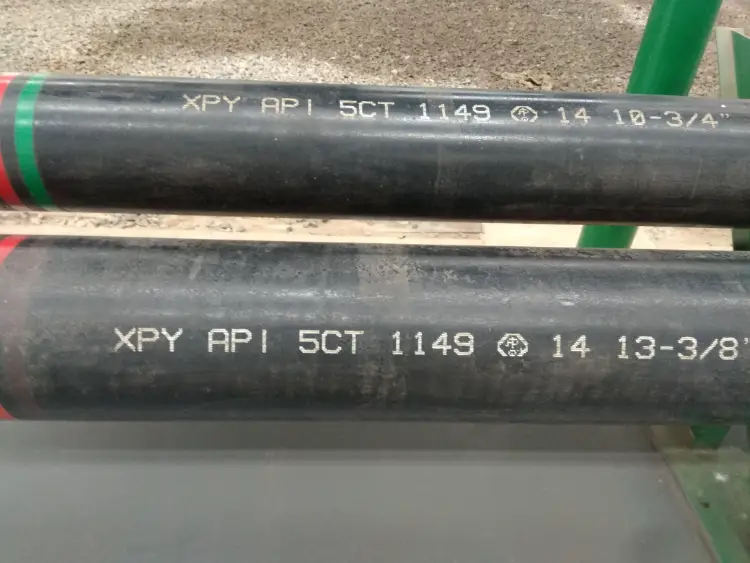
S890QL1 LSAW Pipe
S890QL1 Quenched & Tempered Steel for LSAW Pipe – High Strength 890 MPa, -40°C Impact Toughness to EN 10025-6
Complete material data for S890QL1 LSAW pipe according to EN 10025-6. Chemical composition, mechanical properties at various thicknesses, physical properties, international equivalents and application guide for welded structural pipes requiring 890 MPa yield and -40°C notch toughness.
Welding (SAW, GMAW, SMAW with care for preheating and interpass control), cold forming, hot rolling, quench and temper heat treatment
- Phone : +8618037372205
- Email : [email protected]
- WhatsApp: Contact via Whtsapp
- WeChat: +8618037372205
S890QL1 LSAW Pipe Introduction
S890QL1 is a high-strength quenched and tempered structural steel grade defined in EN 10025-6. With a minimum yield strength of 890 MPa and guaranteed impact energy at -40 °C, it is designed for demanding welded steel constructions where weight savings and safety under dynamic or low-temperature loading are critical. The LSAW pipe (longitudinally submerged arc welded pipe) produced from this grade combines high load-bearing capacity with excellent toughness, enabling use in heavy-duty cranes, offshore structures, pressure vessels and highly stressed mechanical engineering components. Typical delivery condition is quenched + tempered (Q+T) with the suffix L1 indicating longitudinal Charpy V-notch values at -40 °C. The steel offers good weldability when proper low-hydrogen practices are followed.
S890QL1 LSAW Pipe Chemical Composition to EN 10025-6
The S890QL1 steel is microalloyed and vacuum degassed to ensure high strength and low-temperature toughness. Carbon equivalent (CEV) is strictly controlled for weldability. Values as per EN 10025-6 for product thicknesses ≤ 50 mm (typical). For thicker sections, slight adjustments are allowed by the standard but carbon equivalent limits still apply.
| Element | Typical/Required Value (%) | Remarks |
|---|---|---|
| Carbon (C) | ≤ 0.20 | Max 0.20%; typical 0.16-0.18 |
| Silicon (Si) | ≤ 0.80 | Max 0.80%; usual 0.20-0.50 |
| Manganese (Mn) | ≤ 1.70 | Max 1.70%; typical 1.30-1.60 |
| Phosphorus (P) | ≤ 0.020 | Max 0.020% |
| Sulfur (S) | ≤ 0.010 | Max 0.010% |
| Aluminium (Al) | ≥ 0.015 | Minimum 0.015% total aluminium |
| Chromium (Cr) | ≤ 1.50 | May be added |
| Nickel (Ni) | ≤ 2.0 | May be added |
| Molybdenum (Mo) | ≤ 0.70 | May be added |
| Copper (Cu) | ≤ 0.50 | Maximum content |
| Boron (B) | ≤ 0.005 | Possibly added for hardenability |
| Niobium (Nb) | ≤ 0.06 | Microalloying element |
| Titanium (Ti) | ≤ 0.05 | Grain refinement |
| Vanadium (V) | ≤ 0.12 | Precipitation strengthening |
| Zirconium (Zr) | ≤ 0.15 | Inclusion shape control (optional) |
| CEV | ≤ 0.65 | Carbon equivalent value (CEV = C + Mn/6 + (Cr+Mo+V)/5 + (Ni+Cu)/15); typical max 0.58-0.62 to ensure weldability |
S890QL1 LSAW Pipe Typical Physical Properties
The following physical properties are typical for low-alloyed quenched and tempered steels similar to S890QL1 and are provided for design calculations. Exact values may vary slightly with composition and heat treatment. No mandatory requirements exist in EN 10025-6 for these properties.
| Property | Typical Value | Unit | Test Condition |
|---|---|---|---|
| Density (ρ) | 7.85 | kg/dm³ | 20 °C |
| Young's modulus (E) | 210 | GPa | 20 °C |
| Shear modulus (G) | 81 | GPa | 20 °C (calculated from E and ν) |
| Poisson's ratio (ν) | 0.3 | - | 20 °C |
| Thermal expansion coefficient (α) | 11.5 × 10⁻⁶ | K⁻¹ | 20 – 100 °C |
| Thermal expansion coefficient (α) | 12.0 × 10⁻⁶ | K⁻¹ | 20 – 200 °C |
| Thermal expansion coefficient (α) | 13.0 × 10⁻⁶ | K⁻¹ | 20 – 400 °C |
| Thermal conductivity (λ) | 38 | W/(m·K) | 20 °C |
| Thermal conductivity (λ) | 36 | W/(m·K) | 200 °C |
| Specific heat capacity (c_p) | 460 | J/(kg·K) | 20 °C |
| Specific heat capacity (c_p) | 520 | J/(kg·K) | 200 °C |
| Electrical resistivity (ρ_e) | 0.23 | Ω·mm²/m | 20 °C |
S890QL1 LSAW Pipe Mechanical Properties per EN 10025-6
Properties are guaranteed in the transverse direction for plate products unless longitudinal is specified. For LSAW pipe, the test specimen orientation depends on pipe circumferential or longitudinal direction. Values below represent the standardized requirements for plate thicknesses 3 ≤ t ≤ 50 mm (lower strength range) and 50 < t ≤ 100 mm where specified. Impact energy values are for Charpy V-notch test (CVN) at -40 °C.
| Property | Required Value | Unit | Test Condition / Thickness |
|---|---|---|---|
| Yield strength ReH (min) | 890 | MPa | t ≤ 50 mm |
| Yield strength ReH (min) | 830 | MPa | 50 < t ≤ 100 mm |
| Tensile strength Rm | 940 - 1100 | MPa | t ≤ 50 mm |
| Tensile strength Rm | 880 - 1100 | MPa | 50 < t ≤ 100 mm |
| Elongation A5 (min) | 11 | % | t ≤ 50 mm, longitudinal |
| Elongation A5 (min) | 10 | % | 50 < t ≤ 100 mm, longitudinal |
| Charpy V-notch impact energy (min) | 27 (single), 40 (average) | J | Longitudinal, -40 °C (L1 class) |
| Charpy V-notch impact energy (min) | 20 (single), 27 (average) | J | Transverse, -40 °C (if ordered) |
| Bend test (180°) | No cracks | - | Diameter = 3 x plate thickness for t ≤ 50 mm (typical) |
| Hardness (optional) | ≤ 350 HBW or 380 HV10 | - | As agreed, typical for Q+T condition |
S890QL1 LSAW Pipe Complete Equivalents – Identical or Directly Corresponding Grades
| Country/Region | Standard/Grade | Designation | Remarks |
|---|---|---|---|
| Europe | EN 10025-6 | S890QL1 | Original grade; L1 = -40 °C impact test, Q = quenched + tempered |
| Sweden (SSAB) | SSAB Brochure | WELDOX 900 E / 900 F | Proprietary equivalent; WELDOX 900 E often certified to S890QL1 requirements |
| Germany (Dillinger Hütte) | Dillinger Brochure | DILLIMAX 890 | Proprietary grade with comparable properties; available with L2 (-50 °C) option |
| International | EN 10210 / EN 10219 | S890QLH / S890QLH hollow sections | For hollow sections made from S890QL1 material; suffix H indicates hollow sections |
| USA (modified) | ASTM A514 / A517 | Grade B / Q with supplementary CVN at -40 °C (approach) | Not identical; Charpy requirement must be specifically called out; A514 is as-rolled or Q&T but not all grades guarantee -40 °C toughness |
S890QL1 LSAW Pipe Application Introduction
S890QL1 LSAW pipe is engineered for heavy-walled structural tubular applications where high static and fatigue loads coincide with low-temperature service. The quenched and tempered microstructure provides a favourable strength-to-weight ratio and reliable notch toughness. Common uses are in offshore wind foundations (monopile sleeves, transition pieces), mobile crane pedestals, high-pressure penstocks and process piping in cold climates. The LSAW manufacturing process allows pipe diameters up to 60" or more with wall thicknesses exceeding 40 mm. Proper welding procedures, including preheat and interpass temperature control, are essential to preserve the mechanical properties in the heat-affected zone.
Product Applications: LSAW pipes for offshore wind monopile transition pieces, Heavy-wall penstock pipes for hydroelectric plants, Welded beams and columns for high-rise and long-span structures, Thick-wall cylinders for hydraulic presses, Tubular trusses for large bridges, Vacuum tank trailer barrels
Processed into products: LSAW can manufacturing: tubular nodes, jacket legs, caissons, Machined end rings and flanges, Welded crane base sections and telescopic boom segments, Pipe spools with weld-neck flanges for HP applications, Cut-to-length rings for heavy machinery housings, Pin-connected structural arms and linkages
Application industries: Offshore and marine engineering, Wind energy (tower and foundation components), Heavy lift and mobile crane construction, Hydropower (penstocks, bifurcations), Oil & gas (high-pressure gathering lines, structural support), Mining machinery (booms, chassis frames)
S890QL1 LSAW Pipe Near-Equivalent Alternatives
| Country/Region | Standard/Grade | Designation | Remarks |
|---|---|---|---|
| Europe | EN 10025-6 | S890Q | Same yield/tensile but minimum impact at -20 °C; less severe than L1 |
| Europe | EN 10025-6 | S890QL | Same as QL1 but impact test temperature is -40 °C by default? Actually S890QL has -40 °C transverse option; QL1 specifies longitudinal -40 °C. Similar, but L1 has guaranteed longitudinal values; check specification. |
| Europe | EN 10025-6 | S960QL | Higher yield strength (960 MPa) but lower elongation; may be substituted if weight reduction critical and sufficient toughness |
| USA | ASTM A514 | Grade Q | Max yield 690 MPa, significantly lower strength; only suitable if service loads allow |
| China | GB/T 16270 | Q890D | Closest Chinese grade, Q890D guarantees -20 °C impact; additional agreement for -40 °C possible |
Notes:
For LSAW pipe made from S890QL1, it is essential to verify that the pipe manufacturer has qualified the welding procedure and that post-weld heat treatment (if used) does not degrade the quenched and tempered properties. Supplementary testing, such as ultrasonic inspection for plates and pipes, is normally specified. The carbon equivalent (CEV) must be limited to ≤ 0.65% (as per steel standard) to avoid cold cracking; in practice, customers often request CEV ≤ 0.55% for better field weldability. When ordering, specify EN 10025-6 for the base plate and the pipe standard (e.g., EN 10219 or API 5L with a purchase specification). The L1 (-40 °C) longitudinal impact requirement is the default for many projects; always confirm orientation and temperature with the pipe design specification.
- Share



