
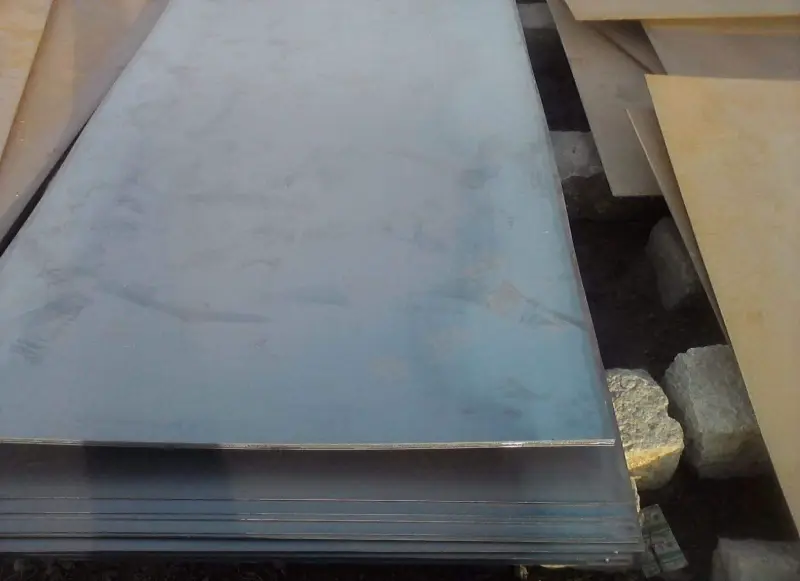
S890QL Quenched & Tempered High-Strength Steel
S890QL Quenched & Tempered High-Strength Steel - EN10025-6 for LSAW Pipe & Structural Use
Detailed material properties, chemical composition, mechanical and physical performance of S890QL steel per EN 10025-6. Includes full international equivalents and application guidance for LSAW pipe and heavy-duty structures.
Hot rolling, quenching and tempering; subsequent processing by welding (LSAW), bending, forming, cutting, and machining
- Phone : +8618037372205
- Email : [email protected]
- WhatsApp: Contact via Whtsapp
- WeChat: +8618037372205
S890QL Quenched & Tempered High-Strength Steel Introduction
S890QL is a high-yield quenched and tempered structural steel defined in EN 10025-6. With a minimum yield strength of 890 MPa in thicknesses up to 50 mm, it offers an outstanding strength-to-weight ratio and excellent low-temperature toughness (impact tested at -40 °C, designated by 'L'). The material is supplied in the quenched and tempered condition and is typically used for LSAW pipes, heavy-lifting equipment, offshore structures, and high-stress structural components. Its fine-grained microstructure ensures good weldability and resistance to brittle fracture, making it a preferred choice for demanding engineering applications where weight savings and high load-bearing capacity are critical.
S890QL Quenched & Tempered High-Strength Steel Chemical Composition
Maximum chemical content limits as specified in EN 10025-6:2019 for grade S890QL. Values apply to heat analysis for thicknesses ≤ 50 mm. Elements are controlled to ensure hardenability, weldability and low-temperature toughness. Actual values may be lower to meet the CEV (Carbon Equivalent Value) restrictions.
| Element | Standard Value (max. % unless range) | Remarks |
|---|---|---|
| Carbon (C) | 0.20 | Max. CEV typically ≤ 0.65 for t ≤ 50 mm |
| Silicon (Si) | 0.80 | Deoxidizer and strength contributor |
| Manganese (Mn) | 1.70 | Promotes hardenability |
| Phosphorus (P) | 0.025 | Strictly limited for toughness |
| Sulfur (S) | 0.015 | Minimised for cleanliness |
| Chromium (Cr) | 1.50 | Improves strength and corrosion resistance |
| Molybdenum (Mo) | 0.70 | Increases high-temperature strength and hardenability |
| Nickel (Ni) | 2.00 | Enhances low-temperature toughness |
| Vanadium (V) | 0.12 | Micro-alloying for grain refinement |
| Niobium (Nb) | 0.06 | Grain refining and precipitation strengthening |
| Titanium (Ti) | 0.05 | Nitrogen binding and grain control |
| Boron (B) | 0.005 | Extremely low amounts for hardenability (if added) |
| Copper (Cu) | 0.50 | May be present; beneficial for atmospheric corrosion resistance |
S890QL Quenched & Tempered High-Strength Steel Thermal & Electrical Physical Properties
Physical constants are typical for low-alloy quenched and tempered structural steel and do not vary significantly within the grade. Values are representative for room temperature unless a temperature range is specified. They are not mandatory requirements of EN 10025-6 but are derived from published material data for similar high-strength steels.
| Property | Typical Value | Unit | Test Condition / Temperature |
|---|---|---|---|
| Density (ρ) | 7850 | kg/m³ | Room temperature |
| Modulus of elasticity (E) | 210 | GPa | Room temperature |
| Shear modulus (G) | ~81 | GPa | Room temperature |
| Poisson's ratio (ν) | 0.30 | – | Room temperature (elastic range) |
| Thermal expansion coefficient (α) | 12.0 × 10⁻⁶ | /K | 20 – 100 °C |
| Thermal expansion coefficient (α) | 12.8 × 10⁻⁶ | /K | 20 – 200 °C |
| Thermal conductivity (λ) | ~35 | W/(m·K) | Room temperature |
| Specific heat capacity (cp) | ~460 | J/(kg·K) | Room temperature |
| Electrical resistivity (ρₑ) | ~0.25 × 10⁻⁶ | Ω·m | Room temperature |
S890QL Quenched & Tempered High-Strength Steel Mechanical Properties
Tensile and impact properties at room temperature, valid for quenched and tempered condition. Values vary with product thickness. Longitudinal test pieces according to EN ISO 6892-1. Impact tests on Charpy-V specimens (10 x 10 mm) at -40 °C per EN ISO 148-1. The grade QL guarantees a minimum average impact energy of 30 J at -40 °C.
| Property | Standard Requirement | Unit | Test Condition / Thickness Range |
|---|---|---|---|
| Yield Strength (ReH) | 890 min. | MPa | Thickness ≤ 50 mm |
| Yield Strength (ReH) | 850 min. | MPa | 50 mm < thickness ≤ 100 mm |
| Yield Strength (ReH) | 780 min. | MPa | 100 mm < thickness ≤ 150 mm |
| Tensile Strength (Rm) | 940 – 1100 | MPa | Thickness ≤ 50 mm |
| Tensile Strength (Rm) | 880 – 1100 | MPa | 50 mm < thickness ≤ 100 mm |
| Tensile Strength (Rm) | 830 – 1000 | MPa | 100 mm < thickness ≤ 150 mm |
| Elongation after fracture (A) – longitudinal | 12 min. | % | Thickness 3 – 50 mm |
| Elongation after fracture (A) – longitudinal | 11 min. | % | Thickness > 50 – 100 mm |
| Elongation after fracture (A) – longitudinal | 10 min. | % | Thickness > 100 – 150 mm |
| Elongation after fracture (A) – transverse | 8 min. | % | Thickness 3 – 16 mm |
| Elongation after fracture (A) – transverse | 8 min. | % | Thickness > 16 – 40 mm |
| Elongation after fracture (A) – transverse | 7 min. | % | Thickness > 40 – 63 mm |
| Elongation after fracture (A) – transverse | 6 min. | % | Thickness > 63 – 150 mm |
| Impact energy (KV) – average | 30 min. | J | -40 °C; longitudinal Charpy-V 10x10 mm |
| Bending test | Upon agreement | – | For products ≥ 12.5 mm; mandrel diameter typically 3×t (t = thickness) |
S890QL Quenched & Tempered High-Strength Steel Fully Equivalent Material Standards & Substitute Grades
| Country / Region | Standard | Grade | Remarks |
|---|---|---|---|
| Europe | EN 10025-6 | S890QL | Identical requirements – quenched and tempered, -40 °C impact test |
| International | ISO 4951-2 | S890QL | Technically equivalent to EN 10025-6 |
| China | GB/T 16270 | Q890E | Yield ≥ 890 MPa, tensile 940–1100 MPa, CVN ≥ 30 J at -40 °C; equivalent in practice |
| Sweden | SSAB (proprietary) | Weldox 900 | Commercial brand meeting S890QL requirements, often certified against EN 10025-6 |
S890QL Quenched & Tempered High-Strength Steel Application Introduction
S890QL steel is specifically chosen where extreme strength and low-temperature toughness are needed. LSAW pipes produced from S890QL plates are used in heavy lifting, offshore, and structural engineering. The grade withstands dynamic loading and aggressive environments, and its weldability (with suitable procedures) allows fabrication of complex assemblies.
Product Applications: LSAW (longitudinally submerged arc welded) pipes, Heavy-wall structural hollow sections, Telescopic crane booms and jibs, Offshore platform columns and braces, Piling pipes and structural piles, Heavy-duty pressure containers
Processed into products: Hydraulic cylinder rods and barrels, Boom and mast segments for mobile cranes, Chassis and frame components of heavy vehicles, Turret rings and slewing platforms, Welded tubular nodes for jack-up rigs, Bearing and shaft housings in high-load applications
Application industries: Crane and heavy lift manufacturing, Offshore oil & gas (jacket legs, risers, structural nodes), Bridge construction and large infrastructure, Pressure vessel and storage tank fabrication, Mining and earthmoving machinery, Wind energy (tower sections, foundation piles)
S890QL Quenched & Tempered High-Strength Steel Similar / Comparable High-Strength Structural Steels
| Country / Region | Standard | Grade | Remarks |
|---|---|---|---|
| Europe | EN 10025-6 | S890Q | Same strength level but impact tested at -20 °C (QL tests at -40 °C) |
| Europe | EN 10025-6 | S960QL | Higher strength (min. 960 MPa yield) quenched and tempered steel; similar toughness |
| Europe | EN 10149-2 | S890MC | Thermomechanically rolled; slightly lower toughness requirements, not quenched and tempered |
| Germany | DIN EN 10025-6 (former SEW 092) | S890QL | Historical designation, now superseded but equivalent |
| USA | ASTM A514 (grades modified) | – | Not a direct match; A514 yields 690 MPa, but custom grades can approach 890 MPa |
| Japan | JIS G 3128 (modified) | SHY 685N-S | Yield ~685 MPa, lower than S890QL; higher grades like SHY 785 exist but not identical |
Notes:
The maximum carbon equivalent value (CEV) for S890QL is controlled to ensure weldability; typical CEV ≤ 0.65 % for thickness ≤ 50 mm. Preheating and post-weld heat treatment may be required depending on thickness and welding procedure. In LSAW pipe production, the base plate is formed and welded; the heat-affected zone (HAZ) retains good properties due to the controlled chemistry. Third-party certification (e.g., DNV, ABS) is often required for offshore applications. Always consult the relevant product standard for the exact thickness-dependent mechanical values.
- Share



