
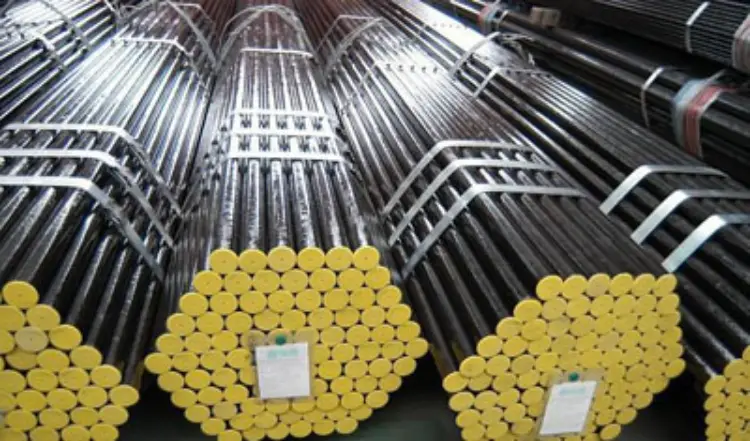
S890Q High Strength Steel for LSAW Pipes
S890Q High Strength Steel for LSAW Pipes | EN 10025-6 Quenched & Tempered Grade
Comprehensive material data for S890Q (EN 10025-6) steel used in LSAW pipes. Includes chemical composition, mechanical properties, thermal performance, international equivalents, and application details for structural and pressure piping.
Hot rolling, controlled rolling, quenching and tempering, cold forming, submerged arc welding
- Phone : +8618037372205
- Email : [email protected]
- WhatsApp: Contact via Whtsapp
- WeChat: +8618037372205
S890Q High Strength Steel for LSAW Pipes Introduction
S890Q is a high-strength, quenched and tempered structural steel grade defined in EN 10025-6. It is specifically designed for heavy welded structures where high yield strength and adequate toughness at low temperatures are required. With a minimum yield strength of 890 MPa for thicknesses up to 50 mm and guaranteed Charpy V-notch impact energy at -20°C, S890Q offers excellent load-carrying capacity and welding performance.
The material is frequently supplied as plates that are subsequently formed and welded into Longitudinal Submerged Arc Welded (LSAW) pipes. LSAW pipes made from S890Q combine high strength, reliable toughness, and good dimensional accuracy, making them ideal for demanding applications in offshore structures, pressure vessels, heavy machinery, and high-pressure fluid transport. The quenched and tempered condition (delivery condition Q) ensures a uniform fine-grained microstructure and consistent mechanical properties throughout the wall thickness.
S890Q High Strength Steel for LSAW Pipes Chemical Composition
The chemical composition of S890Q steel according to EN 10025-6 is designed to achieve high hardenability, excellent weldability, and consistent mechanical properties after quenching and tempering. The table below provides the maximum allowable values for each element, unless a range or minimum is indicated. Microalloying elements such as Nb, V, Ti are added for grain refinement and precipitation strengthening, while Cr, Mo, Ni improve hardenability. The total aluminium content ensures sufficient deoxidation and fine grain practice. The steel is fully killed and fine-grained.
| Element | Maximum Value (wt.%) | Remarks |
|---|---|---|
| C | 0.20 | |
| Si | 0.80 | |
| Mn | 1.70 | |
| P | 0.025 | |
| S | 0.012 | |
| N | 0.015 | |
| B | 0.005 | |
| Cr | 1.50 | |
| Cu | 0.50 | |
| Mo | 0.70 | |
| Nb | 0.06 | |
| Ni | 2.0 | |
| Ti | 0.05 | |
| V | 0.12 | |
| Zr | 0.15 | |
| Al (total) | ≥ 0.015 | Minimum value for fine grain practice |
S890Q High Strength Steel for LSAW Pipes Thermal and Electrical Physical Properties
The following physical properties are typical values for fully quenched and tempered low-alloy carbon steels and are not specified in EN 10025-6. They provide an approximate guideline for design calculations involving heat transfer, thermal expansion, and electrical conductivity. Variations may occur depending on the exact microstructure and composition.
| Property | Typical Value | Unit | Test Condition / Remarks |
|---|---|---|---|
| Density (ρ) | 7.85 | g/cm³ | Room temperature |
| Elastic modulus (E) | 210 | GPa | Room temperature, longitudinal |
| Shear modulus (G) | 81 | GPa | Calculated from E and ν |
| Poisson's ratio (ν) | 0.3 | – | Typical for steel |
| Thermal expansion coefficient (α) | 11.7 × 10⁻⁶ | K⁻¹ | 20°C – 100°C |
| Thermal expansion coefficient (α) | 12.5 × 10⁻⁶ | K⁻¹ | 20°C – 200°C |
| Thermal expansion coefficient (α) | 13.3 × 10⁻⁶ | K⁻¹ | 20°C – 300°C |
| Thermal conductivity (λ) | 50 | W/(m·K) | Room temperature |
| Specific heat capacity (c) | 460 | J/(kg·K) | Room temperature |
| Electrical resistivity (ρₑ) | 0.23 | μΩ·m | Room temperature |
S890Q High Strength Steel for LSAW Pipes Mechanical Properties
The mechanical properties of S890Q steel are guaranteed in the quenched and tempered delivery condition. The yield strength (ReH) and tensile strength (Rm) depend on the product thickness. The table below lists the minimum yield strength, tensile strength range, minimum elongation, and minimum Charpy V-notch impact energy at -20°C (designated by the 'Q' in the grade name). These properties apply to longitudinal samples taken from the plate material used for LSAW pipe fabrication. For pipes, supplementary testing according to the final specification (e.g., EN 10219 or customer standard) may be required.
| Property | Value | Unit | Condition |
|---|---|---|---|
| Yield strength (ReH) | ≥ 890 | MPa | Thickness ≤ 50 mm |
| Yield strength (ReH) | ≥ 830 | MPa | 50 mm < thickness ≤ 100 mm |
| Tensile strength (Rm) | 940 – 1180 | MPa | Thickness ≤ 50 mm |
| Tensile strength (Rm) | 880 – 1100 | MPa | 50 mm < thickness ≤ 100 mm |
| Elongation after fracture (A) | ≥ 12 | % | Gauge length L₀ = 5.65√S₀, longitudinal |
| Impact energy (KV) | ≥ 30 | J | Charpy V‑notch, -20°C, longitudinal |
S890Q High Strength Steel for LSAW Pipes Completely Equivalent Standards and Replaceable Grades
| Country/Region | Standard | Grade | Remarks |
|---|---|---|---|
| European Union | EN 10025-6 | S890Q | Original standard, -20°C impact requirement |
| International | ISO 4950-2 | S890Q | Identical technical delivery requirements |
| China | GB/T 16270 | Q890D | Meets same 890 MPa yield strength and -20°C toughness class |
S890Q High Strength Steel for LSAW Pipes Application Introduction
S890Q LSAW pipes are used in industries where high strength-to-weight ratios, good low-temperature toughness, and reliable weldability are critical. The pipes are fabricated from plates according to customer dimensions, offering flexibility in diameter and wall thickness. Typical applications and fabricated products include:
Product Applications: Longitudinal submerged arc welded (LSAW) pipes for structural and line pipe applications, Spiral welded pipes (alternative pipe forming process using the same grade), Fabricated box sections and hollow structural sections, Heavy plate components for welded structures
Processed into products: Offshore platform legs and braces (LSAW pipe sections), Pressure vessel shell rings and pipe connections, Crane main chords and lattice members, Penstock pipes for hydroelectric power plants, Yaw and tower sections of wind turbines, High-pressure hydraulic piping and accumulators
Application industries: Offshore oil & gas and wind energy (jacket foundations, risers, topside structural piping), Pressure vessel and boiler manufacturing (high-pressure storage and transport), Heavy lifting and transport equipment (crane booms, heavy-duty trailers), Bridge construction (truss members, arch structures), Mining and earthmoving machinery (chassis, booms, hydraulic cylinders), Hydroelectric and penstock systems
S890Q High Strength Steel for LSAW Pipes Similar / Near-Equivalent Substitute Materials
| Country/Region | Standard | Grade | Remarks |
|---|---|---|---|
| European Union | EN 10025-6 | S890QL | Higher toughness: -40°C impact, otherwise same mechanical properties |
| European Union | EN 10025-6 | S890QL1 | Superior toughness: -60°C impact, same strength level |
| European Union | EN 10025-6 | S960Q | Higher yield strength (≥960 MPa), slightly reduced elongation and weldability may be affected |
| Japan | JIS G 3128 | SHY685 | Comparable tensile strength class (higher Mn, different microalloying) – requires careful review for substitution |
| USA | ASTM A514/A514M | Grade S | Similar strength (≥690 MPa yield), but toughness and delivery condition differ; not a direct substitute without re-qualification |
Notes:
- Welding: S890Q is readily weldable with low-hydrogen processes. Preheat and interpass temperature control is essential to avoid cold cracking, as the steel has a high carbon equivalent (CET/CEV). Suitable welding consumables should match the strength and toughness requirements. Post-weld heat treatment (PWHT) is generally not applied in the quenched and tempered condition unless absolutely necessary, and then only with careful procedure qualification to avoid loss of strength.
- Forming: The material can be cold formed to a limited extent; the minimum bending radius should follow the recommendations of EN 10025-6 or specific pipe manufacturing guidelines.
- Supplementary tests: For LSAW pipe applications, additional tests such as flattening tests, hardness measurements, HIC/SSC resistance (if required for sour service) and 100% ultrasonic or radiographic inspection may be specified by the end user. The base material properties listed here refer to the plate; the welded pipe must meet the specific requirements of the final pipe standard (e.g., API 5L for line pipe or EN 10219/EN 10210 for structural hollow sections).
- Share



