
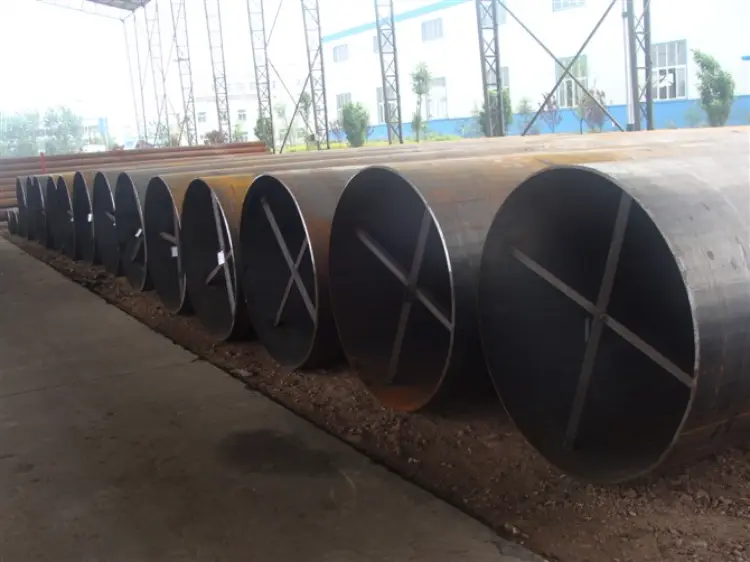
EN 10025-6 S690QL1 LSAW Pipes
EN 10025-6 S690QL1 Quenched & Tempered High-Yield Structural Steel for LSAW Pipes
Detailed material data for S690QL1 steel according to EN 10025-6, including chemical composition, mechanical and physical properties, international equivalents, and application guidance for LSAW pipes.
Hot rolling followed by quenching and tempering; suitable for cold forming, welding, and machining
- Phone : +8618037372205
- Email : [email protected]
- WhatsApp: Contact via Whtsapp
- WeChat: +8618037372205
EN 10025-6 S690QL1 LSAW Pipes Introduction
S690QL1 is a quenched and tempered fine-grain structural steel defined in EN 10025-6, designed for high-strength welded structures. It offers a minimum yield strength of 690 MPa and excellent toughness at low temperatures (≥27 J at -40 °C). The grade is characterised by good weldability, high resistance to brittle fracture, and suitability for heavy plates used in LSAW (longitudinal submerged arc welded) pipes. Typical thicknesses range up to 150 mm. The material is widely employed in demanding applications such as offshore structures, cranes, bridges, and pressure vessels where weight reduction and high load-bearing capacity are critical. Delivery is usually in the quenched and tempered condition.
EN 10025-6 S690QL1 LSAW Pipes Chemical Composition
The chemical composition of S690QL1 meets the requirements of EN 10025-6:2019 Table 2. Values represent maximum limits unless a range is given. The steel is micro-alloyed with niobium, vanadium, titanium, and aluminium to ensure fine grain size and high strength after quenching and tempering. Carbon Equivalent (CEV) must not exceed: 0.47 % for thickness ≤ 50 mm; 0.48 % for 50 < t ≤ 100 mm; 0.52 % for 100 < t ≤ 150 mm (CEV = C + Mn/6 + (Cr+Mo+V)/5 + (Ni+Cu)/15).
| Chemical Element | Standard Value (max %) | Remarks |
|---|---|---|
| Carbon (C) | 0.20 | |
| Silicon (Si) | 0.80 | |
| Manganese (Mn) | 1.70 | |
| Phosphorus (P) | 0.020 | |
| Sulfur (S) | 0.010 | |
| Nitrogen (N) | 0.015 | Total aluminium content ≥ 0.015 % ensures N binding |
| Boron (B) | 0.005 | |
| Chromium (Cr) | 1.50 | |
| Nickel (Ni) | 2.0 | |
| Molybdenum (Mo) | 0.70 | |
| Copper (Cu) | 0.50 | |
| Titanium (Ti) | 0.05 | |
| Vanadium (V) | 0.12 | |
| Niobium (Nb) | 0.06 | |
| Aluminium (Al total) | ≥ 0.015 | Usually a minimum is applied to control grain size |
EN 10025-6 S690QL1 LSAW Pipes Thermal and Electrical Physical Properties
Physical properties for S690QL1 steel at room temperature and for heat-treated condition. These values are typical for this class of steel and are not mandatory in EN 10025-6. They are provided for design calculations.
| Property | Typical Value | Unit | Test Condition / Remarks |
|---|---|---|---|
| Density (ρ) | 7850 | kg/m³ | At 20 °C |
| Modulus of elasticity (E) | 210 | GPa | At 20 °C, static |
| Shear modulus (G) | 81 | GPa | At 20 °C, calculated |
| Poisson's ratio (ν) | 0.3 | — | Typical for steel |
| Thermal expansion coefficient (α) | 11.1 × 10⁻⁶ | K⁻¹ | 20–100 °C |
| Thermal expansion coefficient (α) | 12.5 × 10⁻⁶ | K⁻¹ | 20–300 °C |
| Thermal conductivity (λ) | 40 | W/(m·K) | At 20 °C |
| Specific heat capacity (cp) | 460 | J/(kg·K) | At 20 °C |
| Electrical resistivity (ρe) | 0.25 | Ω·mm²/m | At 20 °C |
EN 10025-6 S690QL1 LSAW Pipes Mechanical Properties
Mechanical properties are according to EN 10025-6:2019 Table 3 and Table 4. Values for longitudinal test pieces at room temperature unless otherwise stated. Impact energy (KV2) is for standard Charpy V-notch specimens. Bending test mandrel diameter is valid for 180° bends.
| Property | Standard Required Value | Unit | Test Condition / Remarks |
|---|---|---|---|
| Upper yield strength (ReH) | ≥ 690 | MPa | Product thickness t ≤ 50 mm |
| Upper yield strength (ReH) | ≥ 650 | MPa | 50 mm < t ≤ 100 mm |
| Upper yield strength (ReH) | ≥ 630 | MPa | 100 mm < t ≤ 150 mm |
| Tensile strength (Rm) | 770 – 940 | MPa | t ≤ 50 mm |
| Tensile strength (Rm) | 760 – 930 | MPa | 50 mm < t ≤ 100 mm |
| Tensile strength (Rm) | 710 – 890 | MPa | 100 mm < t ≤ 150 mm |
| Elongation after fracture (A) | ≥ 14 | % | Gauge length 5.65√S0, all thicknesses |
| Impact energy (KV2, longitudinal) | ≥ 27 | J | At -40 °C (QL1 designation) |
| Impact energy (KV2, transverse) | ≥ 20 | J | At -40 °C (optional agreement) |
| Bend test (180° bend, mandrel diameter) | 3t | t ≤ 16 mm | |
| Bend test (180° bend, mandrel diameter) | 4t | 16 mm < t ≤ 100 mm |
EN 10025-6 S690QL1 LSAW Pipes Fully Equivalent Material Standards and Replaceable Grades
Direct cross-references to the same designation in other standards. Because S690QL1 is a newer impact category, many international standards do not have a completely identical grade. The table shows the closest direct equivalents.
| Country/Region | Standard | Grade | Remarks |
|---|---|---|---|
| European Union | EN 10025-6:2019 | S690QL1 | Original standard, -40 °C/27 J requirement |
| International | ISO 4951-2 | S690QL | ISO grade requires -40 °C/30 J, slightly higher toughness; can be used as a substitute |
| China | GB/T 16270-2009 | Q690E | Yield 690 MPa, impact energy 47 J at -40 °C; over-qualified in toughness, commonly considered equivalent |
EN 10025-6 S690QL1 LSAW Pipes Application Introduction
S690QL1 steel is engineered for high-stress welded structures operating in cold climates. Its combination of high yield strength and excellent toughness makes it ideal for weight-optimised designs. When using this grade for LSAW pipes, the material must be ordered with restrictions on carbon equivalent and with through-thickness properties if required.
- Welding: low-hydrogen consumables are mandatory; preheat and interpass temperatures must be controlled according to thickness and CEV.
- Forming: suitable for cold bending and edge rolling; minimum bending radii must respect the bend test requirements.
- Post-weld heat treatment is generally not recommended for quenched and tempered steels unless strictly necessary and with a qualified procedure.
Product Applications: LSAW line pipes for sour service or high-pressure transmission, Offshore platform legs, nodes, and deck structures, Bridges – main girders and orthotropic decks, Mobile crane telescopic booms, Hydraulic cylinders and thick-wall mechanical components
Processed into products: Pipe bodies and fittings for subsea pipelines, Structural hollow sections and tubular joints, Flanges and ring forgings (after flattening and welding), Machine frames and large structural weldments, Piping systems in industrial plants requiring high strength and low temperature toughness
Application industries: Oil & gas (offshore and onshore pipelines), Shipbuilding and marine structures, Civil engineering (bridges, stadiums, high-rise buildings), Heavy lifting and transport equipment (crane booms, mobile cranes), Penstocks and hydroelectric power plants, Pressure vessels and storage tanks (subject to material restrictions)
EN 10025-6 S690QL1 LSAW Pipes Similar Alternative Materials with Comparable Properties
Grades with minor differences in chemical composition, impact test conditions, or delivery condition. They can often be substituted after evaluating design codes and service requirements.
| Country/Region | Standard | Grade | Remarks |
|---|---|---|---|
| European Union | EN 10025-6:2019 | S690Q | Quenched and tempered, impact at -20 °C (27 J); suitable when less severe low-temperature requirements |
| European Union | EN 10025-6:2019 | S690QL | Quenched and tempered, -40 °C/30 J; improved toughness, can replace S690QL1 without risk |
| USA | ASTM A514 / A514M | Grade Q | Quenched and tempered, min YS 690 MPa; impact not guaranteed at -40 °C unless specified; requires supplementary agreement |
| Japan | JIS G 3128 | SHY685 | Min YS 685 MPa, tensile 780–930 MPa; impact temperature differs, generally -20 °C or -40 °C upon agreement |
| China | GB/T 16270-2009 | Q690D | Yield 690 MPa, impact 47 J at -20 °C; lower low-temperature toughness, may be acceptable for less demanding applications |
Notes:
- The CEV limits given in the standard are mandatory. For higher thicknesses or special applications, the purchaser may impose stricter values (e.g., CEV ≤ 0.45) to improve weldability.
- Ultrasonic testing according to EN 10160 or ASTM A435 is commonly specified for LSAW pipe plates to guarantee internal soundness.
- Through-thickness properties (Z-quality) per EN 10164 may be required for highly restrained joints, especially in offshore structures.
- Consult the latest EN 10025-6 edition and relevant design codes (EN 1993-1-10 for fracture toughness, EN 13445 for pressure vessels) when using S690QL1.
- Share



