
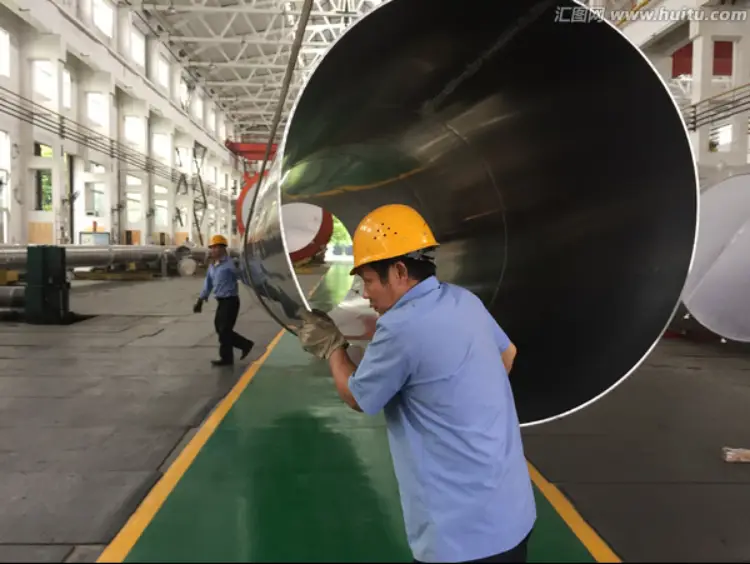
EN 10025-6 S690QL LSAW Pipe
EN 10025-6 S690QL Quenched and Tempered High-Strength Steel for LSAW Pipe Applications
Comprehensive technical data for S690QL structural steel used in LSAW pipe manufacturing, including chemical composition, mechanical properties, thermal properties, and international equivalents.
Hot rolling, quenching and tempering, welding, cold forming, machining, hot forming
- Phone : +8618037372205
- Email : [email protected]
- WhatsApp: Contact via Whtsapp
- WeChat: +8618037372205
EN 10025-6 S690QL LSAW Pipe Introduction
S690QL is a high-strength structural steel supplied in the quenched and tempered condition under European standard EN 10025-6. It offers a minimum yield strength of 690 MPa, combined with excellent toughness at low temperatures and good weldability, making it a preferred material for heavy-duty applications. The "Q" denotes quenching and tempering, while "L" indicates guaranteed impact energy values at -20°C. When fabricated into Longitudinal Submerged Arc Welded (LSAW) pipes, S690QL delivers superior strength-to-weight ratios and reliability for high-pressure fluid transportation, offshore structures, and critical engineering components. Its fine-grained microstructure provides a balance of high strength, ductility, and resistance to brittle fracture.
EN 10025-6 S690QL LSAW Pipe Chemical Composition
Typical chemical limits according to EN 10025-6:2019 for grade S690QL. Elements are given as maximum values unless stated otherwise. The composition is designed to achieve high strength and good weldability through a fine-grained quenched and tempered microstructure. Micoralloying elements such as Nb, V, and Ti contribute to grain refinement and precipitation strengthening.
| Element | Standard Value (max %) | Remarks |
|---|---|---|
| C | 0.20 | |
| Si | 0.80 | |
| Mn | 1.70 | |
| P | 0.025 | |
| S | 0.015 | |
| N | 0.015 | |
| Al (total) | ≥ 0.018 | Minimum value for fine grain practice |
| Nb | 0.06 | |
| V | 0.12 | |
| Ti | 0.05 | |
| Cr | 1.50 | |
| Ni | 2.0 | |
| Mo | 0.70 | |
| Cu | 0.50 | |
| B | 0.0050 | |
| Zr | 0.15 (optional) | May be specified at the time of enquiry |
| CEV | ≤ 0.65 | Carbon equivalent value, depending on thickness |
EN 10025-6 S690QL LSAW Pipe Thermal and Electrical Physical Properties
Listed below are typical physical properties for quenched and tempered S690QL steel. These values are for reference only and are not part of the mandatory requirements of EN 10025-6. They are based on measurements at room temperature unless otherwise noted. Properties may vary slightly depending on exact chemical composition and heat treatment practices.
| Property | Typical Value | Unit | Test Condition / Temperature |
|---|---|---|---|
| Density (ρ) | 7850 | kg/m³ | 20°C |
| Young's modulus (E) | 210 | GPa | 20°C |
| Shear modulus (G) | 80 | GPa | 20°C |
| Poisson's ratio (ν) | 0.3 | — | 20°C |
| Thermal expansion coefficient (α) | 12.0 | 10⁻⁶/K | 20°C to 100°C |
| Thermal conductivity (λ) | 50 | W/(m·K) | 20°C |
| Specific heat capacity | 460 | J/(kg·K) | 20°C |
| Electrical resistivity (ρ_e) | 0.23 | μΩ·m | 20°C |
EN 10025-6 S690QL LSAW Pipe Mechanical Properties
Mechanical properties of S690QL steel in the quenched and tempered condition. Values are minimum requirements unless a range is given. Testing is performed in accordance with EN 10025-6 on longitudinal specimens. The bending test is carried out at 180° with specified mandrel diameters. Impact test is conducted on Charpy V-notch specimens at -20°C.
| Property | Required Value | Unit | Test Condition |
|---|---|---|---|
| Yield strength (ReH) | ≥ 690 | MPa | Thickness ≤ 50 mm |
| Yield strength (ReH) | ≥ 670 | MPa | 50 mm < thickness ≤ 80 mm |
| Yield strength (ReH) | ≥ 630 | MPa | 80 mm < thickness ≤ 100 mm |
| Tensile strength (Rm) | 770 - 940 | MPa | Thickness ≤ 50 mm |
| Tensile strength (Rm) | 760 - 930 | MPa | 50 mm < thickness ≤ 80 mm |
| Tensile strength (Rm) | 710 - 900 | MPa | 80 mm < thickness ≤ 100 mm |
| Elongation after fracture (A) | ≥ 14 | % | L0=5.65√So, longitudinal, thickness ≤ 50 mm |
| Elongation after fracture (A) | ≥ 14 | % | L0=5.65√So, longitudinal, 50 < t ≤ 80 mm |
| Elongation after fracture (A) | ≥ 14 | % | L0=5.65√So, longitudinal, 80 < t ≤ 100 mm |
| Bend test (180°) | No cracks | — | Mandrel diameter 2t for t ≤ 16 mm |
| Bend test (180°) | No cracks | — | Mandrel diameter 3t for 16 < t ≤ 40 mm |
| Bend test (180°) | No cracks | — | Mandrel diameter 4t for 40 < t ≤ 63 mm |
| Bend test (180°) | No cracks | — | Mandrel diameter 5t for 63 < t ≤ 80 mm |
| Impact absorbed energy (KV2) | ≥ 27 | J | Longitudinal, -20°C |
EN 10025-6 S690QL LSAW Pipe Fully Equivalent Material Standards and Substitute Grade Recommendations
| Country / Region | Standard | Grade | Remarks |
|---|---|---|---|
| Europe | EN 10025-6 | S690QL (1.8928) | Identical standard, quenched and tempered |
| United Kingdom | BS EN 10025-6 | S690QL | British adoption of EN 10025-6 |
| Germany | DIN EN 10025-6 | S690QL | German edition of the European standard |
| France | NF EN 10025-6 | S690QL | French version of EN 10025-6 |
| Italy | UNI EN 10025-6 | S690QL | Italian adoption |
| Spain | UNE EN 10025-6 | S690QL | Spanish adoption |
EN 10025-6 S690QL LSAW Pipe Application Introduction
S690QL steel in LSAW pipe form is engineered for demanding load-bearing and fluid transport applications where high strength, toughness, and good weldability are essential. Its combination of properties allows weight savings and improved performance in severe environments. Structural engineers and fabricators should strictly follow approved welding procedures and consider preheating and post-weld heat treatment to preserve mechanical characteristics.
Product Applications: LSAW (Longitudinal Submerged Arc Welded) pipes for high-pressure crude oil, natural gas, and water transmission, Subsea flowlines and risers, High-strength tubular piles and structural hollow sections, Pressure vessels and boilers, Crane booms and lattice mast sections, Heavy-duty vehicle chassis components
Processed into products: Pipe fittings: elbows, tees, reducers, flanges, and weld-on connectors, Fabricated structural nodes and cast nodes for offshore jackets, Crane and excavator booms, arms, and frames, Bridge girders and box sections, Support structures for heavy rotating equipment, Cut-to-length pile sections with drilled holes for bolted connections
Application industries: Oil and gas (onshore and offshore pipeline systems), Marine and offshore engineering (jack-up rigs, platform legs), Construction and civil engineering (long-span bridges, high-rise buildings), Heavy machinery and mining equipment, Wind energy (tower sections, tubular foundations), Shipbuilding (special structural members)
EN 10025-6 S690QL LSAW Pipe Similar / Comparable Substitute Materials
| Country / Region | Standard | Grade | Remarks |
|---|---|---|---|
| International | ISO 4950-2 | E690QL | Very close equivalent, quenched and tempered; impact energy at -20°C |
| USA | ASTM A514/A514M | Grade S | Yield strength 690 MPa, but requires comparable quenching and tempering; impact properties may differ |
| Japan | JIS G 3128 | SHY685 | Yield point 685 MPa class; similar high-strength QT steel, verify tensile and brittle fracture requirements |
| China | GB/T 16270 | Q690D/E | Quenched and tempered high strength steel; compare CEV and notch toughness conditions |
| Sweden | SS-EN 10025-6 | S690QL | Swedish standard, identical to EN; also available as Weldox 700 (SSAB) comparable for information only |
Notes:
Welding of S690QL requires low-hydrogen consumables and controlled heat input to maintain the heat-affected zone toughness. Preheating temperatures (typically 100–150°C) are recommended, and interpass temperatures should not exceed the tempering temperature. Post-weld stress relieving must be performed carefully; consult the supplier for recommended procedures. The CEV (carbon equivalent value) helps predict weldability; for S690QL it is typically ≤0.65. The material is usually supplied with inspection certificates like EN 10204 3.1 or 3.2. LSAW pipes made from S690QL plates may be subject to additional testing, such as ultrasonic or radiographic inspection of the weld seam.
- Share



