
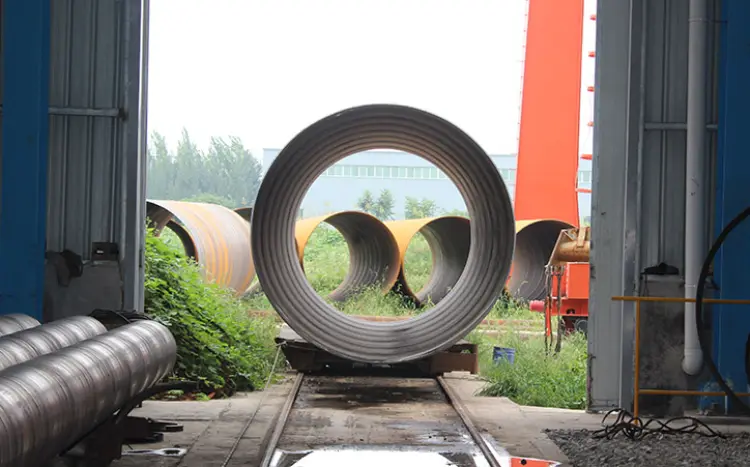
EN 10025-6 S690Q LSAW Pipe
EN 10025-6 S690Q LSAW Pipe: High-Strength Quenched & Tempered Steel for Heavy Structural Applications
Comprehensive material data sheet for S690Q steel according to EN 10025-6, used in longitudinal submerged arc welded (LSAW) pipes. Includes chemical composition, mechanical properties, thermal and electrical properties, and equivalent grades.
Welding, machining, bending (after stress relieving), cutting, cold forming (limited)
- Phone : +8618037372205
- Email : [email protected]
- WhatsApp: Contact via Whtsapp
- WeChat: +8618037372205
EN 10025-6 S690Q LSAW Pipe Introduction
EN 10025-6 S690Q is a high-strength, quenched and tempered structural steel with a minimum yield strength of 690 MPa. It is designed for welded structures subject to high static and dynamic loads, often used in heavy machinery, offshore installations, and bridges. When supplied as LSAW (Longitudinal Submerged Arc Welded) pipe, S690Q combines excellent weldability with superior strength-to-weight ratio, allowing lighter designs without compromising structural integrity. The steel offers good toughness at low temperatures (impact test at -20°C) and can be formed and machined under appropriate conditions.
- Excellent strength and toughness balance
- Good weldability with proper preheating and consumables
- Available in heavy plates and LSAW pipe forms
- Fulfills EN 10025-6 requirements for quenched and tempered steels
EN 10025-6 S690Q LSAW Pipe Chemical Composition
The chemical composition of S690Q steel according to EN 10025-6:2019 for product thickness ≤50 mm. Elements not listed shall not be intentionally added without the purchaser's agreement, except for finishing elements. Maximum values unless a range is indicated.
| Chemical Element | Standard Value (max %) | Remarks |
|---|---|---|
| Carbon (C) | 0.20 | ≤0.20% for thickness ≤50 mm |
| Silicon (Si) | 0.80 | ≤0.80% |
| Manganese (Mn) | 1.70 | ≤1.70% |
| Phosphorus (P) | 0.020 | ≤0.020% |
| Sulfur (S) | 0.010 | ≤0.010% |
| Chromium (Cr) | 1.50 | ≤1.50% |
| Molybdenum (Mo) | 0.70 | ≤0.70% |
| Nickel (Ni) | 2.00 | ≤2.00% |
| Vanadium (V) | 0.12 | ≤0.12% |
| Titanium (Ti) | 0.05 | ≤0.05% |
| Copper (Cu) | 0.50 | ≤0.50% |
| Niobium (Nb) | 0.06 | ≤0.06% |
| Nitrogen (N) | 0.015 | ≤0.015% |
| Boron (B) | 0.005 | ≤0.005% |
EN 10025-6 S690Q LSAW Pipe Thermal and Electrical Physical Properties
Physical properties for S690Q steel are typical for low-alloy high-strength steels and are valid at ambient temperature unless otherwise noted. These values may vary slightly depending on exact composition and heat treatment.
| Property | Typical Value | Unit | Test Condition |
|---|---|---|---|
| Density (ρ) | 7850 | kg/m³ | At 20°C |
| Modulus of elasticity (E) | 210 | GPa | At 20°C |
| Shear modulus (G) | 80 | GPa | At 20°C |
| Poisson's ratio (ν) | 0.3 | — | At 20°C |
| Thermal expansion coefficient (α) | 12.0 | ×10-6 /K | Between 20°C and 100°C |
| Thermal conductivity (λ) | ~42 | W/(m·K) | At 20°C |
| Specific heat capacity (cp) | ~460 | J/(kg·K) | At 20°C |
| Electrical resistivity (ρe) | ~0.23 | μΩ·m | At 20°C |
EN 10025-6 S690Q LSAW Pipe Mechanical Properties
Mechanical properties of S690Q steel at ambient temperature in the quenched and tempered condition, as per EN 10025-6 for flat products. Tensile test specimen orientation transverse to rolling direction, impact test longitudinal. Applicable for thickness up to 50 mm unless otherwise stated.
| Property | Standard Requirement | Unit | Test Condition |
|---|---|---|---|
| Yield strength (ReH) | ≥690 | MPa | Thickness ≤50 mm |
| Yield strength (ReH) | ≥650 | MPa | 50 < thickness ≤100 mm |
| Yield strength (ReH) | ≥630 | MPa | 100 < thickness ≤150 mm |
| Tensile strength (Rm) | 770 – 940 | MPa | Thickness ≤50 mm |
| Tensile strength (Rm) | 760 – 930 | MPa | 50 < thickness ≤100 mm |
| Tensile strength (Rm) | 710 – 900 | MPa | 100 < thickness ≤150 mm |
| Elongation after fracture (A5) | ≥14 | % | L0=5.65√S0, thickness ≤50 mm |
| Elongation after fracture (A5) | ≥14 | % | Thickness 50–100 mm |
| Bend test (mandrel diameter) | No crack after 180° bend | — | d = 3t for t ≤16 mm; d = 4t for 16<t≤50 mm; d = 5t for 50<t≤100 mm |
| Charpy V-notch impact energy (KV2) | ≥27 | J | Test at -20°C, longitudinal |
| Charpy V-notch impact energy (KV2) | ≥27 | J | Test at -40°C for option 'L' quality |
EN 10025-6 S690Q LSAW Pipe Fully Equivalent Material Standards and Substitutable Designations
| Country/Region | Standard | Grade/Designation | Remarks |
|---|---|---|---|
| European Union | EN 10025-6 | S690Q | Original standard; quenched and tempered, impact -20°C |
| International | ISO 4950-2 | S690Q | Equivalent to EN grade; same delivery condition |
| United Kingdom | BS EN 10025-6 | S690Q | British adoption of European standard |
| Germany | DIN EN 10025-6 | S690Q | German adoption of European standard |
| France | NF EN 10025-6 | S690Q | French adoption of European standard |
| Spain | UNE EN 10025-6 | S690Q | Spanish adoption of European standard |
| Italy | UNI EN 10025-6 | S690Q | Italian adoption of European standard |
EN 10025-6 S690Q LSAW Pipe Application Introduction
S690Q LSAW pipes are specifically designed for demanding structural applications where weight reduction and high load-bearing capacity are critical. The material's excellent weldability and toughness make it a preferred choice for offshore, heavy engineering, and infrastructure projects.
Product Applications: LSAW pipes for structural columns and piling in offshore platforms, Jacket legs and braces for subsea templates, Crane lattice booms and telescopic boom sections, Bridge main girders and cross beams, Heavy-duty excavator booms and sticks, Wind turbine tubular tower sections (if strength/diameter ratio justifies), Hydraulic cylinder bodies and thick-walled mechanical tubing
Processed into products: Tubular nodes (K, Y, T connections) for offshore structures, Flanges and end connectors for structural pipes, Chord and brace members in truss-type structures, Reinforcing rings and stiffeners, Welded bearings and supports, Heavy-duty shaft housings
Application industries: Offshore oil & gas platforms (jacket legs, piles, conductors), Heavy lifting and transport equipment (crane booms, mobile crane chassis), Bridge construction (girders, arches, pylons), Mining and earth-moving machinery (excavator arms, dump truck frames), Renewable energy (wind turbine towers, tidal turbine structures), Pressure vessels and penstocks (hydropower), Shipbuilding (heavy lift vessel structures)
EN 10025-6 S690Q LSAW Pipe Similar Alternative Materials and Recommendations
| Country/Region | Standard | Grade/Designation | Remarks |
|---|---|---|---|
| European Union | EN 10025-6 | S690QL | Low temperature variant with guaranteed impact at -40°C (≥30J) |
| European Union | EN 10025-6 | S690QL1 | Extra low temperature variant with guaranteed impact at -60°C |
| USA | ASTM A514/A514M | Grade S (Type I) | Similar high strength quenched & tempered steel; yield 690 MPa, but alloy system differs |
| USA | ASTM A517/A517M | Grade S | Quenched and tempered for pressure vessels; similar strength level |
| China | GB/T 16270-2009 | Q690D | High strength structural steel; impact at -20°C; similar mechanical properties with slight chemistry differences |
| Japan | JIS G 3128 | SHY685NS | High yield strength steel for welded structures; comparable strength and toughness |
Notes:
S690Q LSAW pipes require careful consideration during fabrication:
- Preheating (typically 100–200°C depending on thickness and hydrogen level) is recommended before welding to avoid hydrogen-induced cracking.
- Low-hydrogen welding consumables must be used (e.g., E11018-G electrodes, ER110S-G wires).
- Post-weld heat treatment (PWHT) may be required for thick sections or to relieve residual stresses; however, it can reduce strength slightly.
- Cold forming is possible but crack susceptibility increases; intermediate stress relieving may be needed.
- For LSAW pipe production, the steel plate is formed and welded using the submerged arc process, followed by non-destructive testing (UT, RT) to ensure weld integrity.
- Share



