
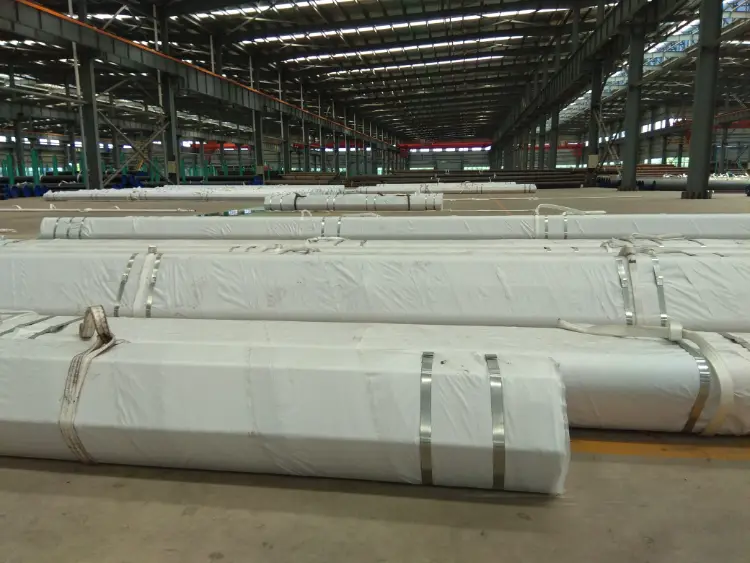
High-Strength S620QL1 Quenched & Tempered Steel for LSAW Pipes
EN10025-6 S620QL1 High-Strength Quenched and Tempered Steel for LSAW Pipe Applications
Comprehensive material data for S620QL1 according to EN 10025-6, including chemical composition, mechanical and thermal properties, international equivalents, and application guidance for LSAW pipes.
Hot rolling, quenching and tempering (Q+T), welding (for pipe manufacturing)
- Phone : +8618037372205
- Email : [email protected]
- WhatsApp: Contact via Whtsapp
- WeChat: +8618037372205
High-Strength S620QL1 Quenched & Tempered Steel for LSAW Pipes Introduction
S620QL1 is a high-strength quenched and tempered structural steel grade defined in EN 10025-6. With a minimum yield strength of 620 MPa for thicknesses up to 50 mm, it offers excellent weldability and low-temperature toughness down to -60 °C (quality L1). The QL1 designation guarantees minimum impact energy of 27 J at -60 °C. It is primarily supplied as hot-rolled flat products (plates, wide flats, strips) and is widely used for heavy-duty welded structures such as LSAW (Longitudinal Submerged Arc Welded) pipes, pressure vessels, cranes, and offshore components. The material is delivered in quenched and tempered condition, providing a fine-grained martensitic/bainitic microstructure with high strength-to-weight ratio.
High-Strength S620QL1 Quenched & Tempered Steel for LSAW Pipes Chemical Composition
The chemical composition of S620QL1 is controlled to ensure high strength, toughness, and weldability. Maximum limits are specified for key alloying elements. The steel is microalloyed with Nb, V, and Ti for grain refinement and precipitation strengthening.
- Carbon equivalent (CEV) is typically ≤0.55% to ensure good weldability.
- For thicknesses >50 mm, some limits may be reduced to maintain through-thickness properties.
| Element | Max. Value (%) | Notes |
|---|---|---|
| Carbon (C) | 0.20 | Ladle analysis |
| Silicon (Si) | 0.80 | Ladle analysis |
| Manganese (Mn) | 1.70 | Ladle analysis |
| Phosphorus (P) | 0.020 | Ladle analysis |
| Sulfur (S) | 0.010 | Ladle analysis |
| Nitrogen (N) | 0.015 | Ladle analysis |
| Boron (B) | 0.005 | Total boron |
| Chromium (Cr) | 1.50 | Ladle analysis |
| Copper (Cu) | 0.50 | Ladle analysis |
| Molybdenum (Mo) | 0.70 | Ladle analysis |
| Niobium (Nb) | 0.06 | Ladle analysis |
| Nickel (Ni) | 2.0 | Ladle analysis |
| Titanium (Ti) | 0.05 | Ladle analysis |
| Vanadium (V) | 0.12 | Ladle analysis |
| Zirconium (Zr) | 0.15 | Ladle analysis |
High-Strength S620QL1 Quenched & Tempered Steel for LSAW Pipes Thermal and Electrical Physical Properties
These values represent typical physical properties for quenched and tempered structural steels at room temperature unless otherwise noted.
- Actual values may vary slightly with product form and heat treatment.
- Thermal expansion and conductivity are essential for welding and elevated-temperature design.
| Property | Typical Value | Unit | Condition / Temperature |
|---|---|---|---|
| Density (ρ) | 7.85 | g/cm³ | Room temperature |
| Modulus of Elasticity (E) | 210 | GPa | Room temperature |
| Shear Modulus (G) | 81 | GPa | Room temperature |
| Poisson's Ratio (ν) | 0.3 | – | Room temperature |
| Thermal Expansion Coefficient (α) | 12×10⁻⁶ | K⁻¹ | 20 – 100 °C |
| Thermal Expansion Coefficient (α) | 13×10⁻⁶ | K⁻¹ | 20 – 200 °C |
| Thermal Conductivity (λ) | 50 | W/(m·K) | Room temperature |
| Specific Heat Capacity (cp) | 460 | J/(kg·K) | Room temperature |
| Electrical Resistivity (ρₑ) | 0.22 – 0.28 | µΩ·m | Room temperature |
High-Strength S620QL1 Quenched & Tempered Steel for LSAW Pipes Mechanical Properties
Mechanical properties are determined on test pieces taken from quenched and tempered plates in the longitudinal direction.
- Values depend on product thickness (t in mm).
- Yield strength decreases with increasing thickness.
- Impact tests are performed on Charpy V-notch specimens at -60 °C; minimum average 27 J (longitudinal).
| Property | Required Value | Unit | Test Condition / Thickness |
|---|---|---|---|
| Yield Strength (ReH) | ≥620 | MPa | t ≤ 50 mm |
| Yield Strength (ReH) | ≥580 | MPa | 50 < t ≤ 100 mm |
| Yield Strength (ReH) | ≥560 | MPa | 100 < t ≤ 150 mm |
| Tensile Strength (Rm) | 700 – 890 | MPa | t ≤ 50 mm |
| Tensile Strength (Rm) | 650 – 830 | MPa | 50 < t ≤ 100 mm |
| Tensile Strength (Rm) | 620 – 800 | MPa | 100 < t ≤ 150 mm |
| Elongation (A, L0 = 5.65√S0) | ≥14 | % | t ≤ 50 mm, longitudinal |
| Elongation (A, L0 = 5.65√S0) | ≥14 | % | 50 < t ≤ 100 mm, longitudinal |
| Elongation (A, L0 = 5.65√S0) | ≥14 | % | 100 < t ≤ 150 mm, longitudinal |
| Charpy Impact Energy (KV2) | ≥27 | J | -60 °C, longitudinal, t ≤ 150 mm |
| Bending Test (mandrel diameter) | Refer to standard | – | 180° bend; mandrel diameter depends on Rm and thickness |
High-Strength S620QL1 Quenched & Tempered Steel for LSAW Pipes Fully Equivalent Material Standards and Designations
| Country/Region | Standard | Designation | Notes |
|---|---|---|---|
| Europe | EN 10025-6 | S620QL1 | Direct designation |
| Germany | DIN EN 10025-6 | S620QL1 | Identical to EN |
| United Kingdom | BS EN 10025-6 | S620QL1 | Identical to EN |
| France | NF EN 10025-6 | S620QL1 | Identical to EN |
| Italy | UNI EN 10025-6 | S620QL1 | Identical to EN |
| Spain | UNE EN 10025-6 | S620QL1 | Identical to EN |
High-Strength S620QL1 Quenched & Tempered Steel for LSAW Pipes Application Introduction
S620QL1 is ideally suited for thick-walled, highly stressed welded structures where weight savings and low-temperature service are critical. The superior strength allows for lighter designs compared to lower strength grades. The L1 quality ensures reliable toughness even in arctic environments. Common applications include
- Subsea and offshore pipelines (LSAW pipes)
- Pressure vessels and boilers
- Mobile crane telescopic booms
- Heavy-duty machinery frames
- Bridge structural elements
Product Applications: LSAW (longitudinal submerged arc welded) steel pipes, Offshore structural components (nodes, braces), Crane telescopic booms and lattice structures, Pressure vessel shells and heads, Bridge girders and arch ribs, Heavy machinery chassis and outriggers
Processed into products: Pipe joints for high-pressure gas/oil transmission, Flanges and forged fittings, Welded box sections for crane booms, Support structures for offshore wind turbines, Thick-walled hollow profiles for hydraulic cylinders, Penstocks and water turbine components
Application industries: Oil & Gas (transmission pipelines, subsea flowlines), Offshore and Marine (jack-up rigs, platforms), Heavy Equipment and Cranes, Renewable Energy (wind turbine towers and foundations), Pressure Vessel and Boiler Manufacturing, Bridge Construction
High-Strength S620QL1 Quenched & Tempered Steel for LSAW Pipes Similar or Approximate Replacement Materials
| Country/Region | Standard | Designation | Notes |
|---|---|---|---|
| Europe | EN 10025-6 | S690QL1 | Higher yield strength (690 MPa min); similar toughness; may require design adjustments. |
| Europe | EN 10025-6 | S620QL | Same strength, but impact tested at -40 °C (QL) instead of -60 °C. |
| USA | ASTM A514/A514M | Grade Q (or modified) | Yield 690 MPa min; higher strength; available in plates; LSAW pipe may need supplementary requirements. |
| USA | ASTM A709/A709M | HPS 100W (Grade 100) | Yield 690 MPa; may be considered if higher strength acceptable. |
| International | ISO 4951-2 | S620Q/S620QL | ISO equivalent categories; similar mechanical properties; check impact temperature. |
Notes:
- The chemical composition applies to ladle analysis. Product analysis tolerances are permitted as per EN 10025‑1.
- CEV is generally limited to 0.55% for welding purposes (optionally agreed).
- For LSAW pipes manufactured from S620QL1 plate, the longitudinal weld must be qualified separately; base metal properties remain per EN 10025‑6.
- Additional testing (ultrasonic, through‑thickness tensile) may be agreed according to EN 10160 and EN 10164.
- All values are typical or minimum required; actual supplier data may differ. Always consult the specific mill certificate.
- Share



