
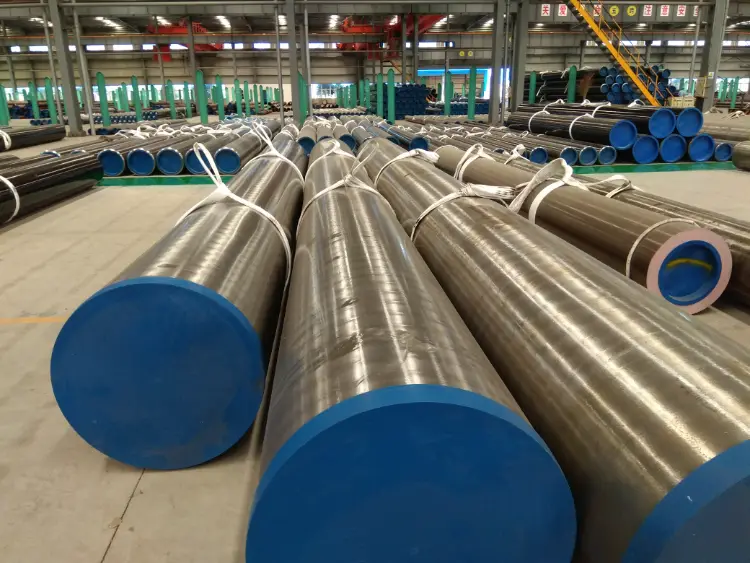
EN10025-6 S620QL LSAW Pipe
EN 10025-6 S620QL High Strength Quenched and Tempered Structural Steel for LSAW Pipes | Data Sheet
Explore the chemical, mechanical, and physical properties of S620QL steel under EN 10025-6. Ideal for LSAW pipes in oil & gas and offshore structures, with detailed equivalent grades and application guidance.
Welding (all common methods with suitable consumables), cold forming (restricted by minimum bend radii and strain ageing), hot forming (not recommended after final tempering), cutting (plasma, laser, waterjet)
- Phone : +8618037372205
- Email : [email protected]
- WhatsApp: Contact via Whtsapp
- WeChat: +8618037372205
EN10025-6 S620QL LSAW Pipe Introduction
S620QL is a high yield strength structural steel grade defined in EN 10025-6 for quenched and tempered delivery conditions. It offers a minimum yield strength of 620 MPa combined with guaranteed impact toughness down to -40°C (QL class). This fine-grain steel is engineered for heavy-duty welded fabrications, notably longitudinally submerged arc welded (LSAW) pipes used in demanding energy and offshore projects. Its balanced chemistry with microalloying elements such as Nb, V, and Ti ensures excellent strength and weldability, making it a preferred choice for weight-optimized structures.
EN10025-6 S620QL LSAW Pipe Chemical Composition
The table below lists the ladle analysis limits for S620QL as specified in EN 10025-6:2019. The steel is fine-grained and microalloyed to achieve the required combination of strength, toughness, and weldability. The carbon equivalent value (CEV) is restricted to ensure good weldability without preheat for moderate thicknesses.
| Element | Standard Value (max %) | Remarks |
|---|---|---|
| Carbon (C) | 0.20 | Maximum; lower limits enhance weldability |
| Silicon (Si) | 0.80 | Maximum |
| Manganese (Mn) | 1.70 | Maximum |
| Phosphorus (P) | 0.020 | Maximum; residual element |
| Sulfur (S) | 0.010 | Maximum; for improved toughness |
| Nitrogen (N) | 0.015 | Maximum |
| Boron (B) | 0.005 | Maximum |
| Chromium (Cr) | 1.50 | Maximum |
| Copper (Cu) | 0.50 | Maximum |
| Molybdenum (Mo) | 0.70 | Maximum |
| Niobium (Nb) | 0.06 | Maximum |
| Nickel (Ni) | 2.0 | Maximum |
| Titanium (Ti) | 0.05 | Maximum |
| Vanadium (V) | 0.12 | Maximum |
| Zirconium (Zr) | 0.15 | Maximum |
| Aluminium total (Al) | – | Not mandatory; typically ≥0.018% if fine grain practice is agreed |
EN10025-6 S620QL LSAW Pipe Thermal and Electrical Physical Properties
These physical constants are provided as typical values for S620QL at ambient temperature. They are not specified in the standard but are useful for design calculations involving thermal expansion, heat transfer, and structural dynamics.
| Property | Typical Value | Unit | Test Condition |
|---|---|---|---|
| Density (ρ) | 7850 | kg/m³ | At 20°C |
| Modulus of elasticity (E) | 210 | GPa | At 20°C |
| Shear modulus (G) | 81 | GPa | At 20°C |
| Poisson's ratio (ν) | 0.3 | – | At 20°C |
| Thermal expansion coefficient (α) | 11.1 × 10⁻⁶ | K⁻¹ | 20°C to 100°C |
| Thermal conductivity (λ) | 50 | W/(m·K) | At 20°C |
| Specific heat capacity (c) | 460 | J/(kg·K) | At 20°C |
| Electrical resistivity (ρₑ) | 0.25 × 10⁻⁶ | Ω·m | At 20°C |
EN10025-6 S620QL LSAW Pipe Mechanical Properties
The mechanical characteristics are valid for quenched and tempered (+QT) condition and depend on product thickness. S620QL requires Charpy impact testing at -40°C. For LSAW pipes, the base metal properties are certified; the pipe body and weld seam must satisfy supplementary project-specific requirements.
| Property | Standard Required Value | Unit | Test Condition / Remarks |
|---|---|---|---|
| Yield strength (ReH) | ≥620 | MPa | For nominal thickness ≤50 mm; for 50 mm < t ≤100 mm: ≥580 MPa; for 100 mm < t ≤150 mm: ≥560 MPa |
| Tensile strength (Rm) | 700 – 890 | MPa | For thickness ≤50 mm; for 50 mm < t ≤100 mm: 660 – 830 MPa; for 100 mm < t ≤150 mm: 620 – 800 MPa |
| Elongation after fracture (A) | ≥14 (longitudinal) | % | Gauge length L0=5.65√S0; for t≤40 mm; for 40 mm < t ≤63 mm: ≥14%; for 63 mm < t ≤100 mm: ≥13% |
| Impact energy (KV) | ≥27 (long.) / ≥20 (transv.) | J | At -40°C, Charpy V-notch; average of 3 tests; individual min 70 % of average |
| Bend test | No cracks | – | Mandrel diameter = 3×thickness (t≤50 mm), bending angle 180°; for t>50 mm: 4×t |
EN10025-6 S620QL LSAW Pipe Direct Equivalent Standards and Replaceable Grades
| Country/Region | Standard | Grade | Remarks |
|---|---|---|---|
| Europe | EN 10025-6 | S620QL | Base specification – quenched and tempered, -40°C impact |
| Germany | DIN EN 10025-6 | S620QL | Adopted European standard, identical technical requirements |
| France | NF EN 10025-6 | S620QL | Adopted European standard |
| Italy | UNI EN 10025-6 | S620QL | Adopted European standard |
| United Kingdom | BS EN 10025-6 | S620QL | Adopted European standard, identical properties |
EN10025-6 S620QL LSAW Pipe Application Introduction
S620QL plates are widely employed in the fabrication of LSAW pipes for high-pressure fluid transportation and in heavy structural fabrications. The steel's high strength permits thinner wall designs, reducing material cost and weight, while its low-temperature toughness ensures safe operation in arctic and deep-water conditions. Common applications span the offshore, energy, and infrastructure sectors.
Product Applications: Longitudinally Submerged Arc Welded (LSAW) pipes, Spiral welded (HSAW) pipes (when produced from wide strip), Welded box columns and bridge sections, Crane booms and lifting devices, Penstocks and pressure shafts for hydropower
Processed into products: Pipeline segments for sour service or deepwater installation, Tubular nodes and K-joints in offshore jackets, Flanges and stiffeners for high-pressure vessels, Welded heavy-wall cylinders for hydraulic presses, Transition pieces in wind turbine support structures
Application industries: Oil & Gas (long-distance transmission pipelines), Offshore engineering (jacket legs, topside modules, risers), Pressure vessel and boiler manufacturing, Heavy machinery, mining and earthmoving equipment, Bridge and structural engineering (long-span girders)
EN10025-6 S620QL LSAW Pipe Similar/Comparable Alternative Materials
| Country/Region | Standard | Grade | Remarks |
|---|---|---|---|
| International | ISO 4951-1 | E620D | High-strength Q&T steel; minimum yield 620 MPa, but impact only at -20°C |
| China | GB/T 16270 | Q620E | Quenched and tempered structural steel; -40°C toughness, chemistry differs from EN |
| USA | ASTM A514/A514M | Grade E | Comparable yield strength (~690 MPa min for some thicknesses); different alloy concept; requires qualification |
| Europe | EN 10025-6 | S690QL | Higher yield class (690 MPa), same Q&T and -40°C impact; often interchangeable if higher strength is acceptable |
Notes:
For LSAW pipe production, the steel plate is cold-formed and welded with submerged arc process. The pipe manufacturer must verify that the heat-affected zone (HAZ) retains adequate toughness. Post-weld heat treatment is generally not mandatory if correct heat input and consumables are used, though stress relieving may be applied for sour service. The carbon equivalent value (CEV) according to IIW formula is typically ≤0.52% for thickness ≤30 mm and ≤0.54% for thicker product. Supplementary requirements such as through-thickness properties (Z-quality, e.g., Z25 or Z35), ultrasonic testing, or improved corrosion resistance can be specified at the time of order.
- Share



