
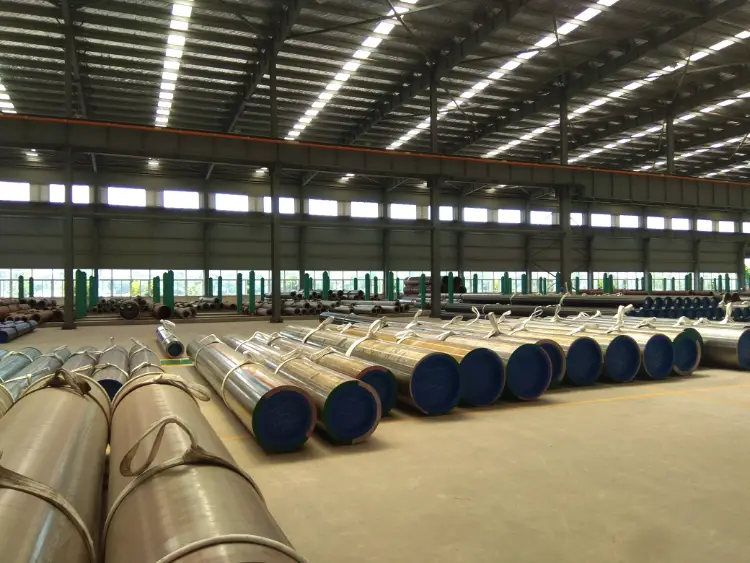
EN 10025-6 S620Q Steel for LSAW Pipe
EN 10025-6 S620Q Steel for LSAW Pipe: High-Strength Quenched & Tempered Material
Comprehensive technical data for S620Q steel grade under EN 10025-6, commonly used for manufacturing LSAW (Longitudinal Submerged Arc Welded) pipes. Includes chemical composition, mechanical properties, physical data, and equivalent grades.
Hot rolling, quenching and tempering, cold forming, welding (SAW, GMAW, SMAW), machining
- Phone : +8618037372205
- Email : [email protected]
- WhatsApp: Contact via Whtsapp
- WeChat: +8618037372205
EN 10025-6 S620Q Steel for LSAW Pipe Introduction
The S620Q grade is a high yield strength structural steel produced according to European standard EN 10025-6, intended for quenching and tempering heat treatment. It offers a minimum yield strength of 620 MPa in thicknesses up to 50 mm, combined with excellent toughness at low temperatures (down to -20 °C, denoted by the 'Q' suffix). Typical applications include LSAW (Longitudinal Submerged Arc Welded) pipes for high-pressure oil and gas transmission, offshore structural members, heavy machinery, and bridges. The steel is supplied in the quenched and tempered condition, which ensures a fine-grained bainitic/martensitic microstructure.
- Key features: High strength-to-weight ratio, good weldability provided by controlled carbon equivalent (CEV ≤ 0.65), and ductility sufficient for cold forming operations.
- Available as plates, cut sheets, or finished LSAW pipes, the material meets strict requirements for through-thickness properties (Z-quality options are possible).
- Delivery condition is quenched and tempered (Q+T); the pipe forming process may include subsequent stress relief or remain in the as-welded condition depending on service demands.
EN 10025-6 S620Q Steel for LSAW Pipe Chemical composition
Chemical composition according to EN 10025-6:2019, Table 2 (typical ladle analysis for S620Q). Maximum limits ensure adequate hardenability, toughness, and weldability. The carbon equivalent value (CEV) is controlled to ≤0.65% to minimize cold cracking risk during welding. Additional elements may be present within specified limits to achieve the required mechanical properties. Note: For LSAW pipe production, the composition of the base plate and the welding consumables must be compatible to guarantee uniform strength and corrosion resistance.
| Chemical element | Maximum content (%) | Remarks |
|---|---|---|
| Carbon (C) | 0.20 | Higher carbon increases strength but decreases weldability |
| Silicon (Si) | 0.80 | Deoxidizer; contributes to solid solution strengthening |
| Manganese (Mn) | 1.70 | Essential for hardenability and toughness |
| Phosphorus (P) | 0.025 | Kept low to avoid brittleness |
| Sulfur (S) | 0.015 | Low sulfur for improved cleanliness and ductility |
| Chromium (Cr) | 1.50 | Enhances hardenability and corrosion resistance |
| Nickel (Ni) | 2.00 | Improves low-temperature toughness |
| Molybdenum (Mo) | 0.70 | Increases hardenability and high-temperature strength |
| Copper (Cu) | 0.50 | Residual element; may influence atmospheric corrosion resistance |
| Nitrogen (N) | 0.015 | Bound by micro-alloying elements to avoid aging |
| Niobium (Nb) | 0.06 | Micro-alloy for grain refinement and precipitation strengthening |
| Titanium (Ti) | 0.05 | Grain refiner and nitrogen fixer |
| Vanadium (V) | 0.12 | Micro-alloy for strength and toughness |
| Zirconium (Zr) | 0.15 | Grain refinement agent |
| Boron (B) | 0.005 | Strong hardenability effect even in small amounts |
| Carbon Equivalent (CEV) | 0.65 (max) | CEV = C + Mn/6 + (Cr+Mo+V)/5 + (Ni+Cu)/15 |
EN 10025-6 S620Q Steel for LSAW Pipe Physical & thermal properties
The following physical properties are representative for quenched and tempered structural steels and are extracted from EN 10025-1:2004, Annex B (informative). These values are applicable to S620Q. Slight variations may occur depending on actual chemical composition and heat treatment. For LSAW pipes, the thermal conductivity influences preheating requirements during welding.
| Property | Typical value | Unit | Test conditions / Remarks |
|---|---|---|---|
| Density (ρ) | 7850 | kg/m³ | Room temperature |
| Elastic modulus (E) | 210 | GPa | Ambient temperature |
| Shear modulus (G) | 81 | GPa | Calculated from E and Poisson ratio |
| Poisson's ratio (ν) | 0.3 | — | Within elastic range |
| Thermal expansion coefficient (α) | 12 × 10-6 | K-1 | 20 °C to 100 °C |
| Thermal conductivity (λ) | 54 | W/(m·K) | Nominal thickness ≤ 100 mm, ambient temperature |
| Thermal conductivity (λ) | 51 | W/(m·K) | Nominal thickness > 100 mm, ambient temperature |
| Specific heat capacity (cp) | 460 | J/(kg·K) | Approximate value at 20 °C |
EN 10025-6 S620Q Steel for LSAW Pipe Mechanical properties
Tensile testing is performed on specimens taken from the quenched and tempered product. The values below represent the minimum guaranteed properties according to EN 10025-6:2019 for S620Q. Impact energy is measured on Charpy-V specimens at -20 °C. Bend test requirements ensure adequate ductility for forming operations. For LSAW pipe orders, the mechanical properties of the weld seam are also tested and must match the base material.
| Property | Value | Unit | Test conditions / Thickness range |
|---|---|---|---|
| Minimum yield strength (ReH) | 620 | MPa | Nominal thickness ≤ 50 mm |
| Minimum yield strength (ReH) | 580 | MPa | Nominal thickness 50 < t ≤ 100 mm |
| Minimum yield strength (ReH) | 560 | MPa | Nominal thickness 100 < t ≤ 150 mm |
| Tensile strength (Rm) | 700 - 890 | MPa | Nominal thickness ≤ 100 mm |
| Tensile strength (Rm) | 650 - 830 | MPa | Nominal thickness 100 < t ≤ 150 mm |
| Elongation after fracture (A, longitudinal) | ≥ 15 | % | Nominal thickness ≤ 100 mm, gauge L0 = 5.65√S0 |
| Elongation after fracture (A, longitudinal) | ≥ 14 | % | Nominal thickness 100 < t ≤ 150 mm, gauge L0 = 5.65√S0 |
| Elongation after fracture (A, transverse) | ≥ 13 | % | Nominal thickness ≤ 100 mm, gauge L0 = 5.65√S0 |
| Elongation after fracture (A, transverse) | ≥ 12 | % | Nominal thickness 100 < t ≤ 150 mm, gauge L0 = 5.65√S0 |
| Impact energy (KV, longitudinal) | ≥ 27 | J | -20 °C, Charpy-V notch |
| Impact energy (KV, transverse) | ≥ 20 | J | -20 °C, Charpy-V notch |
| Bend test (mandrel diameter) | 3t | — | Thickness ≤ 50 mm, bending angle 180° |
| Bend test (mandrel diameter) | 4t | — | 50 < t ≤ 100 mm, bending angle 180° |
| Bend test (mandrel diameter) | 4t | — | 100 < t ≤ 150 mm, bending angle 180° |
EN 10025-6 S620Q Steel for LSAW Pipe Completely equivalent material standards and substitutable grades
| Country / Region | Standard | Grade | Remarks |
|---|---|---|---|
| European Union | EN 10025-6:2019 | S620Q | Primary standard; quenched and tempered structural steel |
| International | ISO 630-2:2011 | S620Q | Identical technical requirements |
| United Kingdom | BS EN 10025-6:2019 | S620Q | Adopted European standard |
| Germany | DIN EN 10025-6:2019 | S620Q | Adopted European standard |
| Italy | UNI EN 10025-6:2019 | S620Q | Adopted European standard |
| Commercial brand | SSAB | Weldox 620 | Proprietary grade matching S620Q properties, widely used for similar applications |
EN 10025-6 S620Q Steel for LSAW Pipe Application Introduction
S620Q steel, particularly in LSAW pipe form, delivers an ideal combination of high strength, toughness, and fabricability. Typical applications include:
- Oil & gas pipelines: onshore and offshore high-pressure transmission lines.
- Offshore structures: jacket legs, brace members, riser support frames.
- Bridge construction: main girders, box sections, arch ribs.
- Heavy engineering: crane booms, excavator arms, mining dump truck frames.
- Pressure vessels and pill tanks requiring high strength and good notch toughness.
Because the material is supplied in the quenched and tempered condition, cold forming operations should account for springback, and hot forming may require re-heat treatment to restore properties. Welding procedures must be qualified with appropriate preheat and interpass temperatures based on the CEV and thickness.
Product Applications: LSAW (Longitudinal Submerged Arc Welded) pipes, Spiral welded pipes (when S620Q coil is used), Heavy wall pressure vessel shells, Offshore platform legs and braces, Crane booms and lattice sections, Bridge girders and box columns, Piling pipe for deep foundations
Processed into products: Pipe elbows, tees, reducers (for high-pressure service), Flanges and connector hubs, Welded structural nodes (cast nodes often replaced by forged S620Q parts), Machined pins, bushings, and wear plates, Support brackets and beam stiffeners, Hydraulic cylinder bodies and piston tubes
Application industries: Oil & gas (upstream, midstream), Offshore wind and marine construction, Bridge and structural engineering, Mining and heavy equipment manufacturing, Pressure vessel and tank fabrication, Hydroelectric and industrial piping
EN 10025-6 S620Q Steel for LSAW Pipe Closely related or alternative steel grades
| Country / Region | Standard | Grade | Remarks |
|---|---|---|---|
| China | GB/T 16270-2009 | Q620D | Similar yield strength (620 MPa), quenched and tempered; impact at -20 °C |
| European Union | EN 10025-6 | S690Q | Higher strength (690 MPa) alternative; same family, often used when higher load-carrying capacity is needed |
| USA | ASTM A514/A514M | Grade S | Yield 690 MPa, quenched and tempered; heavier sections may be substituted if slight over-matching is acceptable |
| Japan | JIS G 3128 | SHY685 | High yield (685 MPa) quenched and tempered steel for bridges; can be considered where code allows strength deviation |
| Commercial brand | SSAB | Weldox 700 | Proprietary 700 MPa grade; used when Weldox 620 is insufficient |
Notes:
Additional remarks: For LSAW pipe orders, the steel is typically certified to EN 10225 for offshore structures or API 5L for line pipe, with the base material still traceable to EN 10025-6 S620Q. The weld seam Charpy toughness may be specified at -10 °C or -20 °C. Z-quality (through-thickness) options according to EN 10164 can be ordered for critical structural joints. When the pipe undergoes post-weld heat treatment (PWHT), the mechanical properties of the weld and heat-affected zone must be re-validated. Consult the material supplier for data on sustained elevated temperature performance and sour service (HIC/SSC) suitability, as these are not covered by the base standard.
- Share



