
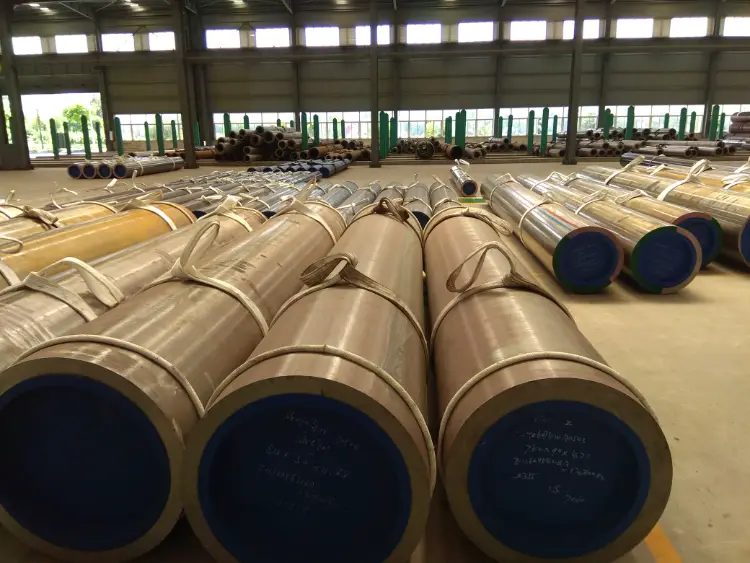
EN10025-6 S550QL1 LSAW Pipes
EN10025-6 S550QL1 High Yield Strength Quenched & Tempered Structural Steel for LSAW Pipes
Comprehensive material data for S550QL1 steel under EN10025-6, quenched and tempered condition, used in LSAW pipes for heavy-duty structural applications.
Quenching and Tempering (Q&T), Hot Rolling, Welding (SAW, MIG/MAG with preheating/post-weld heat treatment as per established guidelines), Cutting, Cold Forming (with limitations due to high strength)
- Phone : +8618037372205
- Email : [email protected]
- WhatsApp: Contact via Whtsapp
- WeChat: +8618037372205
EN10025-6 S550QL1 LSAW Pipes Introduction
S550QL1 is a high-strength quenched and tempered structural steel conforming to standard EN 10025-6. Designed for heavy structural and mechanical engineering applications, it features a minimum yield strength of 550 MPa in thicknesses up to 50 mm. The 'S' denotes structural steel, '550' indicates the minimum yield strength in MPa, 'Q' signifies quenching and tempering heat treatment, and 'L1' defines a minimum impact energy of 27 J at -40°C in the longitudinal direction. This steel grade is renowned for its
- Excellent combination of high strength and toughness at low temperatures
- Good weldability with adherence to appropriate welding procedures
- Homogeneous properties through quenching & tempering process
Commonly supplied in the form of LSAW (Longitudinally Submerged Arc Welded) pipes, it is extensively used in offshore structures, heavy machinery, bridges, and pressure vessels where weight reduction and high load-bearing capacity are critical.
EN10025-6 S550QL1 LSAW Pipes Chemical Composition
The chemical composition of S550QL1 steel is precisely controlled during the steelmaking process to achieve the required high strength and excellent low-temperature toughness after quenching and tempering. The alloying elements such as carbon and manganese provide strength, while micro-alloying elements like niobium and titanium refine the grain structure. Phosphorus and sulfur are kept at low levels to ensure high ductility and toughness, which is critical for demanding structural applications.
| Element | Typical Value (Max / Range % by Mass) | Remarks |
|---|---|---|
| Carbon (C) | ≤ 0.20 | Maximum limit applies for thickness ≤ 50 mm; for > 50 mm ≤ 100 mm, max 0.22 |
| Silicon (Si) | ≤ 0.80 | For deoxidation and strength enhancement |
| Manganese (Mn) | ≤ 1.70 | Key strength and hardenability element |
| Phosphorus (P) | ≤ 0.020 | Strictly controlled to improve toughness |
| Sulfur (S) | ≤ 0.010 | Low sulfur for improved cleanliness and transverse properties |
| Chromium (Cr) | ≤ 1.50 | Optional element for enhancing hardenability |
| Nickel (Ni) | ≤ 2.0 | Optional element, beneficial for low-temperature toughness |
| Molybdenum (Mo) | ≤ 0.70 | Optional element to increase hardenability and reduce temper embrittlement |
| Copper (Cu) | ≤ 0.50 | Residual element; may be used for corrosion resistance |
| Titanium (Ti) | ≤ 0.05 | Micro-alloying element for grain refinement and strengthening |
| Niobium (Nb) | ≤ 0.06 | Micro-alloying element for grain refinement and strengthening |
| Vanadium (V) | ≤ 0.12 | Optional micro-alloying element for strengthening |
| Nitrogen (N) | ≤ 0.015 | Controlled to prevent detrimental effects on toughness |
| Aluminum (Al, total) | ≥ 0.018 | Minimum required for fine-grain practice and deoxidation |
| Boron (B) | ≤ 0.005 | Optional trace element used in small amounts to dramatically increase hardenability |
EN10025-6 S550QL1 LSAW Pipes Thermal and Electrical Physical Properties
The following physical properties are typical for low-alloyed, quenched and tempered structural steels like S550QL1 and are provided for design calculations. These values are influenced slightly by the precise chemical composition and thermal history but are generally consistent across this steel grade family. Thermal expansion and conductivity values are critical for engineering designs involving thermal cycling or welding distortion analysis.
- Values are indicative for the temperature range 20°C to 100°C unless specified otherwise.
- Property variations may exist depending on product thickness and exact chemical formulation.
| Property | Standard Requirement / Typical Value | Unit | Test Condition / Remarks |
|---|---|---|---|
| Density (ρ) | ~7.85 | g/cm³ | At 20°C, typical for medium-carbon low-alloy steels |
| Modulus of Elasticity (E) | ~210 | GPa | At 20°C, longitudinal tension/compression |
| Shear Modulus (G) | ~81 | GPa | Calculated from E and ν, at 20°C |
| Poisson's Ratio (ν) | ~0.3 | — | At 20°C, within the elastic range |
| Coefficient of Thermal Expansion (α) | ~11.5, ~12.5 | 10⁻⁶/K | 20°C to 100°C; 20°C to 200°C respectively |
| Thermal Conductivity (λ) | ~42, ~40 | W/(m·K) | At 20°C; At 200°C respectively |
| Specific Heat Capacity (cp) | ~460, ~490 | J/(kg·K) | At 20°C; At 200°C respectively |
| Electrical Resistivity (ρe) | ~0.23 | Ω·mm²/m | At 20°C, approximate standard value |
EN10025-6 S550QL1 LSAW Pipes Mechanical Properties
The mechanical properties are verified in the +QT (Quenched and Tempered) delivery condition. The values listed are guaranteed minimums based on longitudinal test specimens as per EN 10025-6:2019. High yield and tensile strengths are ensured for thicknesses up to 100 mm. A minimum elongation demonstrates good ductility, while the guaranteed Charpy-V impact energy values at -40°C prove excellent toughness for low-temperature service, which is essential for LSAW pipes used in harsh environments.
| Property | Standard Requirement Value | Unit | Test Condition / Remarks |
|---|---|---|---|
| Yield Strength (ReH) | ≥ 550 | MPa | Nominal thickness (t) ≤ 50 mm, transverse direction optional |
| Yield Strength (ReH) | ≥ 530 | MPa | 50 mm < t ≤ 100 mm |
| Tensile Strength (Rm) | 640 – 820 | MPa | t ≤ 50 mm |
| Tensile Strength (Rm) | 590 – 770 | MPa | 50 mm < t ≤ 100 mm |
| Elongation after Fracture (A) | ≥ 16 | % | Proportional gauge length L0 = 5.65√S0 (S0 = original cross-section area); applies to t ≤ 100 mm |
| Charpy-V Impact Energy (KV) | ≥ 27, ≥ 19 | J | Longitudinal sample, test temperature -40°C (L1 grade); single min / average of 3 tests |
EN10025-6 S550QL1 LSAW Pipes Exact International Equivalent Material Standards & Designations for Full Substitution
| Country / Region | Standard | Designation / Grade | Remarks |
|---|---|---|---|
| European Union | EN 10025-6:2019 | S550QL1 (1.8926) | Original specification; fully compliant. |
| European Union | EN 10225:2009 | S550QL1 | For weldable structural steels for fixed offshore structures; same tensile/yield requirements but may have stricter chemical control. |
EN10025-6 S550QL1 LSAW Pipes Application Introduction
S550QL1 provides an optimal high strength-to-weight ratio and robust low-temperature toughness, making it a material of choice for weight-critical and safety-critical structures fabricated via welding, especially LSAW pipes. Its delivery condition (+QT) ensures homogeneous mechanical properties throughout the thickness. Application design must strictly follow relevant codes like EN 1993 (Eurocode 3) for steel structures or EN 13445 for pressure vessels. Strict adherence to welding guidelines, including preheating, interpass temperature control, and appropriate filler metal selection (matching strength and low-hydrogen), is mandatory to preserve the heat-affected zone properties.
Product Applications: LSAW (Longitudinally Submerged Arc Welded) steel pipes for high-pressure transmission, deepwater risers, and structural piling, Heavy welded H-beams, box sections, and tubular structural members, Welded pressure vessels and storage tanks for low-temperature service, Custom-fabricated structural modules and nodes for offshore structures
Processed into products: Offshore jacket legs, braces, and pile sleeves, Deck beams and crane pedestals for heavy lift vessels, Boom sections and arms for mobile cranes and excavators, Hydraulic cylinder bodies for heavy-duty actuators, Structural chords and cross-bracing for long-span bridges, Penstock sections and spiral casings for hydroelectric power plants, LSAW pipe spools and fittings for subsea tie-backs and flowlines
Application industries: Offshore Oil & Gas (platforms, jackets, subsea structural supports), Renewable Energy (wind turbine towers, offshore substation jackets, penstocks for hydropower), Shipbuilding & Marine (heavy lift crane pedestals, structural members for ice-going vessels), Bridge Construction (long-span box girders, arch bridges, key structural elements), Heavy Civil Engineering & Construction (high-rise buildings, stadium trusses), Mining & Heavy Machinery (excavator booms, dump truck chassis, crusher frames)
EN10025-6 S550QL1 LSAW Pipes Similar/Comparable Substitute Material Recommendations
| Country / Region | Standard | Designation / Grade | Remarks |
|---|---|---|---|
| USA | ASTM A514 / A517 | Grade S | High-strength quenched and tempered plates for structural and boiler/pressure vessel applications. Close match in yield strength but different impact test regimes. |
| USA | ASTM A709 | Grade HPS 70W (70 ksi yield) | High-performance structural steel with 485 MPa yield. Lower strength, but excellent weather resistance and toughness for bridges. |
| European Union | EN 10025-6 | S500QL / S500QL1 | Lower minimum yield strength (500 MPa) with equivalent low-temperature toughness. Offers higher formability but requires strength de-rating. |
| European Union | EN 10025-6 | S620QL / S620QL1 | Higher yield strength (620 MPa) grade within the same standard family. Potential substitute where higher strength is needed, but requires more careful welding procedures. |
| European Union | EN 10025-6 | S690QL / S690QL1 | Highest common QT steel strength grade (690 MPa yield). Offers significant weight savings, but has reduced formability and more complex weldability compared to S550QL1. |
Notes:
Special Considerations for LSAW Pipe Fabrication with S550QL1:
- Welding: Requires low-hydrogen welding processes (e.g., SAW, FCAW, MCAW with basic/neutral fluxes). Controlled pre-heating (typically 100-175°C depending on thickness and carbon equivalent value) is essential to prevent hydrogen-induced cold cracking. Post-weld heat treatment (PWHT) is generally avoided unless indispensable, as it can degrade the carefully achieved mechanical properties from quenching and tempering.
- Cold Forming: Due to its high yield strength, S550QL1 exhibits significant springback. The minimum bending radius should generally be at least 3-4 times the plate thickness (t) in transverse rolling and larger in longitudinal rolling. Stress relief annealing may be necessary after severe cold deformation.
- Corrosion Protection: This steel has no inherent atmospheric corrosion resistance. For marine and offshore applications, it typically requires coating systems (e.g., three-layer epoxy/polyurethane) or cathodic protection when submerged or buried.
- Testing & Certification: Ultrasonic testing (UT) of plates for internal soundness (Class S2/E2 per EN 10160) and Charpy impact testing at -40°C are mandatory by default for this grade when specified for safety-critical LSAW piping applications.
- Share



